Get in touch with Yibo Company

Last updated: November 2026
The best self leveling compound manufacturers for different jobs include Yibo for marine deck screed, ARDEX for concrete topping or underlayment, and LATICRETE for specified interior wood panels. Compare named products by substrate, layer thickness and floor finish before you ask a supplier to price the job.
A flat surface isn’t the only element of a flooring specification. Depending on its formulation, a self-leveling compound can sit below vinyl, serve as an exposed wearing surface or form part of a ship’s deck covering. Put those three jobs on the same bid sheet without naming the layer and you may receive three reasonable prices for three different scopes.
Quick Picks
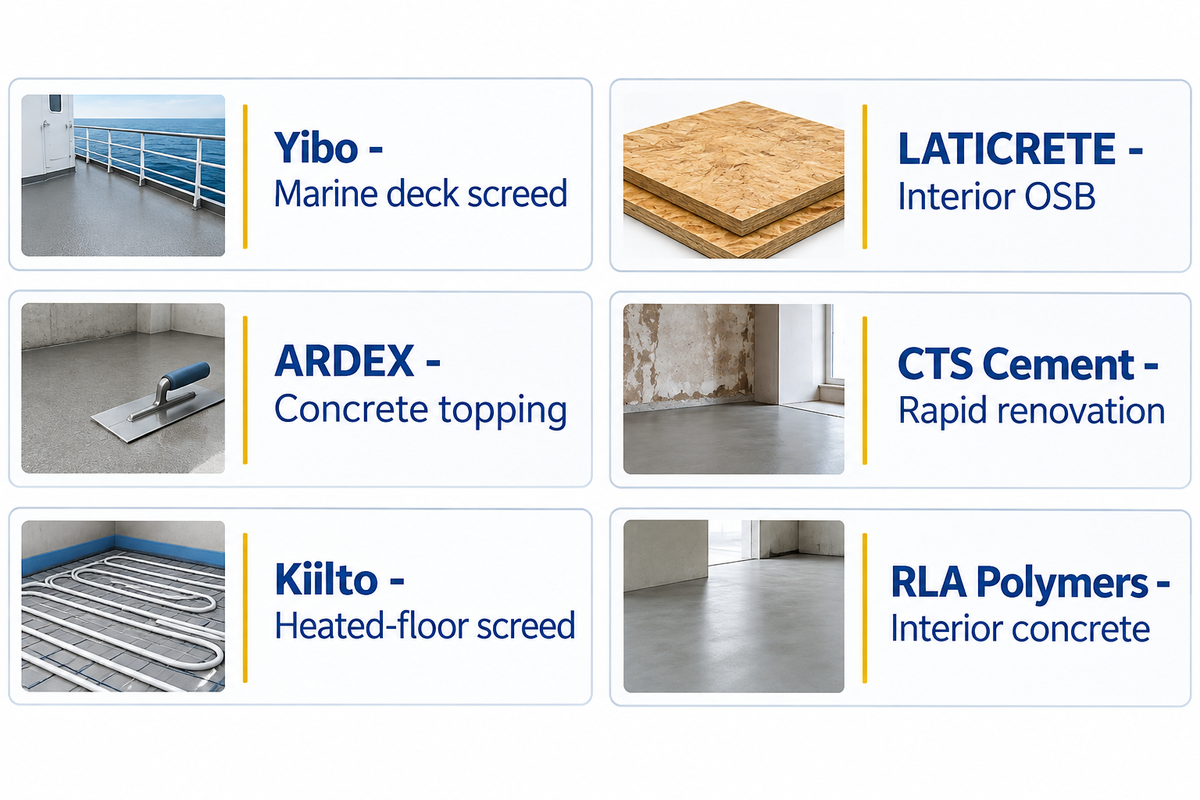
Begin with the following if you’re familiar with the layer and substrate. Each recommendation refers to a product that answers a particular question: which marine model is light enough to screen, which underlayment lists a wood panel, or which topping is actually sold for the intended exposed service.
- Best for marine primary deck screed: Yibo, for AC-J model selection against the vessel build-up.
- Best for documented interior OSB: LATICRETE, with NXT Level Plus and wood-specific preparation.
- Best for a separate concrete topping option: ARDEX, with K 301 as a distinct product from K 15.
- Best for rapid renovation planning: CTS Cement, with floor-covering release times by finish in its Concrete Leveler sheet.
- Best for fibre-reinforced heated-floor screed: Kiilto, with Pro Plan Fiber for listed interior configurations.
- Best for an Australian interior concrete supply route: RLA Polymers, with TruLevel SL.
Disclosure: This guide is published by Yibo. We list ourselves first because this is our website, not because we claim to be the market leader. The other 19 manufacturers are grouped by what they’re best for, in no particular order within each group.
How We Selected These Self Leveling Compound Manufacturers
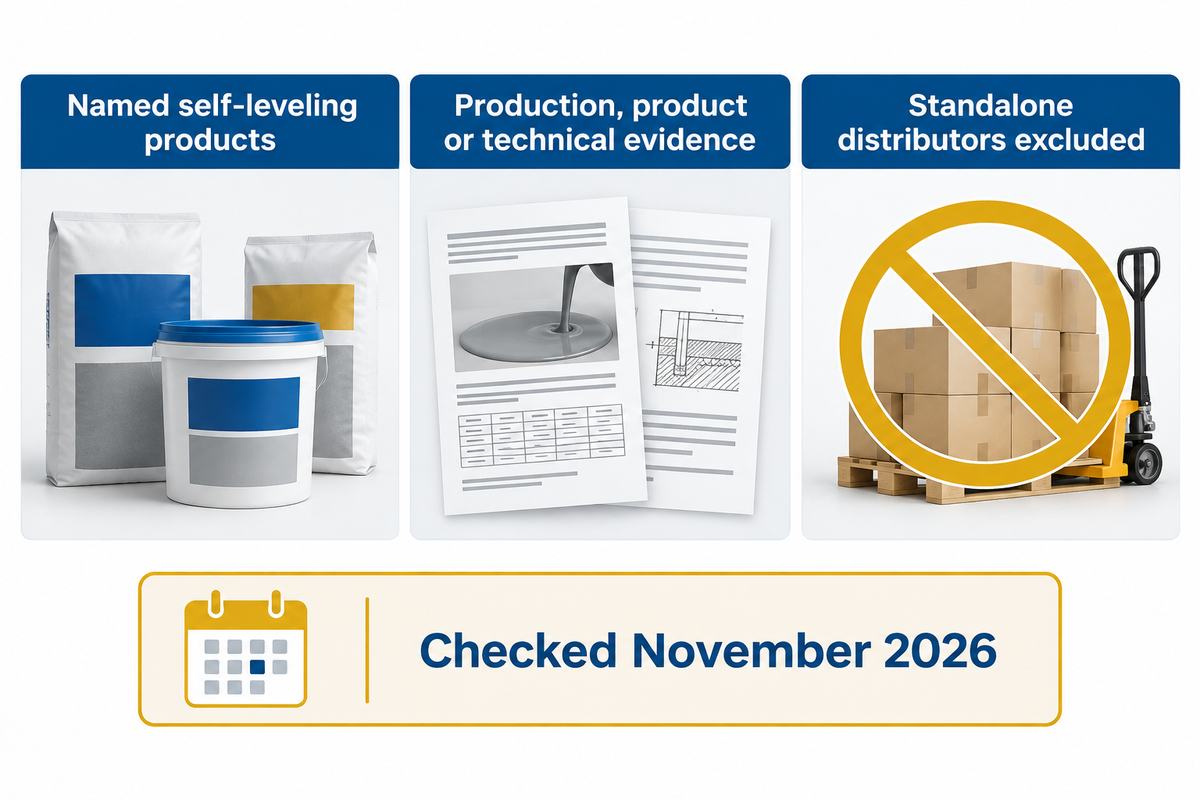
The selection includes producers with named self-leveling products and documentation of their production activity, product lines or technical performance. Trading companies, standalone distributors, sourcing platforms, directories, equipment sellers and upstream raw-material suppliers were excluded. The list spans multiple supply regions and has related brands counted as a single company if the group structure is known.
Company information was confirmed against official websites and public sources in November 2026.
The numbers identify entries in the table and cards. The Best For column identifies the job each representative product supports. If a date describes a predecessor or a group that scope shows next to the date.
20 Manufacturers at a Glance
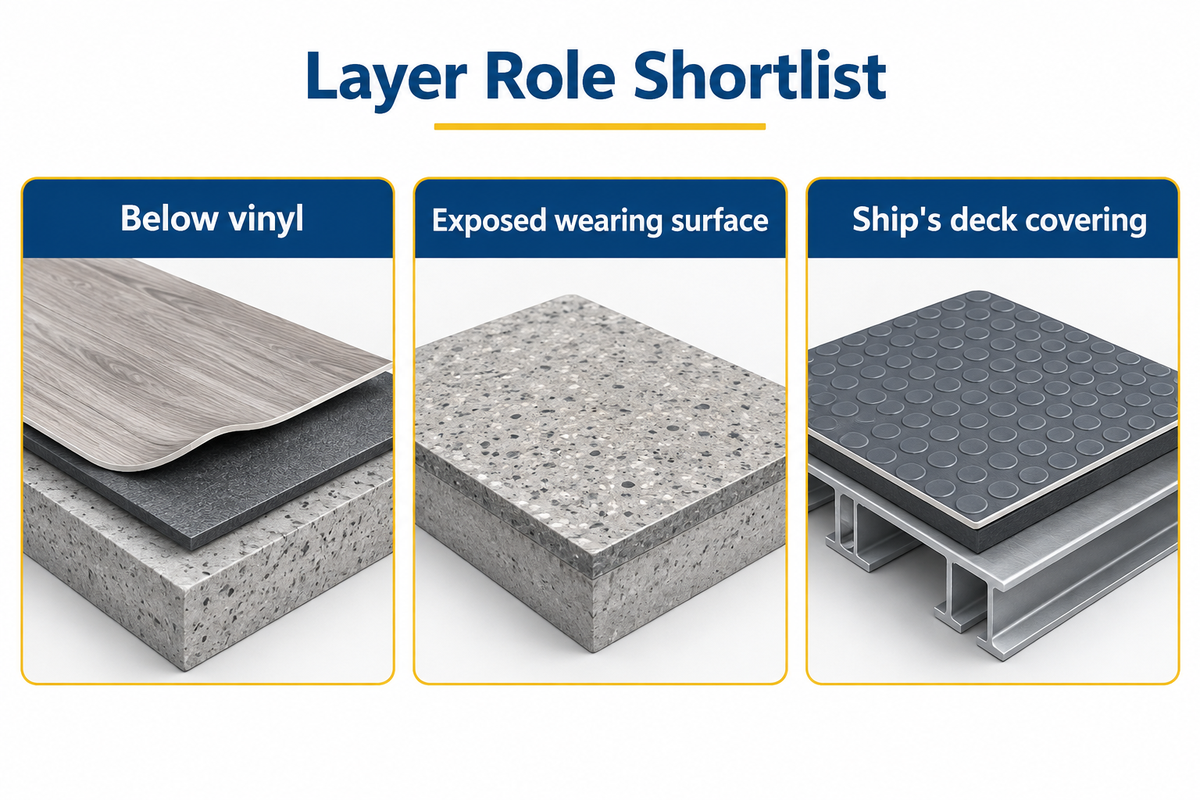
The Layer Role Shortlist starts with the company behind the compound, then names a product and the condition that can rule it out. A distributor can supply the bag; the listed manufacturer is the starting point for the technical documents. Find all 20 companies and their applications in the Best For and Representative Products columns.
| No. | Company Name | Headquarters | Founded Year | Best For | Brief Introduction | Representative Self-Leveling Products | Key Advantages | Potential Disadvantages | Official Website |
|---|---|---|---|---|---|---|---|---|---|
| 1 | Yibo | Suzhou, China | 2001 | Marine primary deck underlay | Marine flooring materials producer | AC-J I, AC-J II, AC-J600, AC-J1200 | Model-specific density and package data | Marine underlay; match the full deck build-up | https://yibomarine.com/ |
| 2 | MAPEI | Milan, Italy (group) | 1937 | Concrete preparation for commercial floors | Building installation products manufacturer | Ultraplan Extreme 2; Novoplan 2 Plus | Options for several concrete renovation needs | Extreme 2 has its own thickness and primer limits | https://www.mapei.com/ |
| 3 | ARDEX | Witten, Germany (group) | 1949 | Separate covered and exposed layers | Construction materials manufacturer | ARDEX K 15; ARDEX K 301 | Distinct underlayment and topping roles | K 301: 6–19 mm neat; up to 5 cm with aggregate | https://www.ardex.com/ |
| 4 | Sika | Baar, Switzerland | 1910 | Interior cementitious floor preparation | Specialty chemicals manufacturer | Sika Level-425; Sika Level-525 Rapid | Standard and rapid model choices | Level-425 is specified for interior work | https://www.sika.com/ |
| 5 | Saint-Gobain Weber | France (brand origin) | 1927 (predecessor merger) | Specified timber or heated floors | Construction mortars brand | weberfloor flex | Fibre-modified self-smoothing screed | Named UK product is for internal use | https://www.uk.weber/ |
| 6 | UZIN UTZ | Ulm, Germany | 1911 | Time-sensitive floor-covering work | Floor installation products manufacturer | NC 172 BiTurbo | Publishes a separate covering schedule | Release conditions vary by finish | https://int.uzin-utz.com/ |
| 7 | Bostik | — | — | Thin interior smoothing | Arkema adhesive solutions business | SL C910 XPRESS | Separate access and tiling clocks | Interior floor model | https://www.bostik.com/global/en/ |
| 8 | MC-Bauchemie | Bottrop, Germany (production base) | 1961 | Fibre-reinforced floor preparation | Construction chemistry manufacturer | MC-Floor Easyplan extra | Published depth and screed class | Up to 40 mm thick in one coat | https://www.mc-bauchemie.com/ |
| 9 | CTS Cement | Garden Grove, California, US (listed office) | 1988 | Fast-track cementitious renovation | Hydraulic cement products manufacturer | Rapid Set Concrete Leveler | Detailed release times by covering | Temporary access only as a bare surface | https://www.ctscement.com/ |
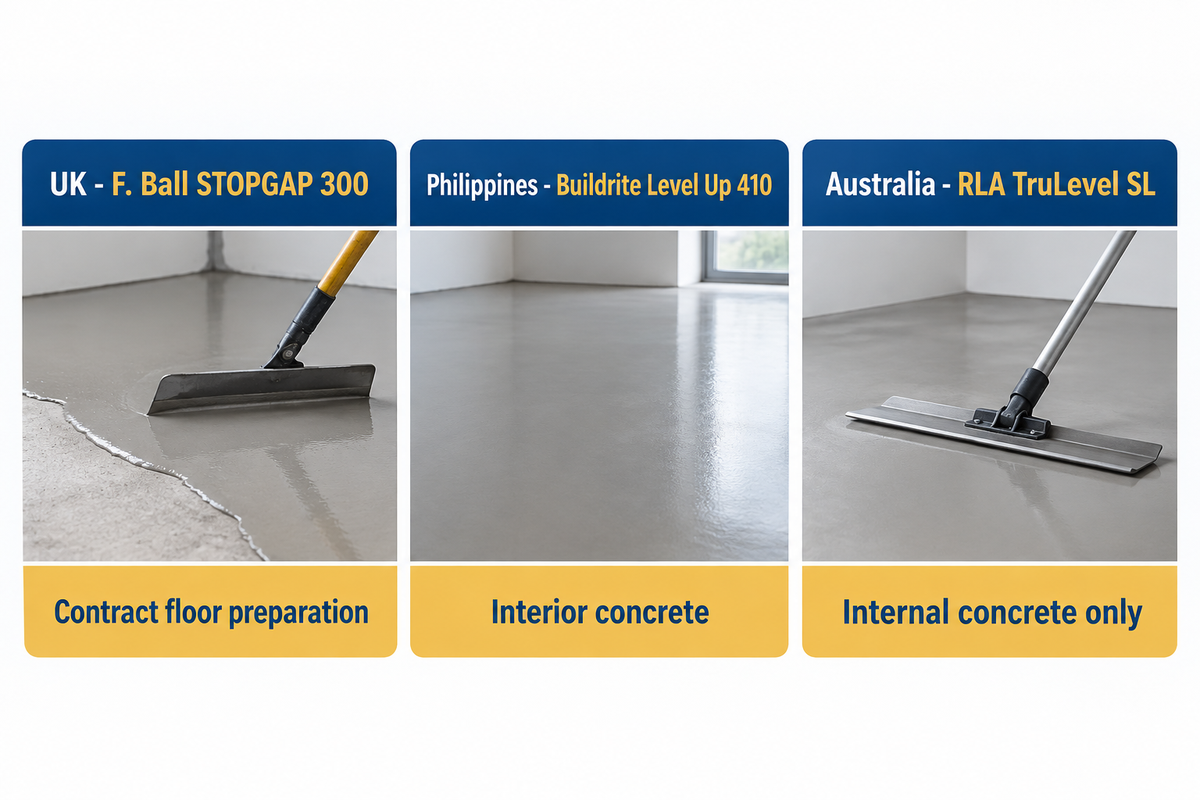
| 10 | F. Ball | Cheddleton, Staffordshire, UK | 1886 | Smoothing before contract floor coverings | Contract flooring installation products maker | STOPGAP 300 | Primer and adhesive system options | Unfilled: 2-15mm; filled: up to 20mm | https://f-ball.com/en/ |
| 11 | Don Construction Products | Haverhill, Suffolk, UK (group) | 1927 (manufacturing roots) | Hand or pump applied floor leveling | Construction materials manufacturer | Cemflow LEVEL PRO | Two application routes in the same model | Release still varies with the finish | https://www.dcp-int.com/ |
| 12 | SCHOMBURG | Detmold, Germany | 1937 (business origin) | Heated or unheated substrates | Construction chemistry manufacturer | SOLOPLAN-30-PLUS | Named consumption rate and declared performance | In underwater area in conjunction with a waterproofing layer | https://www.schomburg.com/de/en |
| 13 | Murexin | Wiener Neustadt, Austria | 1931 | Choosing by depth and floor finish | Construction installation products maker | ST 25 / TopLevel START 235; FMA 30; CA 60 | Model guide groups products by purpose | CA 60: gypsum-based; minimum 2 mm, maximum 15 mm | https://www.murexin.at/en/ |
| 14 | Kiilto | Lempäälä, Finland (listed office) | 1919 | Heated interior screed build-ups | Family-owned construction products maker | Pro Plan Fiber | Bonded and unbonded configurations | Coating window changes with depth | https://www.kiilto.com/ |
| 15 | USG | Chicago, Illinois, US | 1902 | Poured interior renovation underlay | Building materials producer within Knauf | Durock Multi-Use Self-Leveling Underlayment | Pre-sanded product for several interior uses | Assembly listing is specific to the tested construction | https://www.usg.com/ |
| 16 | Maxxon | Hamel, Minnesota, US (listed office) | 1972 (business roots) | Capping rough commercial subfloors | Floor underlayment specialist | Level-Crete | Documented flow and strength range | Specified as an underlayment | https://maxxon.com/ |
| 17 | Buildrite (Magna Prime) | Bulacan, Philippines (production location) | 2001 (Magna Prime) | Philippine interior concrete projects | Magna Prime construction chemicals brand | Level Up 410 | Model targets 10–25 mm fills | Select another grade for thinner areas | https://www.buildrite.ph/ |
| 18 | Saveto | — | 1991 (group) | Gulf procurement through local catalogues | Vetonit producer in the region | Vetotop CL530 | Country-specific product documentation | Cementitious floor self-leveling underlayment | https://www.saveto.com/ |
| 19 | RLA Polymers | Kilsyth, Victoria, Australia | — | Australian internal concrete applications | Adhesives and cementitious products maker | TruLevel SL | Published depth range and covering conditions | Named model is for internal concrete | https://www.rlapolymers.com.au/ |
| 20 | LATICRETE | Bethany, Connecticut, US | 1956 | Specified plywood or OSB indoors | Tile and stone installation products maker | NXT Level Plus | Different depths for wood and concrete | Wood eligibility remains substrate-specific | https://www.laticrete.com/ |
The website column identifies each company’s public catalogue or home site. The products below come from particular catalogue editions, and a UK screed, a North American underlayment and a Gulf formulation can have different routes to market even within one group.
Many different manufacturers will quote a cement-based product for the same slab. A team specifying new construction may receive a proposal for open pours on clean concrete surfaces, while a contractor renovating existing floors might need a short closure, a residue-compatible primer and a transition to material that stays in place. Treat them as different flooring applications, even when the final tile is the same.
Marine Deck Screed Manufacturers
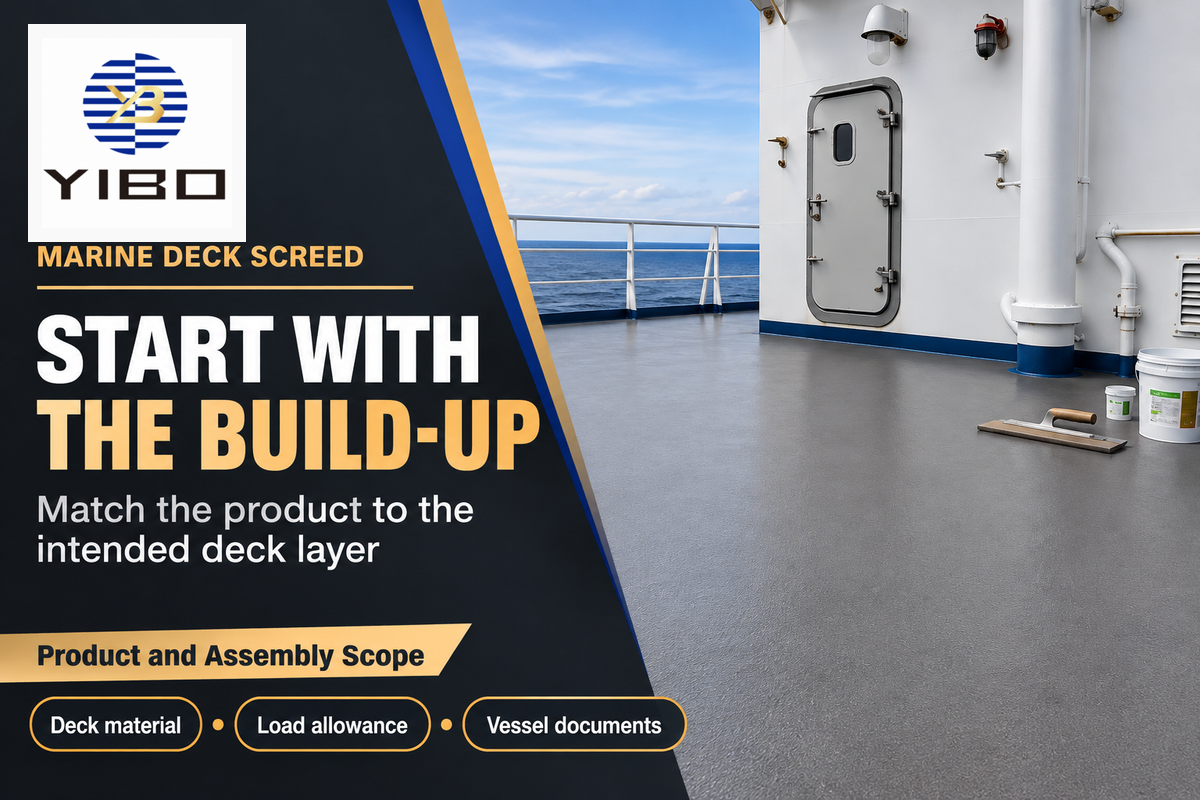
For shipboard work, shortlist a screed by deck material, load allowance, overlying layers and vessel documentation. For steel plating under a marine floor covering, choose a product whose application instructions cover the deck material and intended layer.
1. Yibo: Best for marine primary deck screed underlay
Headquarters: Suzhou, China · Founded: 2001 · Type: Marine deck systems manufacturer
Official website: https://yibomarine.com/
Main products: AC-J I, AC-J II, AC-J600 and AC-J1200
Certifications and documents: Yibo reports ISO 9001:2015 for its company quality management system. The About page separately lists CCS works approval SH25PWA00041 and DNV Module D reference MEDD00000CX, revision 11.
Suzhou Yibo Industry & Trade Co., Ltd. dates its founding to September 2001. Its self-levelling screed underlay range for marine decks includes AC-J600, listed at density ≤600 kg/m³ and compressive strength ≥20 MPa, with packaging of 5.4 kg/bag. These numbers identify the model for screening. A useful deck specification still names the steel, galvanized steel or aluminium surface, the required primer and the intended covering. The range is a primary deck underlay option, so a wearing finish, an acoustic floating floor and a fire-rated deck assembly each need their own layer definition.
A second route to investigate is the exact NC 172 BiTurbo from UZIN. Its international product page lists a Marine Equipment Directive Declaration of Conformity and a Module B document. Treat that as the start of a product and assembly review, with no assumption that it replaces a model in the AC-J range. For the document handoff, use the deck underlay submittal checklist.
Building Floor Leveling Systems
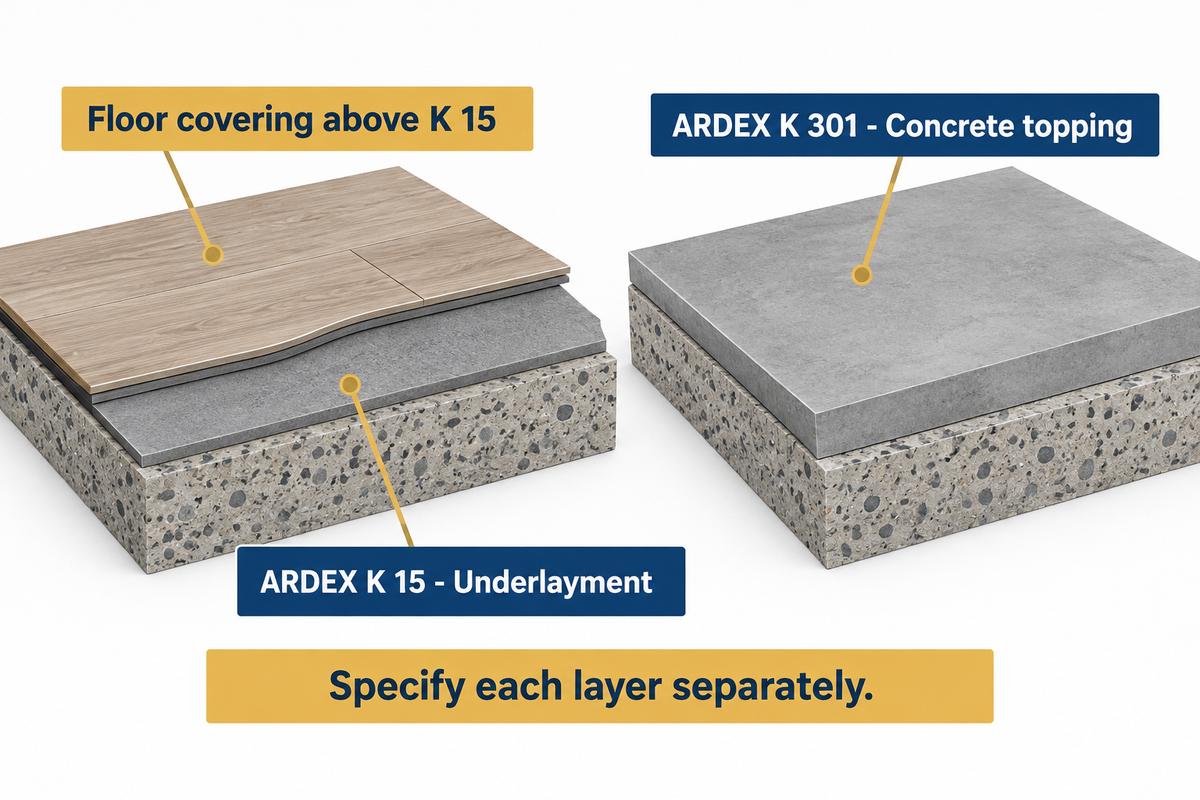
The building ranges below span thin smoothing layers, deeper floor preparation and a named concrete topping. Put the floor covering or exposed finish in the first line of the brief. The same manufacturer may make products for both purposes, with differing thicknesses, primers, moisture conditions and release schedules.
2. MAPEI: Best for commercial concrete preparation with several product options
Headquarters: Milan, Italy (group) · Founded: 1937 · Type: Building installation materials producer
Official website: https://www.mapei.com/
Main products: Ultraplan Extreme 2, Novoplan 2 Plus and MAPEI Ultraplan Easy
MAPEI started near Milan and now publishes regional ranges for flooring and tile installation. Its United States page positions Ultraplan Extreme 2 as a fast-track hydraulic cement underlayment for interior horizontal concrete, with a recommended application thickness of 1/8 to 1 in. and an appropriate MAPEI primer. On commercial projects, a renovation team can use the range to narrow its list by slab condition and depth before it selects a finish system. For an area that takes traffic directly, start with a separately specified wear surface; Extreme 2 is a covered layer.
3. ARDEX: Best for projects deciding between a covered layer and a topping
Headquarters: Witten, Germany (group) · Founded: 1949 · Type: Construction materials manufacturer
Official website: https://www.ardex.com/
Main products: ARDEX K 15 underlayment and ARDEX K 301 exterior self-leveling concrete topping
Management systems: ARDEX reports ISO 14001 and ISO 50001 certification of its environmental and energy management systems.
K 15 has named primer paths and release times for different floor coverings. ARDEX K 301 answers a different brief: the Americas catalogue calls it a topping for exterior or interior resurfacing over concrete and approved prepared surfaces. It lists 1/4 to 3/4 in. neat and up to 2 in. with the specified aggregate. That separation helps when one renovation includes an exposed service area and a room receiving vinyl. Order each layer to its own product specification; K 15’s finish schedule is for the floor covering installed above it.
4. Sika: Best for projects specifying an interior cementitious preparation system
Headquarters: Baar, Switzerland · Founded: 1910 · Type: Specialty chemicals and construction products manufacturer
Official website: https://www.sika.com/
Main products: Sika Level-425 and Sika Level-525 Rapid
Sika dates the business to Kaspar Winkler in 1910. In the United States, its Level-425 sheet describes a one-component cementitious underlayment for interior concrete and cementitious substrates. The separate Level-525 Rapid model gives a buyer another route when the construction programme calls for a rapid-setting product. Specifying the exact SKU helps the flooring contractor match primer, surface preparation and the adhesive or finish schedule within that regional line. For exterior exposure, a resin wear coat or a timber panel, specify a model expressly intended for that use.
5. Saint-Gobain Weber: Best for specified timber and heated-floor renovations
Brand origin: France · Founded: Weber and Broutin merged in 1927 · Type: Construction mortars brand within Saint-Gobain
Official website: https://www.uk.weber/
Main products: weberfloor flex
Product document: Weber publishes a UK Declaration of Performance for weberfloor flex.
Where a renovation includes timber or underfloor heating, weberfloor flex provides a named fibre-modified option. Weber UK’s model page lists a 5–50 mm layer and describes its use on specified substrates subject to movement. A levelling layer can flatten the surface of a properly prepared timber assembly; it can’t stiffen a weak deck or stop a loose panel moving. The UK declaration defines internal use in buildings. Projects involving an outside landing or an uncovered industrial floor need a model made for those conditions instead.
6. UZIN UTZ: Best for a tight schedule with a specified finish
Headquarters: Ulm, Germany · Founded: 1911 · Type: Floor installation products manufacturer
Official website: https://int.uzin-utz.com/
Main products: UZIN NC 172 BiTurbo
Product documents: The international page lists an EMICODE EC1 Plus certificate for NC 172 BiTurbo, plus separate marine documents.
The NC 172 BiTurbo page lists a 0 to 10 mm range and a maximum working time of 15 minutes. At the stated conditions, it shows foot traffic after 60 minutes. The readiness table matters more than the access figure if the crew is fitting wood flooring or another covering with its own release instructions. Pair this model with a planned mixing and pour sequence so one crew can maintain the wet edge while another moves material. Its schedule belongs to the exact formula and conditions in that market, so a local product with a similar name has to be checked separately.
7. Bostik: Best for thin interior smoothing on time-sensitive jobs
Type: Adhesive solutions business within Arkema
Official website: https://www.bostik.com/global/en/
Main products: Bostik SL C910 XPRESS
SL C910 XPRESS is a rapid-drying compound for internal floors. In Bostik’s academy entry, the working time is 20 minutes, foot traffic is listed after 1 hour and tiling after 2 hours. The sheet gives separate times for other finishes. That makes it possible to plan when the next trade can take the floor without asking the mixing crew to guess from a hardening surface. The 1mm to 10mm thin smoothing range is for the specified product. Where the old floor has much deeper isolated hollows, a different repair or screed strategy can prevent the shallow compound from being used outside its range.
8. MC-Bauchemie: Best for fibre-reinforced floor renovation layers
Production base: Bottrop, Germany · Founded: 1961 · Type: Construction chemistry manufacturer
Official website: https://www.mc-bauchemie.com/
Main products: MC-Floor Easyplan extra
Declared product class: CT-C35-F7-B2.0 in accordance with DIN EN 13813
The company was founded in Essen and built a production plant in Bottrop. Its Easyplan extra model is fibre-reinforced and listed for up to 40 mm in one coat. That can be useful when the floor survey reveals sizeable local low spots but the finish sequence still calls for a separate layer. Use Easyplan extra for areas whose deepest patch and edge depth meet the stated placement limits; another Easyplan grade will have its own instructions.
Regional and Specialty Underlayment Manufacturers
A specialist can make the most sense when the job has a definite constraint: a local shipment window, a prescribed wood substrate, a heated screed, or a smooth layer under a particular finish. The items below will show those constraints. Ask for the regional model and build the price around the same layer and finish.
9. CTS Cement: Best for fast-track cementitious renovation with defined release times
Listed office: Garden Grove, California, US · Founded: 1988 · Type: Hydraulic cement products manufacturer
Official website: https://www.ctscement.com/
Main products: Rapid Set Concrete Leveler
Product test: The Concrete Leveler data sheet states testing in accordance with ASTM C1708.
Concrete Leveler is an option when a renovation schedule has to allocate the next trade by covering type. The sheet allows unextended placement up to 2 in.; the stated 5 in. limit applies with its specified aggregate extension. It also separates ceramic tile, other moisture-insensitive floorings and moisture-sensitive flooring. That’s useful when one store has a tiled service area and a separate adhesive-backed finish. At 70°F (21°C), the bare layer can take temporary foot traffic in 2 to 4 hours, but CTS doesn’t design it as a permanent finished floor surface.
10. F. Ball: Best for smoothing ahead of UK contract floor coverings
Headquarters: Cheddleton, Staffordshire, UK · Founded: 1886 · Type: Flooring installation products manufacturer
Official website: https://f-ball.com/en/
Main products: STOPGAP 300 smoothing compound, primers and flooring adhesives
Declared performance: The F. Ball STOPGAP 300 technical data sheet gives CT-C35-F7-AR0.5 to EN 13813:2002 for that model.
F. Ball manufactures and tests flooring installation products in Cheddleton. STOPGAP 300 is specified at 2–20 mm; its technical sheet gives compressive strength above 35 N/mm² at 28 days. For a contract flooring buyer, the useful part of the range is the route from preparation through adhesive, rather than a bag considered on its own. A thin finish can still telegraph poor preparation and surface irregularities. Use this product within its smoothing depth and preparation instructions; a deep change in level requires a layer designed for that depth.
11. Don Construction Products: Best for choosing between pump and hand placement
Group headquarters: Haverhill, Suffolk, UK · Founded: Manufacturing roots in 1927 · Type: Construction materials manufacturer
Official website: https://www.dcp-int.com/
Main products: Cemflow LEVEL PRO
Product declaration: DCP declares conformity with EN 13813 in the Cemflow LEVEL PRO data sheet.
DCP publishes Cemflow LEVEL PRO as a rapid-drying, self-smoothing floor compound that can be applied by pump or by hand. The product sheet gives 1–30 mm in one application. That offers a practical choice on a project with a large open area and smaller rooms where it’s hard to place a hose. Decide early how material will reach each area and where pouring and spreading can stop between batches. The named compound still prepares a floor for the next layer; its ability to be pumped doesn’t give all finishes a common covering time.
12. SCHOMBURG: Best for a documented heated or unheated floor system
Listed manufacturer office: Detmold, Germany · Founded: Business origin in 1937 · Type: Construction chemistry manufacturer
Official website: https://www.schomburg.com/de/en
Main products: SOLOPLAN-30-PLUS
Product document: SCHOMBURG lists a Declaration of Performance to DIN EN 13813 for SOLOPLAN-30-PLUS.
SCHOMBURG traces its Detmold business to 1937. Its published SOLOPLAN-30-PLUS information covers heated and unheated substrates and lists approximate consumption at 1.65 kg/m² per mm of layer thickness. A buyer can pair that rate with the depth survey and use it to check whether suppliers have priced the same amount of material. That number belongs to SOLOPLAN-30-PLUS. Underwater applications require a waterproofing layer with SOLOPLAN-30-PLUS.
13. Murexin: Best for matching a product family to the finish and depth
Headquarters: Wiener Neustadt, Austria · Founded: 1931 · Type: Construction installation products manufacturer
Official website: https://www.murexin.at/en/
Main products: ST 25 / TopLevel START 235, FMA 30 and CA 60.
Murexin’s range guide groups levelling and filling products by application. It identifies separate choices for standard indoor work, parquet or other floor coverings, industrial flooring and outdoor layers. The TopLevel naming is useful as a first pass when a specification lists several rooms with different finishes. Pick the exact product for each area and keep the preparation steps with that product in the order. CA 60 / TopLevel SUPRA 215 G is gypsum-based, with a minimum layer thickness of 2 mm and a maximum of 15 mm.
14. Kiilto: Best for interior fibre screeds and heated-floor build-ups
Listed office: Lempäälä, Finland · Founded: 1919 · Type: Family-owned construction products manufacturer
Official website: https://www.kiilto.com/
Main products: Kiilto Pro Plan Fiber
Product classification: Kiilto lists CT-C30-F7 to EN 13813 and M1 on its Pro Plan Fiber product page.
Used indoors, Pro Plan Fiber is a pumpable, fibre-reinforced screed. Kiilto describes bonded and unbonded uses and a 3–50 mm application range on concrete, which can help once the engineer has identified the supporting layers and the position of the heating elements. The model page distinguishes walkability from the point when a covering can go down. In the Kiilto Pro Plan Fiber technical table, layers of 3–30 mm can be coated after 1–3 days.
15. USG: Best for poured interior underlayment in renovation and light commercial work
Headquarters: Chicago, Illinois, US · Founded: 1902 · Type: Building materials manufacturer within Knauf
Official website: https://www.usg.com/
Main products: Durock Multi-Use Self-Leveling Underlayment
Product document: USG’s submittal identifies the product as UL Classified for specified assemblies.
USG’s Durock model is a pre-sanded cementitious underlayment for several interior applications. The company points to wood-frame, renovation and light commercial construction and lists approximate compressive strength at 3,500–4,500 psi. That range describes the product; load acceptance on a particular project still depends on the substrate and the complete assembly. Where a floor is being renovated within a specified construction, identify that construction on the bid before considering substitution. The classification is for named assemblies, and the Durock model remains an interior layer beneath the finish.
16. Maxxon: Best for commercial caps over rough or spalled floors
Listed office: Hamel, Minnesota, US · Founded: Business roots in 1972 · Type: Floor underlayment producer
Official website: https://maxxon.com/
Main products: Level-Crete commercial underlayment; Gyp-Crete for separately specified work
Product test: Maxxon lists ASTM E84 results for Level-Crete.
Level-Crete is a hydraulic cement product for capping uneven, rough or spalled subfloors. Maxxon publishes a typical compressive strength of 4,000–5,000 psi for this model and gives a route to local representatives. A buyer who needs to preserve the elevations at doors or stairs can ask that representative which depth and edge preparation belong in the quote. The company’s sound control and Gyp-Crete ranges address different floor assemblies. Keep Level-Crete in its published role as an underlayment; its product fire-test results don’t give the completed floor a fire-resistance rating.
17. Buildrite (Magna Prime): Best for interior concrete work in the Philippines
Production location: Bulacan, Philippines · Founded: 2001 for Magna Prime · Type: Construction chemicals brand of Magna Prime
Official website: https://www.buildrite.ph/
Main products: Level Up 410
Quality management: Magna Prime’s 2025 certification announcement reports that Magna Prime Chemical Technologies maintained its ISO 9001:2015 quality system certification.
Buildrite describes Level Up 410 as a ready-to-mix self-smoothing mortar for interior flooring systems or coverings. The product page states a 10–25 mm application and says it can be applied to concrete floors. That makes it a regional option when the measured dips on an existing slab need more than a thin skim layer. The published mix description identifies cement, graded aggregates and synthetic polymers. If the floor survey includes feathered edges or thin transitions, specify a separate model for those areas rather than taking the named Level Up 410 outside its thickness range.
18. Saveto: Best for regional procurement through Gulf building product catalogues
Founded: 1991 for Saveto Group · Type: Building finishes manufacturer and regional Vetonit producer
Official website: https://www.saveto.com/
Main products: Vetotop CL530
According to Saveto’s history, the RAR Group acquisition of Saudi Vetonit in 1991 established Saveto Group. Its country catalogues list Vetotop CL530 as a single-component cementitious floor self-leveling underlayment. For a purchasing team buying across more than one Gulf market, the practical advantage is a product catalogue tied to the country of delivery. Use the catalogue to ask for the right bag, the primer and the local document set as a single quote. The regional designation matters: treat Vetotop CL530 as a covered layer and don’t assume that identically named stock and paperwork transfer between markets.
19. RLA Polymers: Best for Australian internal concrete applications
Headquarters: Kilsyth, Victoria, Australia · Type: Adhesives and cementitious products manufacturer
Official website: https://www.rlapolymers.com.au/
Main products: TruLevel SL
Quality management: The About RLA page identifies the quality management system at RLA Polymers’ Kilsyth head office as ISO 9001:2015 certified.
The RLA TruLevel SL data sheet describes rapid-drying leveling of new or existing internal concrete at 1–30 mm. The data sheet identifies the covering step separately, which is useful when an Australian contractor is booking a finish crew to follow the floor preparation team. This line makes sense where the substrate fits and the distributor can quote both the compound and the compatible preparation products. The manufacturer names internal concrete for this model. Timber, exterior work and a permanently exposed wear layer are different briefs and should be priced as such.
20. LATICRETE: Best for specified interior plywood or OSB
Headquarters: Bethany, Connecticut, US · Founded: 1956 · Type: Tile, stone and surface preparation materials manufacturer
Official website: https://www.laticrete.com/
Main products: LATICRETE NXT Level Plus
Company history: LATICRETE records the Bethany plant’s ISO 9001 certification in the 1990–1999 section of its company history.
NXT Level Plus is a pumpable, fibre-reinforced cement-based self-leveling underlayment for listed interior materials including plywood or OSB. The manufacturer publishes 1/8 to 2 in. over concrete and 1/4 to 2 in. over wood. That difference is useful when a renovation transitions from slab to an upper-level wood-framed floor. Because the product is approved over OSB under specified conditions, panel identity is part of the bid rather than a detail for the installer to discover. An approved substrate name still leaves fastening, panel stiffness and finish preparation to the actual floor assembly.
How to Choose a Self Leveling Compound Manufacturer
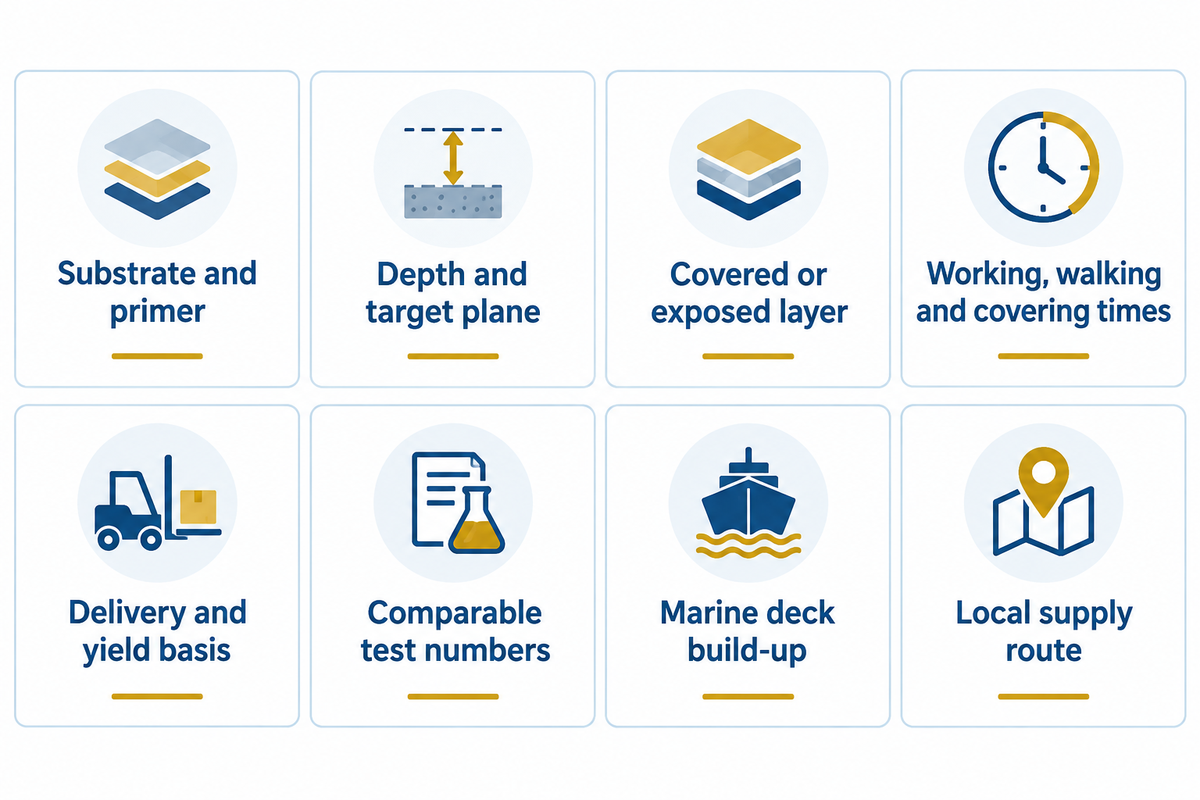
Compare the product each manufacturer proposes against the same substrate, depth range, finish, deadline and delivery address before comparing bag prices. If one quote is for underlayment and another for wearing surface, adjust the scope before you attempt to select the less expensive bid.
1. Name the substrate and the primer
Start with the material actually exposed after removal. A concrete floor with old adhesive residue is a different surface from clean concrete; glazed ceramic tiles, an epoxy coating and timber panels have different adhesion issues again. Put the condition, the removal method and the planned primer in the same line of the bid. ARDEX K 15, for instance, publishes different primer paths for concrete and many non-porous surfaces. Surface preparation is where the first substitution decision is made.
On a slab at grade, document the location of potential sources of moisture before selecting the right compound. A layer used to create a smooth surface is not automatically a moisture treatment. The primer, leveling course and floor finishes must withstand the environment collectively.
On a wood floor, document the panel, attachment and framing. Just because a product is specified for plywood or OSB doesn’t mean it’s appropriate for a loose assembly.
For residential and commercial renovations alike, assign someone to record what remains after stripping. When the project moves from a concrete floor in a corridor to a timber floor in a room, include both conditions in the material request. Do not describe the bid as a single flooring solution and leave the substrate decision to the crew. Price the panel preparation and primer separately if they differ.
2. Give the installer a depth range and a target plane
Measure the high points and hollows and record what the new surface has to meet. A nominal average can hide a deep patch or a doorway that requires virtually no build-up. Record those areas separately.
A specification for a self-leveling floor may require one material in the main area and a repair material at an isolated edge.
A product described as flowing and leveling still needs a spreader, planned edges and a way to hold material at openings. At a deck built to drain, use a screed and placement technique capable of producing the required slope. Level marks serve as guides to placement; they don’t prevent a flowing compound from migrating to low spots.
Choosing the right depth also means drawing the transitions. A thick pour behind a doorway can alter the threshold and leave an awkward joint where various floor coverings meet. Mark the high and low spots in the same space.
If manufacturers recommend a minimum thickness, set that minimum next to the measured high point and ensure the proposed material still fits the available height.
3. Decide whether the layer will be covered or exposed
A cement-based self-leveling underlayment can create a smooth, level surface beneath tile, vinyl or other covering. A topping intended for exposure needs to meet requirements for service traffic and resistance to wear. Certain floor coatings even end up being self-leveling.
Self-leveling epoxy is a resin system with a different job from a cement layer used to fill a low spot.
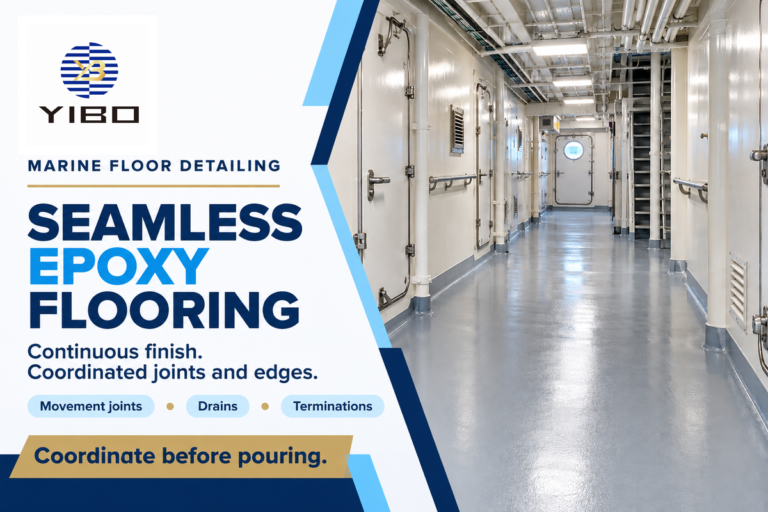
Describe whether the room will see wet cleaning, heavy loads, carts or wheels, and whether the finish must be wear-resistant or has another performance requirement. In the case of a marine resin finish, the marine epoxy floor guide shows where that coating fits into the floor build-up. Make the preparation product and the finish selection simultaneously prior to writing an equivalent-material clause.
Products sold as self-leveling compounds include options for covered layers and exposed finishes. A quality self-leveling underlayment can ensure a smooth base for the next trade when it suits the substrate and is placed properly. In an exposed loading area, pair the topping and traffic specification to get a durable flooring solution.
4. Put the three clocks on the work schedule
The ARDEX K 15 Americas product page gives 2 to 3 hours for walking, 6 hours for moisture-insensitive tile and stone, and 16 hours for all other floor coverings. Working time is a separate checkpoint for the crew doing the pour. A worker may be able to cross a floor well before the next trade can lay the tiles or put down an adhesive.
Rapid setting can cut the wait between trades, but it also narrows the time available for mixing, pouring and spreading. For best results, supply the vendor with the room and substrate conditions you expect and the floor section that the crew can finish in one continuous run. For renovation projects, list rooms that need to reopen between pours.
The timing switch affects the materials and labour staging.
A faster compound reduces installation time only when the shorter wait is on the critical path. If another trade still needs the room or the covering has its own preparation window, the shorter access time may save nothing. Use the time and labor costs to compare the flooring crew’s actual shift plan.
Mark when the primer, leveler and finish need to be ready for the next step.
5. Compare quantities on the same delivery and yield basis
Request the seller to supply the coverage basis, bag weight, bags/ pallet, freight Terms for the same depth stated. Bag weight indicates how much dry product is delivered. Two quotes can specify “one pallet” while covering different areas because one assumes a thinner layer or excludes deep repairs.
Base the order quantity on the surveyed low spots and the yield of the approved mix. A ready-to-mix compound that cures in the planned environment can still fall short of its expected yield if the crew fills penetrations or cracks that weren’t part of the survey. Treat primers, edge materials, water, pump setup and waste as separate costs.
On commercial and industrial work, those items often determine the delivered floor preparation cost more clearly than the nominal bag price.
6. Compare the numbers that answer the same question
Density helps the designer estimate the load added by a layer. Strength and other mechanical properties answer a different question about the material as tested. Depth tells the contractor where the layer can be placed, and a release time tells the scheduler what can happen next.
Request the test method, age, conditioning and reference for any guarantee value before you dump multiple suppliers into one column.
Cement-based mixtures can contain fine aggregates, silica sand or polymer modifiers, and some products are formulated for faster flow or finishing. For pump work on uneven concrete, put the permitted mixing method and working time in the installer brief.
7. Check the exact deck build-up for marine work
In ship design, show the substrate, primer, screed and floor covering on one drawing. Match the works approval to the named facility, and each conformity document to the specific model or assembly it covers. Route a proposed alternative through the same submittal before it goes on the order.
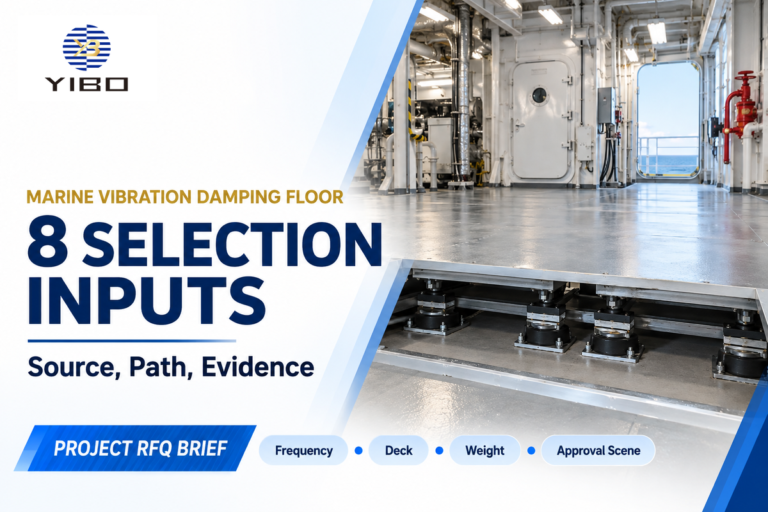
Keep the deck weight allowance beside the depth survey. The layer selected for flatness is also a load. Use the marine underlay model screening matrix to help you whittle down the models before the document review.
To handover the installation, send the self-levelling deck covering guide with the approved spec.
8. Choose a local order route that can support the job
The manufacturer can usually point to a local distributor or representative. Ask that seller to confirm the model it can supply, the site to which it will deliver, expected lead time and how it handles a replacement shipment. A quote designed for efficient distribution in one country might not cover the product name or packaging in another.
Environmentally sensitive fit-outs may need a product-level emissions document. It is different from a manufacturer’s quality system certificate. For commercial spaces with high-traffic entrances or an occupied floor below, specify the wear, reopening or sound control needs before asking the sales team to suggest alternatives.
The handoff should identify each flooring system’s model, quantity and sales territory. A stockist can supply various flooring materials under one purchase order, but the installed flooring results still depend on how those layers fit together. If the named compound is unavailable, assess the proposed replacement against the same dates and assembly.
FAQ
What is a self-leveling compound for concrete?
A self-leveling compound for concrete is a flowable material used to level a prepared slab before the next layer is laid. The majority of products marketed as underlayment lie beneath a finish. A topping is specified for exposed service. Use the instructions to match the named compound to the primer, depth and floor covering.
Which is the best self-levelling compound?
For specified interior OSB, start with LATICRETE NXT Level Plus; for an exposed concrete topping, look at ARDEX K 301. Yibo’s AC-J range is a starting point for marine deck underlay. These serve different jobs, so compare each model with the substrate, finish and release schedule in your own specification first.
What is the difference between a manufacturer and a supplier?
The manufacturer makes the designated compound and provides its technical product information. The supplier sells it, and can perhaps organize delivery or hold stock of the compatible primer. For a large order, list both so that the correctly directed questions about the product are answered by the manufacturer and stock problems by the seller.
Who is the largest self-leveling compound manufacturer?
There is no reliable product-line leader to name. Group revenue covers many unrelated products, so it cannot rank makers of leveling compound. Shortlist companies for your substrate and finish by use of the table.
Where can I buy self-leveling compound in bulk?
Building floor compounds are available through flooring distributors and regional manufacturer representatives. ARDEX Americas offers a distributor lookup, and Maxxon has a representative finder. For marine screed, start with the manufacturer’s marine team so the quotation names the deck substrate, screed model and documents. Give the seller the measured area, depth range, delivery date and staging address. Ask how much of the specified product is in each bag and pallet and whether primer and freight are quoted separately.
How should I compare self-leveling compound costs per square metre?
The installed price per square metre includes the compound, primer, freight, expected waste, preparation and labour at the depth in your floor survey. Compare delivered material prices, then add preparation and labour costs. Have each seller state its coverage assumption, any area excluded for deep repairs, the finish to be installed and the amount of material that will arrive. A price per bag alone will not compare two products with different yields. Record the agreed depth on both quotes.
Choose the Layer Before the Supplier

Choose the layer from the shortlist then instruct the supplier to confirm the precise product and delivery basis. For a commercial floor, specify the floor finish and planned opening date. For a ship, send the substrate and deck build-up as well, with the depth survey and any project document requirements.
Specify a marine deck screed with Yibo. Share the deck material, depth, finish, quantity and delivery port so the team can discuss the relevant AC-J model.
References & Sources
Company and product descriptions draw on the manufacturers’ official histories, technical data and declarations. The table and cards identify the manufacturer websites. The time examples are from the ARDEX K 15 instructions and the CTS Concrete Leveler data sheet. Product test terminology follows the ASTM test methods for self-leveling mortars containing hydraulic cements; concrete and wood preparation context is covered by the ASTM practice for installing self-leveling underlayment for resilient flooring. Product documents give the conditions and intended uses for the specific model.