
Get in touch with Yibo Company


Shipyard Application & Handover Guide
A self levelling deck covering is not a finished floor and it is not an outdoor pedestal. On a ship, it is a construction layer in an approved floor. A reliable job starts by freezing that construction, then releasing the steel deck, each batch, the cured surface, and the final-floor interface against current project documents.
The short answer
The term “self-levelling” should not trigger a pour release by itself. It should only be released when the given layer construction, the current instructions, the steel-deck condition, the material safety information, the work environment, the batch controls, inspection criteria, and the requirements of subsequent trades are all in harmony.
What Is a Self Levelling Deck Covering on a Ship?

A marine primary deck covering sits between deck plating and the layers above it. The U.S. Coast Guard’s finishes guidance defines the primary covering by its position directly on the deck and includes necessary primer, anti-corrosive compound, or adhesive within that construction. Other coverings are treated as floor coverings.
This should be understood. The levelling layer could be used to prepare a surface for vinyl, carpet, tile, or any other finish, but it is not a finish in this case because it is not exposed. Similar internet searches for joist supports, deck pedestal, roof-deck systems, and general residential concrete show different products and different approval concerns.
1. Deck plating
Identify the actual steel workfront and its accepted condition.
Identify the actual steel workfront and its accepted condition.
2. Approved layers
Include the specified primer, tie coat, covering, adhesive, and interfaces.
Include the specified primer, tie coat, covering, adhesive, and interfaces.
3. Final floor
Release the exposed finish only after its substrate requirements are met.
Release the exposed finish only after its substrate requirements are met.
What is self-levelling decking?
In this guide, the phrase means a flowable marine deck-covering material installed by trained personnel as one layer of a specified ship floor. “Self-levelling” describes how the mixed material behaves within its stated application limits; it does not mean self-preparing, self-inspecting, or suitable for every thickness and substrate. The name of the product must not decide whether a primer is necessary, which shop primer is compatible, how much water is permissible, or when a final floor can be bonded.
The Fire Test Procedures Code in the International Maritime Organization’s fire-protection history explains that the Fire Test Procedures Code covers laboratory testing, type approval, and fire-test procedures for primary deck coverings; this is regulatory context, not blanket approval of every material, thickness, layer combination, vessel, or installation.
Freeze the Assembly and Hold Points Before Work Starts
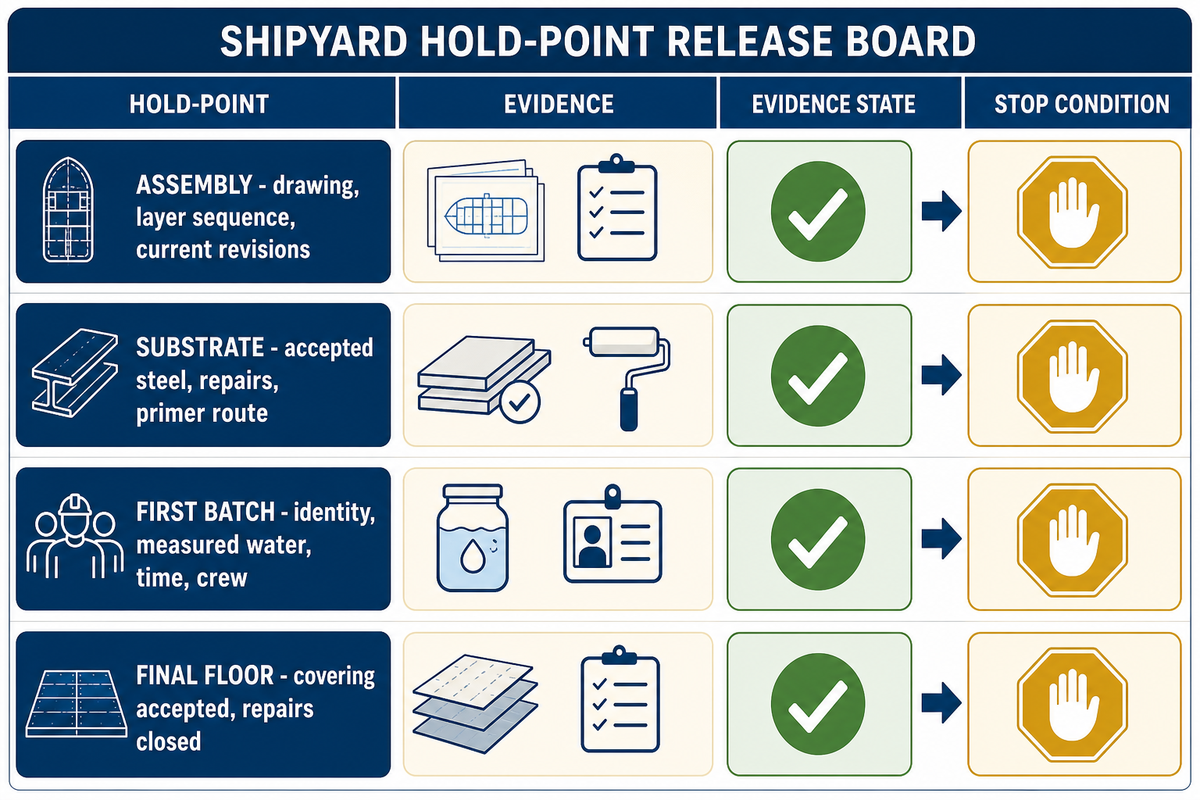
The approval documentation must describe the construction that is actually going to be installed, not a generically labelled product. Layer identities as well as the application rate, the thickness and density, and combinations that were tested may include binding constraints in the approval documents. The method statement and inspection and test plan add the construction sequence as well as the necessary witness points, tolerances, measurements, and signing off.
| Hold point | Release evidence | Stop when |
|---|---|---|
| Assembly | Deck zone, drawing, layer sequence, product identity, finish, current revisions | Documents describe different constructions |
| Substrate | Accepted steel condition, repairs, contamination checks, primer route | The deck has changed since inspection |
| First batch | Batch identity, measured water, equipment, environment, timestamps, crew | A required field or calibrated measure is missing |
| Final floor | Covering acceptance, repairs closed, moisture or other specified criteria, finish-contractor release | “Walkable” is the only evidence offered |
How thick can self-levelling material be poured?
There is no defensible uniform thickness. The specified product and approved construction define the permitted range, which also depends on deck geometry, slope, the primer or tie-coat route, and current application instructions. A value from another product does not release the work. Record the permitted nominal and local range on the workfront sheet, define how it will be checked, and obtain a technical assessment before treating a deep low spot as an ordinary pour.
Prepare the Steel Deck for the Specified System
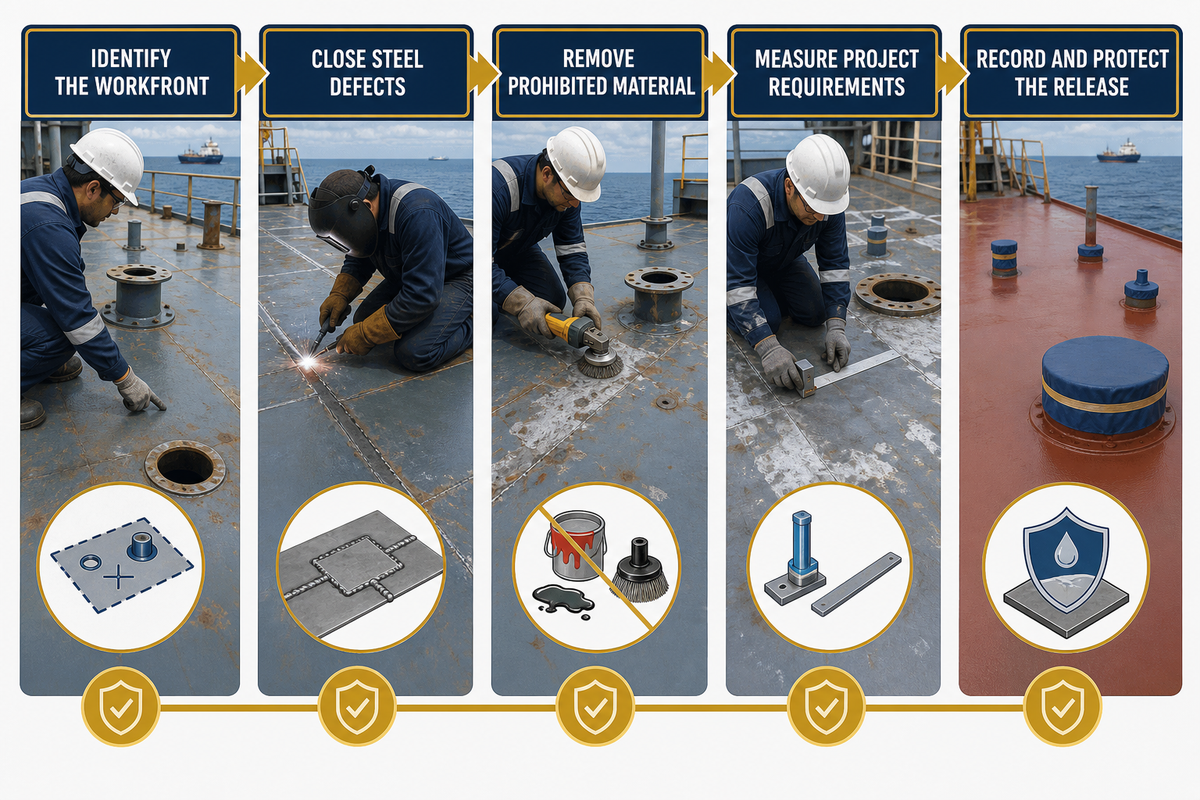
Flow cannot remove oil, salt, loose corrosion products, dust, weld spatter, sharp edges, moisture, or an incompatible coating. Preparation therefore does not end with the statement “it looks clean.” The required preparation grade, profile, soluble-contamination test, primer, and maximum interval before covering must be given in the project specifications and the current system documents.
- Identify the workfront. Mark the location of the deck zone, penetrations, drains, thresholds, interfaces with bulkheads or equipment foundations, and the slopes.
- Close steel defects. Address weld, plate, edge, and fabrication conditions that would telegraph through the covering or break the specified thickness.
- Remove prohibited material. Treat corrosion products, oil, salts, dust, water, and incompatible shop-primer damage by the approved method.
- Measure what the project requires. When the specification points to this ISO surface-preparation standard, use the controlled edition; otherwise use the project-named standard and calibrated tools where the inspection plan requires a profile, contamination, climate, or other test.
- Record and protect the release. Photograph the accepted condition, identify the inspector and time, and control traffic, condensation, dust, hot work, and delay before the next operation.
Practical rule
If the deck condition cannot be traced to one accepted workfront and one approved layer route, it is not ready for mixing—even if a nearby area has already been poured.
Control the Environment, Access, and Workfront

Open the workfront only after both quality and safety control mechanisms are in place. Check the product-specific substrate and ambient limits, ventilation, lighting, power, clean water source, mixer location, delivery route, waste handling, communication, and exclusion boundary. Plan where a batch can be rejected without blocking escape or contaminating accepted deck.
For cementitious materials, the current safety data sheet and the shipyard job safety process must cover wet cement contact, dust, eye exposure, hygiene, washing facilities, training and provision of appropriate PPE. The OSHA Portland cement safety publication explains why wet cement can damage skin and why workers should not wait for pain before responding. Modified, resinous, or other systems may provide different hazards; never reproduce a protective control list from another chemistry.
- Record both substrate and ambient conditions as documented in the method statement.
- Confirm that ventilation supports the product instruction and the safety assessment without creating prohibited draught during cure.
- Separate active hot work, grinding leaks and overhead work from the released area.
- Position enough labour and equipment to maintain the planned wet edge without adding water to the system.
- Before opening the first bag, explain the stop-work signals, quarantine area, and technical escalation path.
Batch and Place Without Guessing
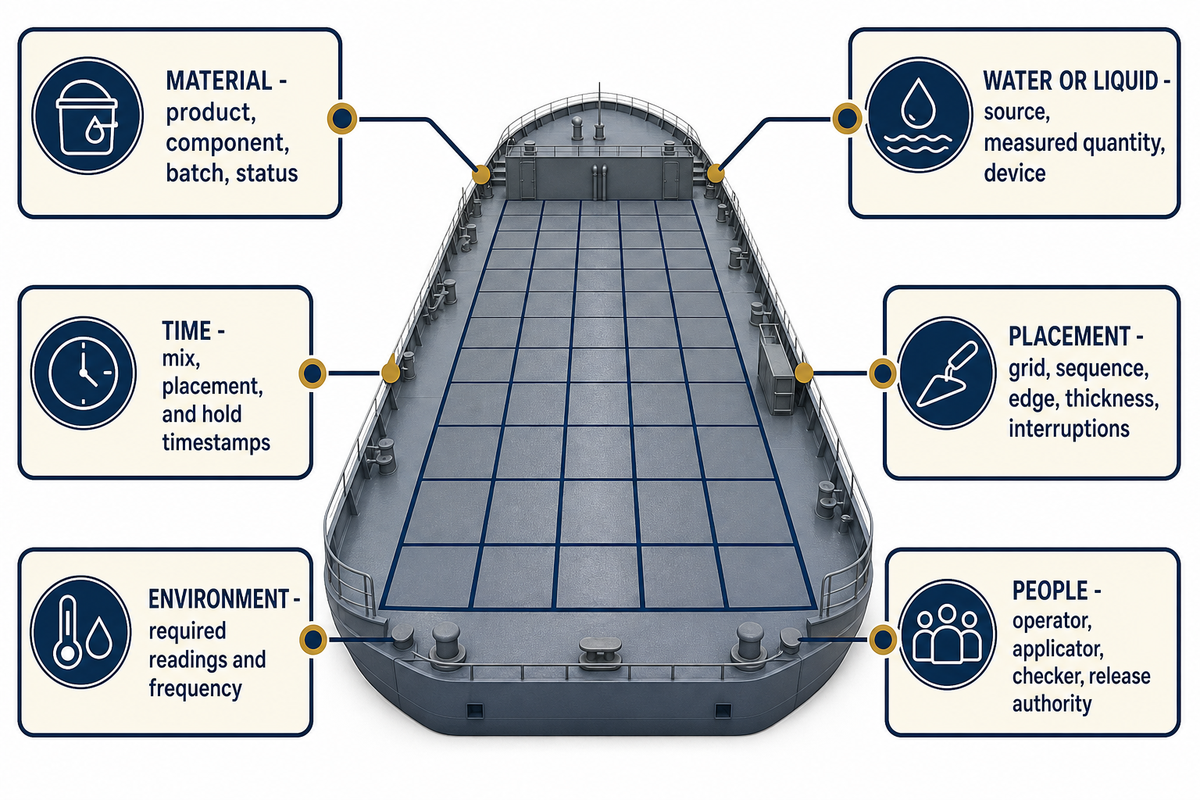
Because a primary deck covering forms part of the deck construction, a batch sheet should allow the finished area to be reconstructed without substituting a generic mixing recipe. It is not post-pour documentation. It is the link between the delivered material, the measured inputs, the crew’s actions, the environment, and the physical deck zone.
| Record field | What to capture | Why it changes a decision |
|---|---|---|
| Material | Product, component, lot or batch, expiry/status | Defines which instruction and evidence apply |
| Water or liquid | Approved source, measured quantity, device identification | Separates controlled dosing from visual adjustment |
| Time | Mix start/end, placement start/end, relevant hold time | Shows whether the product-specific window was respected |
| Environment | Required readings at the specified frequency | Connects a batch to actual workfront conditions |
| Placement | Deck grid, sequence, edge, thickness checks, interruptions | Lets a defect be mapped beyond one visible spot |
| People | Mixer/operator, applicator, checker, release authority | Closes responsibility and escalation gaps |
Follow the instructions for sequence of addition, mixing equipment, speed, duration, pause or remix steps, tools for placement, working time, and thickness. Do not add water to recover flow unless the controlled instruction expressly permits a measured adjustment within its stated limit. Do not mix in old and new material across an uncontrolled edge. When work is interrupted, define the edge, time, batches, and disposition.
What are common mistakes when using self-leveling concrete?
For marine work, the correct solution is not a residential recipe. Common process failures include opening an unreleased substrate, using the wrong manual revision, estimating water by sight, mixing outside the stated method, extending a batch beyond its working window, losing the wet edge, ignoring environmental change, and leaving thickness or workfront identity unrecorded. These are control failures and not assessments of later cracking or hollow response. If any occurs, quarantine the affected area and obtain a documented technical disposition.
Cure and Protect the Deck Before the Next Trade
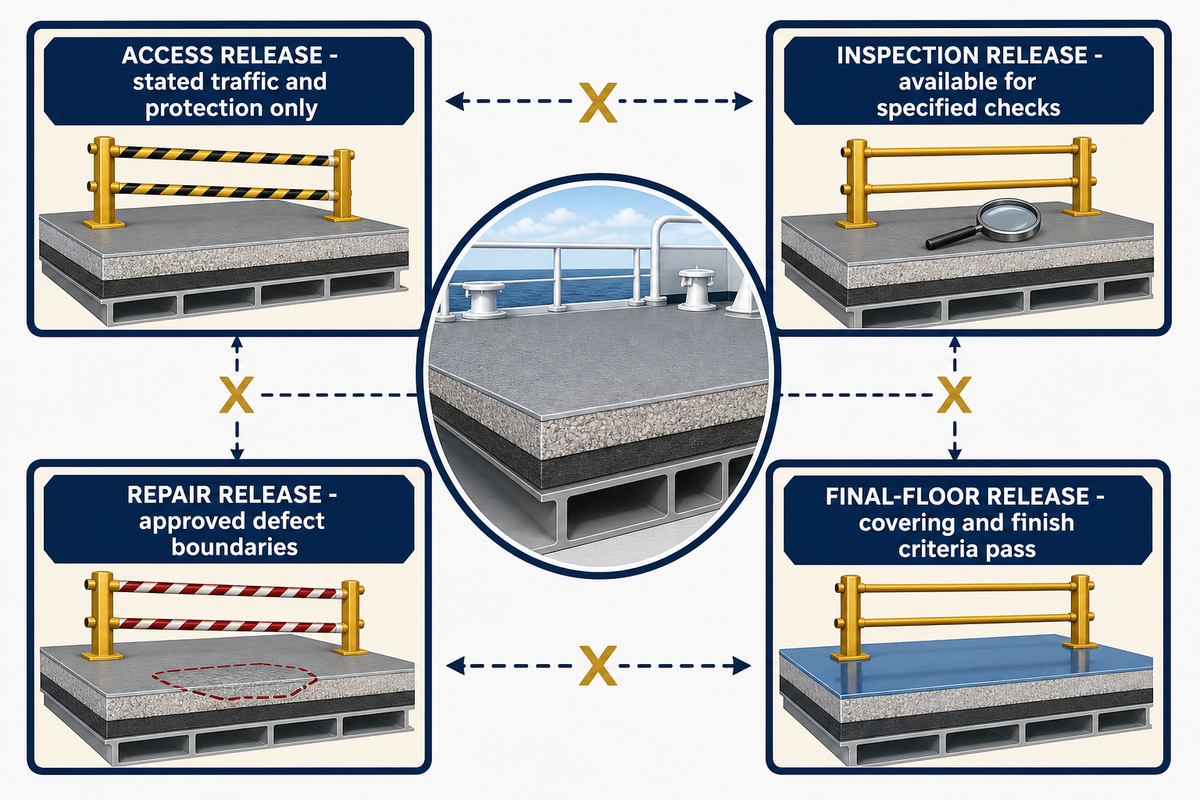
The type-approval context for primary deck coverings does not make “hard,” “dry-looking,” “walkable,” and “ready for the final floor” the same workfront release state. Current product documents can assign different conditions to each state, and the finish or adhesive supplier may impose additional substrate criteria. Treat access, inspection, repair, and final-floor bonding as separate releases.
Access release
Only the stated traffic and protection are allowed.
Only the stated traffic and protection are allowed.
Inspection release
The surface is available for the specified checks.
The surface is available for the specified checks.
Repair release
Defects and repair boundaries have an approved disposition.
Defects and repair boundaries have an approved disposition.
Final-floor release
Covering, moisture, repair, and finish-system criteria all pass.
Covering, moisture, repair, and finish-system criteria all pass.
Protect the layer from direct heat and contact with hot work. Protect the layer from water, dust, uncontrolled ventilation, tool dropping, and contamination as required by the specified system. Record the time and location of excursions from the method statement, instead of assuming excursions reset the cure time.
Inspect and Accept the Installed Covering
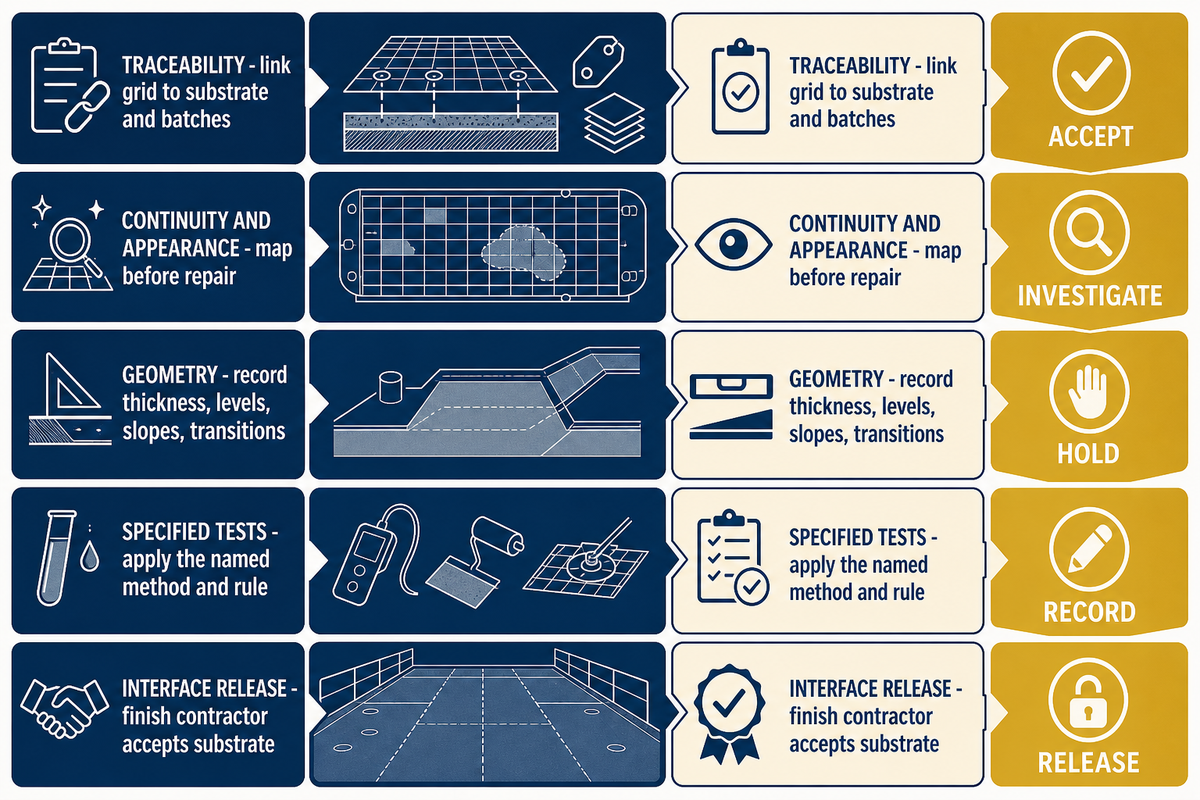
Acceptance is a comparison with controlled criteria. The SOLAS chapter II-2 summary provides high-level fire-safety objectives; it does not supply a deck-zone flatness tolerance or a job-specific repair rule. The approval documentation may outline part of the construction that is being assessed. The project drawing, specification, method statement, current product instruction, and inspection plan must complete the acceptance basis.
| Evidence | Question | Disposition |
|---|---|---|
| Traceability | Can every inspected grid be linked to accepted substrate and batches? | Accept, investigate, or hold |
| Continuity and appearance | Are cracks, ridges, pinholes, soft areas, edges, and interfaces within the stated criteria? | Map before repair |
| Geometry | Do recorded thickness, levels, slopes, transitions, and clearances meet the project basis? | Record measured result |
| Specified tests | Were required soundness, adhesion, strength, moisture, or other tests performed by the named method? | Use the stated acceptance rule |
| Interface release | Has the final-floor contractor accepted the substrate under its own controlled criteria? | Release or retain hold |
Diagnose Defects Before Choosing a Repair
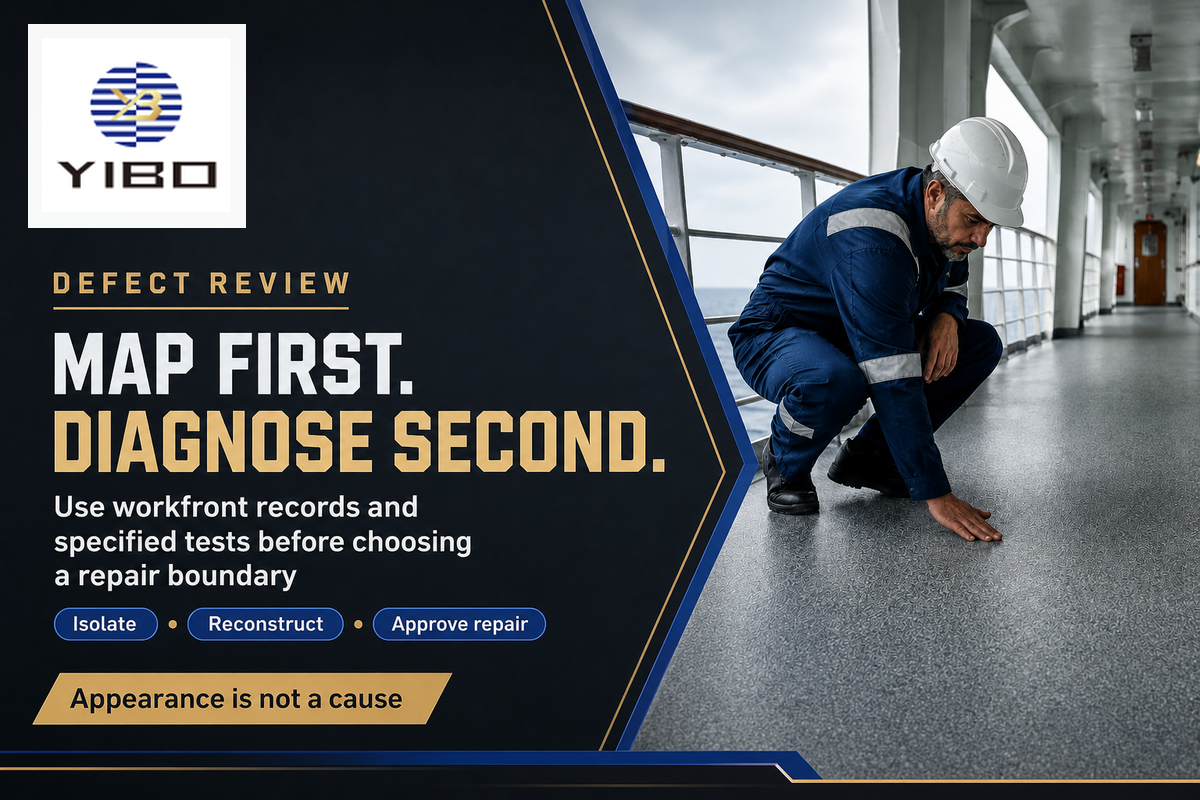
A symptom is a routing signal, not a remote diagnosis. A crack can indicate any number of issues such as movement of the substrate, the geometry, the material, the mixing, the placement, the curing, damage, or an interface, and more than one of these can be true. The same is true of pinholes, ridges, soft spots, discolouration, a hollow or local debonding, or a weak spot.
| Symptom type | Check first | Decision owner |
|---|---|---|
| Pinholes or surface voids | Substrate release, priming, mix record, placement method, mapped extent | Project quality and system technical authority |
| Ridges or cold edges | Batch and placement timestamps, wet-edge plan, interruption record | Method-statement owner |
| Cracks | Deck condition, crack pattern, thickness, batches, cure history, adjacent zones | Responsible technical parties under the project plan |
| Soft or hollow areas | Material identity, water, mix/time records, contamination, test method, boundary map | Quality authority before removal or patching |
| Local debonding | Substrate and primer release, interface condition, mapped boundary, test basis | System technical authority and project quality |
| Discolouration | Batch identity, water or liquid record, contamination, cure and protection history | Project quality before cosmetic treatment |
| Surface dusting | Material status, batching, exposure, curing conditions, cleaning history | Responsible technical parties before the next trade |
| Damaged edge or transition | Traffic, protection, joint detail, adjacent work, repair boundary | Interface owner and project quality |
Keep the next trade out and isolate the area, and compare affected work with adjacent areas of the same and different batches. Agree the extent of the investigation prior to any removal or destructive testing. Where the U.S. approval framework applies, retrieve the drawings, specifications, qualification tests, and related correspondence retained under 46 CFR 2.95-10, then reconcile them with the project records for the affected area. A repair instruction should define the removal extent, treatment of the substrate, the new construction, together with cure, re-inspection, records to be kept, and the closing of the nonconformance. Cosmetic smoothing without cause review can conceal a wider process problem.
Build the Seven-Record Deck Handover Pack (7-Record Handover Pack)
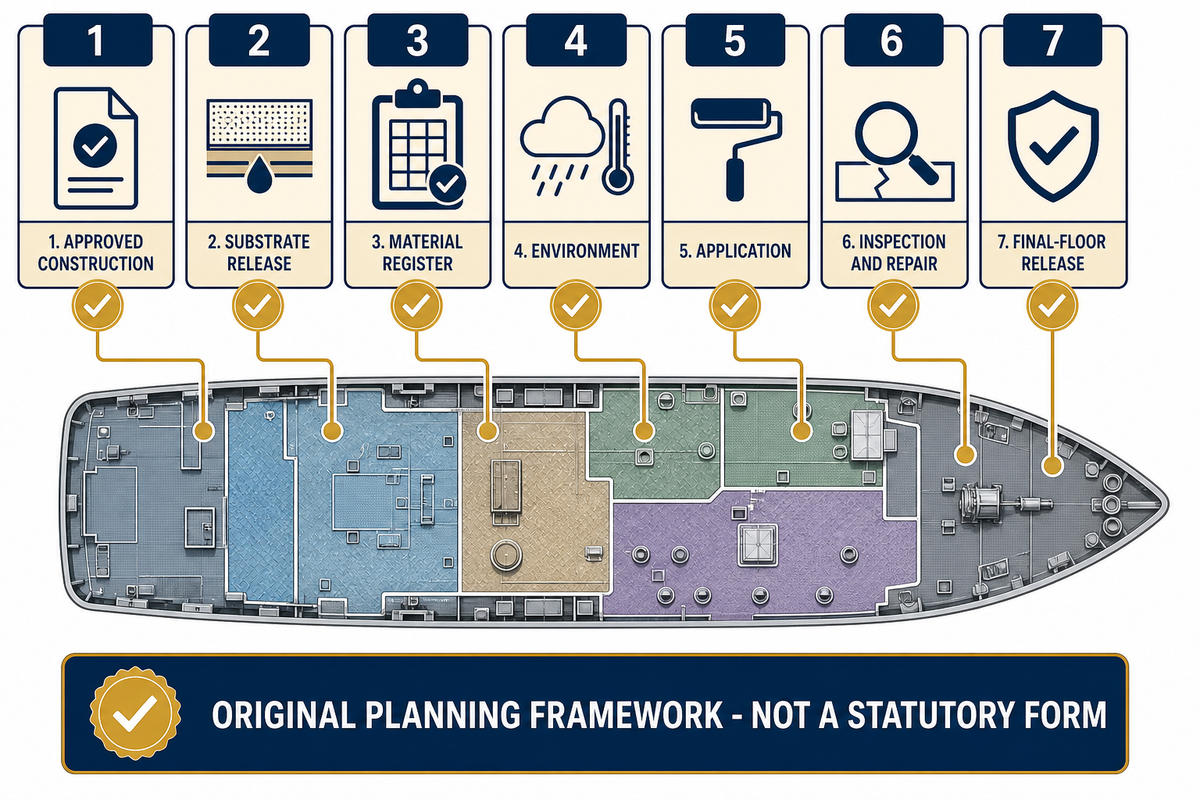
The Seven-Record deck Handover Pack is an original planning framework, not a statutory form or classification-society rule. Such records help to reconstruct one fully installed workfront. U.S. laws such as 46 CFR 2.95-10 show why approval drawings, specifications, qualification tests, and related records have an identifiable owner and retention context. Your project pack must still comply with its own contract and inspection plan.
Seven-Record Deck Handover Pack
| Record group | Minimum identity | Release question |
|---|---|---|
| 1. Approved construction | Vessel, deck zone, drawing, layer sequence, products, revisions | Does it describe the installed assembly? |
| 2. Substrate release | Area, condition, checks, repairs, inspector, date/time | Was the same deck later poured? |
| 3. Material register | Product/components, lot, status, storage, issue to workfront | Can delivered material be traced? |
| 4. Environment | Required readings, times, location, deviations | Were stated limits maintained? |
| 5. Application | Water/liquid, mixer, timestamps, crew, grid, thickness, interruptions | Can every area be linked to a batch? |
| 6. Inspection and repair | Results, defect map, tests, repair approvals, reinspection | Are all holds and repairs closed? |
| 7. Final-floor release | Covering acceptance, finish criteria, responsible signatures | May the next trade bond its system? |
| Pack release check | All seven groups name the same workfront and responsible signatories | Close the pack or retain the hold |
Pack release: close the handover only when all seven record groups identify the same work front and every open hold, repair, and interface decision has an accountable sign-off.
Use the Three-Signal Stop-Work Rule (3-Signal Rule)
Stop the next operation when any one of the three signals is noticed: identity drift (the material, layer, lot, area, or document does not match); control drift (water, time, environment, preparation, thickness, cure, or safety condition leaves its approved basis); or evidence drift (the work may look acceptable, but the required record, inspection, or release cannot be reconstructed). Quarantine the affected boundary, assign an owner, record the disposition, and reopen only after the governing documents agree.
For Yibo model information, marine-document routes, project-fit questions, and commercial selection, use the dedicated self levelling deck covering systems page. This guide, intentionally, will not repeat its model table, certificate details, product tools, or quote details.
Need to review a deck-covering workfront before release?
Prepare the vessel, deck zone, substrate, approved layer construction, target thickness, final finish, flag/class context, and current document revisions. Yibo can then review the product-document route and the information still needed for a project-specific discussion.
Frequently Asked Questions
Does self-levelling mean steel-deck preparation can be skipped?
No. Flow behaviour cannot remove contamination, corrosion products, defects, moisture, or incompatible coatings, so the released steel deck and specified preparation route still control the start.
The required preparation and primer route come from the exact approved construction, project specification, and current product instruction. Record the accepted substrate before material is mixed. If the inspected deck is contaminated, damaged, exposed beyond its permitted interval, or changed by another trade, reopen the release instead of relying on the previous sign-off. Confirm the renewed boundary, test or inspection result, responsible person, and time before the mixer restarts. This protects traceability when hot work, traffic, leaks, condensation, dust, or coating damage occurs between inspection and placement.
What should be recorded before the first batch is mixed?
Before mixing, bind the exact deck area, approved construction, material and batch identity, measured inputs, environment, equipment, responsible people, and planned times to one workfront record.
Record the deck zone, substrate release, product and batch identity, instruction revision, target thickness, primer status, measured water or liquid, mixer, environmental readings, start time, workfront boundaries, safety release, and assigned checker. The final field list follows the method statement and inspection plan, but an undocumented workfront should not become a live batch.
When is the deck ready for the final floor covering?
The deck is ready only when the current product cure criteria, project inspection requirements, accepted repair status, and the finish-system supplier’s substrate conditions all agree for that specific workfront.
Foot traffic, inspection, repair, and final-floor installation are separate releases. Use the current product curing instruction, recorded conditions, specified tests, accepted repairs, and the adhesive or finish supplier’s substrate requirements. A hard-feeling surface or elapsed time alone does not prove readiness by itself for vinyl, carpet, tile, or another finish.
Is this the same as an adjustable outdoor deck pedestal?
No. This guide covers a flowable layer within a ship’s floor construction; an adjustable outdoor pedestal is a separate joist, rooftop, or patio support system.
This guide concerns a flowable layer within a ship floor construction. It is not a joist support, rooftop pedestal, patio platform, or general residential-concrete recommendation. Outdoor pedestal specifications, loads, slopes, and building-code references cannot be transferred to a marine primary deck covering.
How should cracks, hollow areas, or soft spots be handled?
Map and isolate each crack, hollow area, or soft spot before selecting a patch or removal depth; appearance alone cannot establish the cause or the proper repair boundary.
Review the substrate release, batch identity, measured inputs, mixer and placement times, environmental record, cure and protection history, photographs, adjacent work, and specified tests. The responsible project and technical parties should approve the investigation boundary, substrate treatment, replacement method, cure, reinspection, and record closure. Do not assign one cause from appearance alone.
What if the supplied product file has specifications but no application instructions?
Treat a missing application instruction as a pre-start hold, not permission to use a familiar recipe, universal mixing limits, or an assumed cure and inspection sequence.
Request the current approved application document and reconcile it with the vessel’s construction, method statement, inspection plan, and safety process. A data sheet can describe performance or packaging without supplying the sequence, limits, equipment, cure protection, tests, and escalation rules required at the workfront.
Scope and attribution note
This is a process-control educational guide. It does not replace vessel drawings, flag or class requirements, approval documents, the current product application instruction, safety data sheet, method statement, inspection and test plan, or the decisions of responsible project personnel. Yibo corporate history, certification, classification-society, and shipyard-relationship statements are first-party statements unless independently verified.
References & Sources
- Finishes and Furnishings — Primary Deck Coverings, U.S. Coast Guard
- History of SOLAS Fire Protection Requirements, International Maritime Organization
- Summary of SOLAS Chapter II-2, International Maritime Organization
- 46 CFR 2.95-10 — Equipment or Material Required to Be Approved, Electronic Code of Federal Regulations
- Preventing Skin Problems from Working with Portland Cement, Occupational Safety and Health Administration



![Marine PU Floor: Selection & Installation [Guide]](https://yibomarine.com/wp-content/uploads/2026/09/marine-pu-floor-blog-featured-150x150.png)