Get in touch with Yibo Company


Commercial Marine Flooring Systems for Newbuild Shipyards and Ship Repair Yards
We are a commercial marine flooring manufacturer based in Suzhou, and we produce the deck covering, the resin floor and the acoustic floating floor in the same works. Our fire-rated deck constructions are type approved by CCS, by DNV under the EU Marine Equipment Directive and by NK. Send us the deck plan and the noise level you have to meet, and we will name the certified constructions that match it.
Please advise the decking plate thickness, compartment and what dB the sound insulation must be. You get back a certified construction and the certificate line that covers it.
Send Us Your Deck Schedule and Noise Specification
25
certified deck constructions
Rw 37-56 dB
fire class A-0 and A-60
30-45 days
Production runs are scheduled at
FOB Shanghai
Shipped
Our Commercial Marine Flooring Capability at a Glance
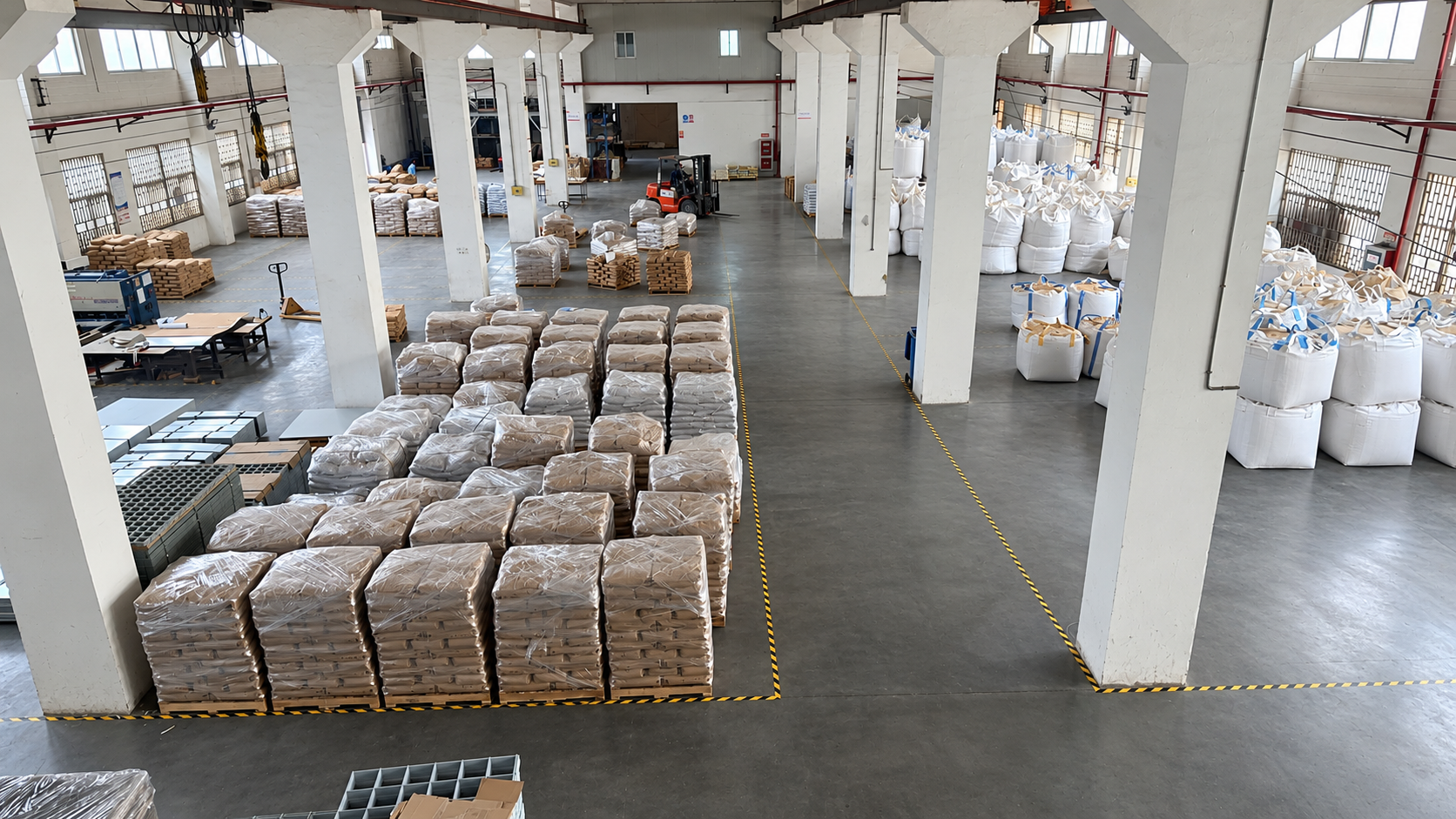
At a single production site of over 6,000 square metres in Suzhou, Yibo builds marine flooring for newbuilding and for after-market repair work. Everything from the layer that meets the steel deck to the finished surface is made here, and the type approvals that cover it are held here too.
Certified deck constructions
Registered on CCS type approval SH25PTB00152, covering Rw 37-56 dB, fire class A-0 and A-60, sound-reduction level R35 and R45, across 25 certified deck constructions
Product families
Deck coverings, self-levelling coverings, epoxy and polyurethane resin floors, acoustic floating floors and damping coating
Lead time
Small-batch orders ship in 15-30 days after drawing approval. Production runs are scheduled at 30-45 days, confirmed with your quotation
Sampling
Samples are available for evaluation before a bulk order, and sample freight is normally paid by the buyer
Payment and shipping
30% T/T deposit with the balance before shipment, or an L/C at sight, by wire transfer. Shipment is FOB Shanghai, with other Incoterms on request
With every shipment
A packing list, a commercial invoice and the batch test report for your production lot ships with your order
And it is those six figures a shipyard buyer asks for first, each one traceable to a certificate number and a product data sheet held at the Suzhou works.
25 certified deck constructions, rated 37 dB to 56 dB
Material densities across the range from ≤600 kg/m³ to ≤2200 kg/m³
Small-batch delivery in 15-30 days after drawing approval
Send us your deck schedule and we will name the certified construction, the fire class and the sample lead time.
Submit Deck ScheduleFour Marine Flooring Systems We Manufacture
Our four system families sit on the same steel deck and answer different questions: levelling, mechanical duty, noise, and where each one belongs on the ship. All four are made at the Yibo works in Suzhou, so the levelling covering and the topping above it leave the same production line. Start from the compartment you are specifying and work back down to the build-up.
Marine Deck Covering Systems
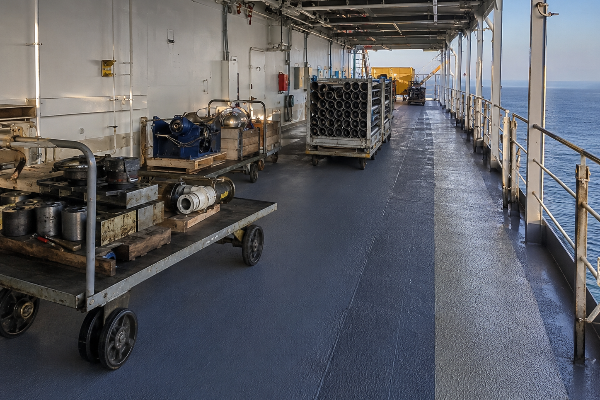
Ordinary and primary deck coverings, self-levelling and polyester levelling coverings for accommodation cabins, corridors and stairways. This family levels the steel deck and carries the finished surface above it.
- Five deck covering grades from ≤800 to ≤2100 kg/m³, compressive strength ≥3 MPa to ≥5 MPa
- Six self-levelling grades including AC-J I at flow Φ≥130 mm and AC-J600 at ≤600 kg/m³
- Finished with carpet, PVC sheet or a painted surface
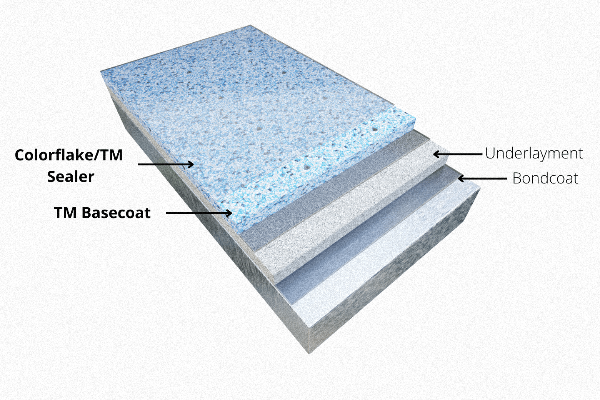
Marine Resin Floor Systems
Epoxy and polyurethane resin floors for engine rooms, galleys, cooler rooms, provision rooms and any space that needs a jointless surface. Our supply covers the levelling covering and the resin topping as one certified build-up.
- YB-Epoxy Floor E60 at compressive strength ≥50 MPa and flexural strength ≥35 MPa
- Bond strength ≥2.0 MPa and abrasion loss ≤0.03 g on the same grade
- YB-S20 and YB-S22 levelling coverings at ≤1100 and ≤1400 kg/m³
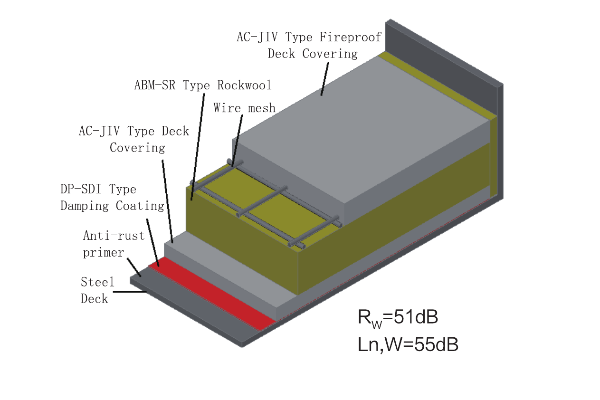
Marine Acoustic Floor Systems
High sound insulation floating floors and damping coating for cabins and public areas that carry a noise level requirement. This is the family we build when the deck has to carry an insulation figure and not only a finish.
- Floating floor constructions rated Rw ≥45 dB to ≥56 dB
- Surface weight from ≤27.45 to ≤67.63 kg/m²
- DP-SDI damping coating applied at 1.5 mm ±0.5, adhesion ≥1.8 MPa
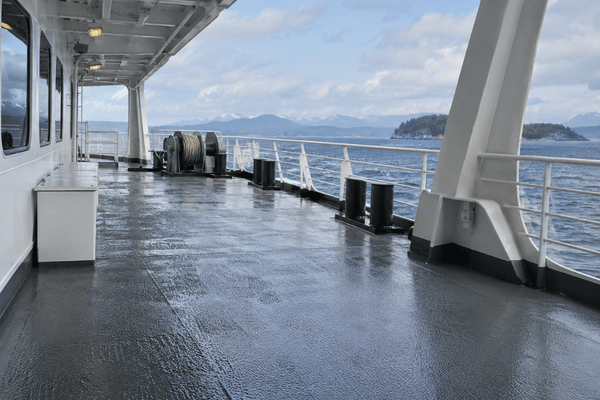
Vessel & Ship-Area Applications
The same three families, arranged by vessel type and by the part of the ship's interior you are fitting out. Use it to get from a general arrangement drawing to a specific certified build-up.
- Accommodation cabins, corridors and stairways
- Public spaces, galleys and provision rooms
- Engine rooms, control rooms and open decks
Reading the Rw Figures
Rw is the weighted sound reduction index, the single-number airborne rating defined in ISO 717-1, and it is the figure a noise specification normally quotes. A higher Rw means more airborne sound held back by the construction as it was tested. On its own it says nothing about impact noise, which the resilient layer governs.
Marine Deck Covering Materials and Where Each One Belongs
The covering that meets the steel is chosen by weight budget and by the load the compartment carries, not by the finish you want to see. Yibo publishes the density and strength figures for every grade so a naval architect can check the weight before the material is on the ship.
| Grade | Dry density | Flexural strength | Compressive strength | Pack size |
|---|---|---|---|---|
| YB-1 deck covering | ≤1300 kg/m³ | ≥3 MPa | ≥8 MPa | 39 kg/set |
| YB-3 deck covering | ≤1000 kg/m³ | ≥3 MPa | ≥8 MPa | 38 kg/set |
| YB-4 deck covering | ≤800 kg/m³ | ≥3 MPa | ≥8 MPa | 19 kg/set |
| YB-5 self-levelling | ≤1800 kg/m³ | ≥3.5 MPa | ≥10 MPa | 25 kg/bag |
| YB-7 deck covering | ≤2100 kg/m³ | ≥5 MPa | ≥15 MPa | 50 kg/bag |
| AC-J I self-levelling | ≤1700 kg/m³ | ≥8 MPa | ≥30 MPa | 25 kg/bag |
| AC-J II self-levelling | ≤800 kg/m³ | ≥5 MPa | ≥20 MPa | 13 kg/bag |
| AC-J1200 self-levelling | ≤1200 kg/m³ | ≥8 MPa | ≥30 MPa | 18 kg/bag |
No single grade is ideal for every compartment on the ship. Weight and strength move against each other across this range, and the lighter grades are not simply the better ones. AC-J II at ≤800 kg/m³ saves weight in accommodation areas, whereas AC-J I at ≤1700 kg/m³ carries the compressive load a galley or a provision room puts on the floor.
- Accommodation cabins and corridors: the lighter deck coverings and self-levelling grades
- Galleys, cooler rooms, provision rooms and pantries: the higher-strength self-levelling grades under a resin topping
- Engine rooms and workshops: YB-7 at ≥15 MPa compressive strength
- Cabins with a noise limit: an acoustic floating floor instead of a plain covering
- Repair work on an existing deck: the grade that matches the thickness you can recover
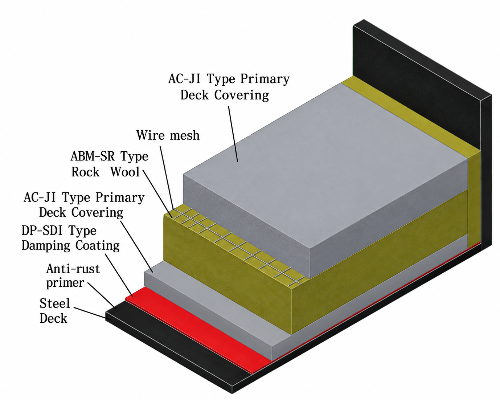
Surface Finishes, Colour Options and Imitation Teak
Yibo also provides the wearing surface on the same order as the covering beneath it, so the yard receives one build-up from a single production source. All the colour work stays in house, where the match is confirmed against your interior specification before production starts. Any of the finishes below can sit above the levelling coverings shown earlier, from ≤800 to ≤2100 kg/m³.
01
Painted and coated finishes over a levelling covering
02
PVC sheet and carpet laid on a prepared covering
03
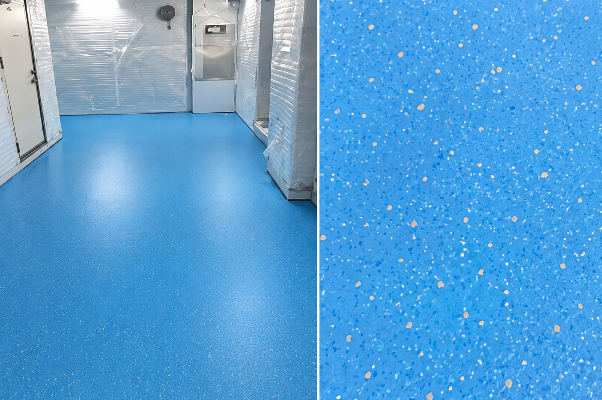
Jointless epoxy and polyurethane resin surfaces over YB-S20 or YB-S22 levelling coverings at ≤1100 and ≤1400 kg/m³
04
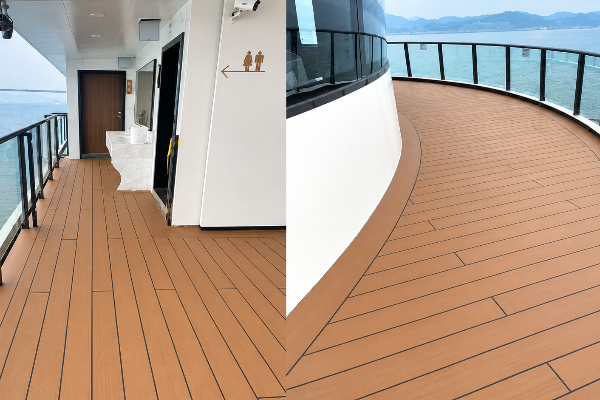
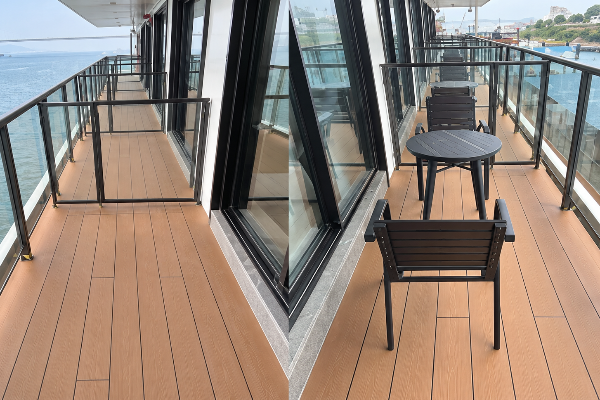
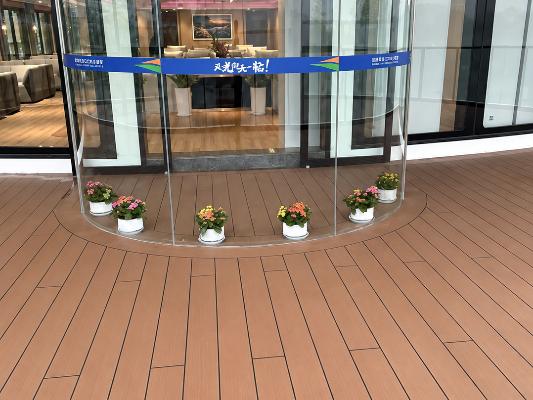
Imitation teak deck for open decks and terraces
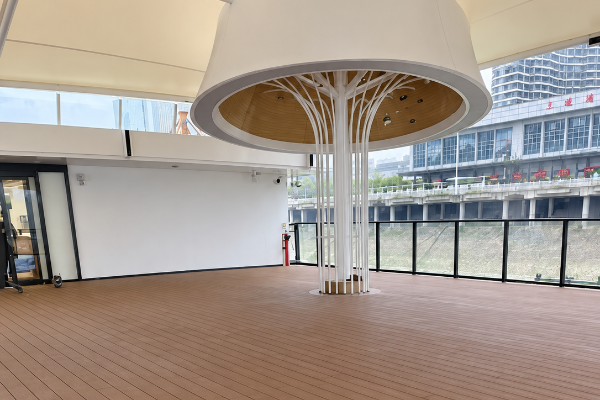
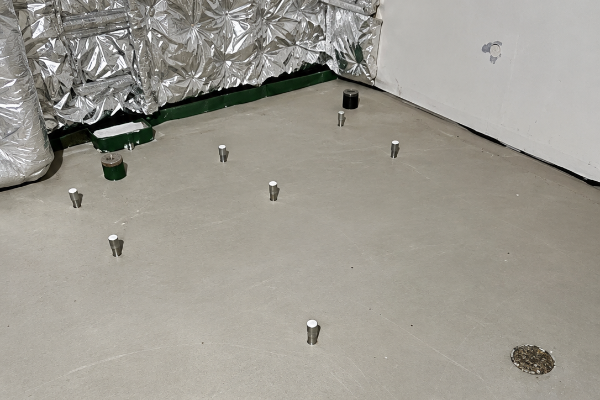
On a marine floor the colour is judged in a sample cabin under the lighting the ship will actually use, not matched against a printed card. The colour reference stays in the order file, so a repeat batch for a sister vessel starts from the same reference.
Where the interior designer provides the sample, the sample is the reference, not the name of a colour
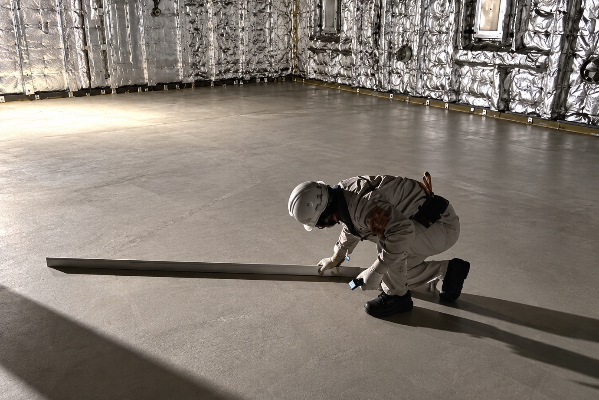
Under a jointless resin surface the levelling covering is YB-S22 at a flow of 250-300 mm, because the flatness you see in the finish is set by that layer and not by the topping
Floor coverings are one of the product categories Part 5 of the IMO 2010 FTP Code names, and that part is the surface flammability test run to ISO 5658-2. Part 2 adds the smoke density and toxicity test to ISO 5659-2 for the same category. A finish chosen on appearance alone can fail either of them, which is why we specify the finish together with the construction beneath it.
Our imitation teak floor is a Class C product for open decks, terraces and other spaces where the look of a laid teak deck is wanted. Yibo supplies it as a finish, and we publish no acoustic or fire performance figures for it. If the area also carries a noise or fire requirement, the requirement is answered by the construction underneath, not by the teak appearance.
Lead Times, Sampling And Commercial Terms
Shipyard purchasing needs the commercial terms in the same conversation as the technical answer, so we publish ours instead of holding them back for the quotation stage. Below are the figures Yibo works to on any new marine flooring order.
Term
What we work to
Small-batch orders
Small-batch orders ship in 15-30 days after drawing approval.
Series production
Production runs are scheduled at 30-45 days, confirmed with your quotation.
Payment
30% T/T deposit with the balance before shipment, or an L/C at sight, by wire transfer.
Shipping
We ship FOB Shanghai; other Incoterms on request.
Documents
A packing list, a commercial invoice and the batch test report for your production lot ships with your order.
Samples Before a Bulk Order
Samples are available for evaluation before a bulk order, and sample freight is normally paid by the buyer. A sample panel is worth asking for when the yard wants to see the finish and the application behaviour before the deck schedule is committed. Samples go out in the same grade the production order would use, not as a display piece.
Repair Material and Sister-Vessel Repeats
Repair yards order differently from newbuild yards, because the quantity is small and the schedule is set by the docking window. The order file from the first delivery holds the grade, the colour reference and the certificate number, so a repeat order does not restart the technical review. That also applies to a sister vessel built a year after the first hull.
Type Approvals: IMO Fire Test Standards, EU MED Modules B and D, and Class Certificates
Marine flooring is approved in layers, and a buyer who checks only one of them can still receive a product that cannot be wheelmarked. Yibo holds all three layers, and we name the certificate numbers so your maker list reviewer can verify them at source.
- The product construction. A module B examination certificate or a class type approval certificate covers the construction itself, tested to the IMO 2010 FTP Code.
- The production quality system. A module D certificate covers the factory that makes it, and on our route it is what allows the wheelmark to be applied.
- The works. A works approval certifies the production site itself, its process controls, its materials and its compliance.
A module B certificate on its own does not authorise a wheelmark, and a module D certificate on its own covers no product. We certify on the module B plus module D route, so both certificates have to be in force together before our equipment can be placed on an EU-flagged ship.
| Certificate | Issued by | Covers | Category | Issue date | Valid to |
|---|---|---|---|---|---|
| SH25PTB00152 | CCS Shanghai | 25 deck constructions | Class type approval | 2026-07-20 | 2027-07-27 |
| MEDB000070D Rev1 | DNV SE Hamburg, notified body 0098 | YB-A60FIII-1 | MED/3.11a module B | 2025-11-03 | 2030-11-02 |
| MEDB0000BBX Rev0 | DNV SE Hamburg, notified body 0098 | YB-A60-7 | MED/3.11a module B | 2026-08-06 | 2031-08-05 |
| MEDD00000CX Rev.11 | DNV SE Hamburg, notified body 0098 | 19 models in the annex | Module D production quality assurance | 2025-06-12 | 2027-01-19 |
| SH25PWA00041 | CCS | Suzhou production site | Works approval | 2025-10-18 | 2027-07-22 |
The module D annex lists 19 models across MED/3.1, MED/3.11a and MED/3.18c, each with its own United States Coast Guard number. These module B examination certificates sit behind them.
- MEDB00005WR, AC-J I, MED/3.1, valid to 2029-11-21
- MEDB00005WM, AC-J II, MED/3.1, valid to 2029-11-24
- MEDB00005WN, DP-SDI damping coating, MED/3.1, valid to 2029-11-24
- MEDB00008VR, AC-J1200, MED/3.1, valid to 2029-03-06
- MEDB00007R8, YB-S20, valid to 2027-03-17
- MEDB00007R9, YB-S22, MED/3.18c, valid to 2027-03-15
- MEDB00001WK Rev2, YB-Epoxy Floor E60, MED/3.18c, valid to 2027-09-25
ClassNK has issued us type approvals under numbers TA241215E(R), TA241211E(R), TA241214E(R), TA241212E(R) and TA24323E(N). The works approval SH25PWA00041 was audited against SOLAS Chapter II-2 Regulations 3, 4, 5 and 6 together with Parts 1, 2 and 5 of the IMO 2010 FTP Code, and it carries an audited asbestos-free declaration. Our CCS type approval also cites the IMO 2010 FTP Code Part 3 and IMO Resolution MSC.337(91) among its approval standards.
- Part 1, non-combustibility, run as the ISO 1182 furnace test
- Part 2, smoke density and toxicity, run to ISO 5659-2
- Part 3, the furnace test for A, B and F class divisions
- Part 5, surface flammability for linings, coatings and floor coverings, run to ISO 5658-2
Behind the certificates sit 24 fire test reports and 24 sound insulation test reports, plus 7 approved construction drawings and an SGS report numbered AJFS2310009299FF dated 2023-11-21. A reviewer who wants to trace a single construction back to its measurement can be given the report number for that construction.
Certificate Pack and Product Data Sheets on Request
A certificate pack is issued on request from a shipyard or an owner, matched to the models on your enquiry rather than sent as a general bundle. We issue it against the most recent revision, because revisions change and an obsolete copy sitting in a purchasing file is a real risk at maker list review.
How We Work With a Shipyard, From Enquiry to Onboard Application
A marine flooring order passes through more approval gates than most purchased items, and a delay at any one of them moves the outfitting schedule. Yibo works to the seven stages below, and we say plainly which of them we control and which the yard or class controls. Drawing approval at stage three is where the delivery clock starts, at 15-30 days for small-batch quantities and 30-45 days for a production run.
-
Enquiry and construction selection.
You send the deck schedule, the fire boundary and the noise level; we name the certified constructions that match, from a register of 25 rated 37 dB to 56 dB. We judge this stage.
-
Maker list and prequalification.
Your yard and the owner review us against the newbuilding contract maker list. They judge this stage.
-
Drawing and specification submittal.
We supply the product data, the reference from our 7 approved construction drawings and the certificate copies for the submittal package. We judge our part of it.
-
Class and flag review.
Class and flag review the whole submittal. Those are their decisions, and we do not undertake to obtain their approval.
-
Sample or mock-up acceptance.
The yard applies a sample area and the owner accepts the finish. The yard and the owner judge this stage.
-
Substrate acceptance and application.
The yard prepares the vessel deck and applies the floor coating to our written specification. The yard judges and performs this installation stage.
-
Onboard inspection and handover documents.
The surveyor inspects and validates the installed floor, and the handover file is closed. The surveyor judges this stage.
What We Undertake and What We Do Not
We manufacture the material, we supply the certified construction data for all 25 registered deck constructions, and we answer technical questions through the approval chain. We do not undertake installation, we do not obtain class plan approval on your behalf, and we do not promise an acceptance outcome, because those are judgements for the yard and the surveyor, and a supplier who promises them is promising something outside its control.
After Delivery
In one publicly filed newbuilding contract we have read, the buyer has ten working days to object to the maker list on named grounds, among them availability of spares and the quality of post-delivery service support. Our order file stays open after handover, so a spares enquiry 3 years later is answered from the same grade, the same colour reference and the same certificate number. Maintenance advice for the applied floor is issued with the delivery documents.
When Our Systems Are Not the Right Choice
Where a marine floor is specified into the wrong place it will decay slowly and expensively, and the yard will carry that cost. Our systems are not suited for every deck, and saying so early is cheaper for you than finding out on board. Yibo would rather turn down an enquiry than supply a construction that cannot hold the requirement, and here we say no.
01
Where the noise requirement is driven by machinery vibration through the structure, a floating floor alone will not deliver it, and a damping coating is not a substitute for it either.
02
Where the steel deck cannot be prepared to the written surface requirement we will not supply the covering.
03
Where an A-60 boundary is required and the weight budget cannot carry 45.8 kg/m², the deck design must change first.
04
Where the deck belongs to a leisure boat rather than a certified commercial vessel our type approvals are not the evidence that job needs.
05
Where imitation teak is wanted in a space that also carries an acoustic figure, the teak is not the answer.
06
Where the existing floor is failing because of steel corrosion, replacing the covering treats the symptom not the cause.
A type approval certificate covers the product construction as it was tested, and nothing beyond it.
- It says nothing about this ship's deck design or the substrate condition
- It says nothing about the workmanship on board
- It says nothing about the acceptance decision at handover
The Rw values in our register are laboratory construction performance, measured on a nominal 5 mm steel deck. There is no correction factor that converts them into an as-built cabin figure, and we will not invent one.
Commercial Marine Flooring Against Leisure Boat Flooring
Commercial marine flooring and leisure boat flooring reach the same search box, but they are not one product class. Our constructions are type approved for SOLAS vessels, and that approval brings weight and paperwork a small craft has no reason to carry. Synthetic boat decking for an open cockpit is a different trade, and Yibo does not supply it.
Laboratory Rating Against As-Built Result
A delivered rating and an in-service rating are not interchangeable, because the cabin adds flanking paths, penetrations and a ceiling that the laboratory construction does not have. Compliance is proved by measurement at sea trials with a class 1 sound level meter, the instrument class the IMO noise code calls up for that survey, while the Rw figures in our register were measured on a nominal 5 mm steel deck. That gap between a laboratory deck and a fitted-out cabin is not a defect in the flooring; it is how acoustic measurement works.
A Softer Resilient Layer Is Not Always the Better One
Softness on its own is not the property that makes a resilient layer work. Below a certain stiffness it compresses under load and the separation it was chosen for is lost. Prolonged loading of the softer materials reduces the very noise reduction they were selected to deliver, which is why the layer is matched to the load the compartment carries rather than to a catalogue figure.
Commercial Marine Flooring Engineering Tools
Access our technical calculators and databases to configure your vessel's deck specifications.
01
02
03
Deck Buildup Weight
Calculate the exact surface weight added to your vessel's deck based on specified underlayment layers and material density.
Launch ToolAcoustic Construction Finder
Filter our register of certified deck constructions by fire class and Rw sound reduction ratings to match your noise level requirements.
Launch ToolLevelling Compound Quantity
Estimate the precise volume and material requirements for your levelling compound based on deck area and target application thickness.
Launch ToolSend Us Your Deck Schedule and Noise Specification
Yibo answers a marine flooring enquiry with a certified construction number, its fire class and its weight taken from our own production and our own type approval register. Send the deck plan and the requirement and we will work back to the build-up.
- 01 Deck areas and plate thickness
- 02 Fire boundary class required, A-0 or A-60
- 03 Sound insulation level required, with the drawing it comes from
FAQ: Marine Flooring Questions From Shipyard Buyers
Yes. Yibo holds DNV module B examination certificates and a module D production quality assurance certificate both issued by DNV SE in Hamburg under notified body 0098. Module D certificate MEDD00000CX Rev.11 covers 19 models in its annex.
- The annex spans the MED/3.1, MED/3.11a and MED/3.18c categories
- Every annex model carries a United States Coast Guard number as well
- On our module B plus module D route a wheelmark is applied only where that model's module B certificate is still valid
Ask for the pack against the models on your enquiry and both certificate layers arrive matched to them.
Our CCS type approval SH25PTB00152 registers 25 deck constructions with weighted sound reduction indices from 37 dB to 56 dB, at fire class A-0 and A-60. Every construction was measured on a nominal 5 mm steel deck. Name the level you must reach and the certificate line that supports it comes back with the construction.
Published surface weights run from ≤27.45 kg/m² for the A-0 construction YB-LdB-1 to ≤67.63 kg/m² for the A-60 construction YB-HdB-5. The lightest A-60 construction with a published weight is YB-A60-7 at ≤45.8 kg/m². Send the deck areas from your schedule and the added weight is totalled against them, area by area.
Small-batch orders ship in 15-30 days after drawing approval. Production runs are scheduled at 30-45 days, confirmed with your quotation, on 30% T/T deposit with the balance before shipment, or an L/C at sight. Shipment terms are FOB Shanghai; other Incoterms on request.
Samples are available for evaluation before a bulk order, and sample freight is normally paid by the buyer. Tell us the grade and the area you want to trial.
No. Yibo manufactures and supplies the material with its written application requirement and the yard applies it on board.
![Marine PU Floor: Selection & Installation [Guide]](https://yibomarine.com/wp-content/uploads/2026/09/marine-pu-floor-blog-featured-150x150.png)