
Get in touch with Yibo Company


Ordinary deck covering is a cementitious marine underlay in this guide; its repair begins with determining what has been installed and what changes have been made. A finish that’s cracked, a wet spot, or a hollow sound indicates what needs investigation, but it doesn’t reveal all damaged layers or what type of system should be used as a replacement.
Before requesting a repair price
Check the layer identity, observed condition, water history, assessment permissions, proposed work scope and governing system documents. Use the six-field handoff below to record the answers and the unresolved questions.
This memo addresses planning for the repair of cementitious marine underlays in commercial vessels. This memo doesn’t give the right to open or remove a floor, specify a removal method or approve the return to service of a vessel.
Marine primary deck covering: identify the damaged layer
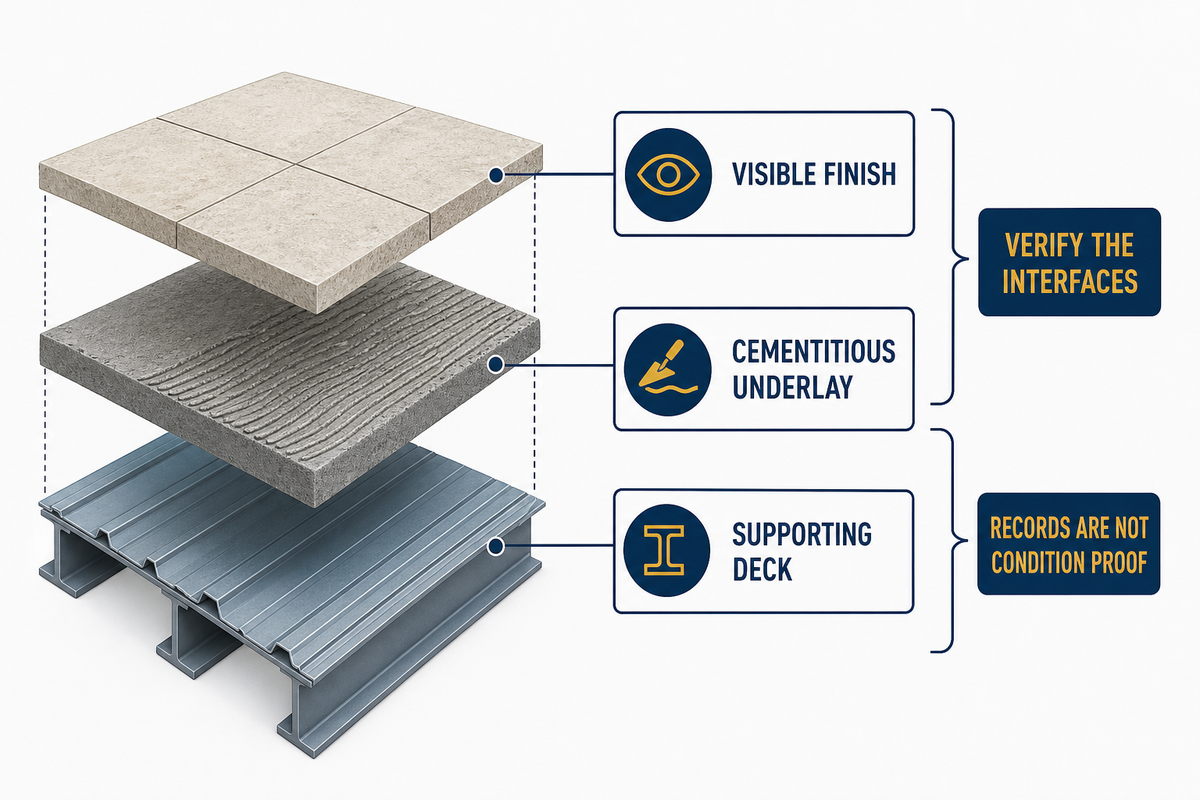
Before a marine flooring repair even considers a material recommendation, a description of the layer is needed. From what’s on record, determine the finish, its adhesive or bond coat, the underlay, and the supporting deck. Where uncertainty in the interface exists, don’t provide a speculative cause, but mark the interface as unknown.
“This document is applicable to deck coverings (underlay, cement type).”
The same ISO abstract excludes overlay floor coverings such as ceramic tiles, carpeting, and rubber sheeting. The US Coast Guard’s guidance attributes its primary deck covering definition to the IMO FTP Code: the first layer of floor construction includes the primary coat, anti-corrosive compound or adhesive needed at the deck plating.
| Record item | What to identify | What the record does not prove |
|---|---|---|
| Visible finish | Carpet, vinyl, tile, resin or another documented finish | Condition of the underlay beneath it |
| Adhesive | Product, application record and adjoining materials | Compatibility with a proposed substitute |
| Cementitious underlay | Mortar or screed designation and recorded thickness | Bond condition across the whole area |
| Primary coat | Primer or bond-coat identity | Remaining adhesion after water exposure |
| Corrosion protection | Existing coating specification on the steel | Absence of concealed corrosion |
| Waterproof layer | Membrane location, if shown in the build-up | Continuity around drains and penetrations |
| Acoustic arrangement | Cork, damping layers or floating floors, if specified | Retention of the original noise performance |
| Thermal insulation | Insulating layer and its approved arrangement | Suitability of a direct-bond repair |
| Supporting deck | Plate material, location and inspection records | Structural acceptance from a flooring photograph |
A commercial name isn’t a complete construction drawing. Compare the installed product with the ordinary deck covering product information; use the separate primary deck covering installation guide when planning a new installation.
Identify the space as well as the ship
For passenger vessels such as ferries and cruise ships, record whether the job concerns a cabin, corridor or another interior space. An offshore vessel, yacht or naval project also needs its own location and governing documents; this guide doesn’t extend an interior underlay repair scope to exposed teak decking or synthetic teak.
Planning example: a cabin finish lifts
A ferry cabin has a lifted edge in its decorative vinyl. The invoice identifies the finish but says nothing about the underlying mortar; the record therefore describes the visible lifting and leaves underlay identity and condition unresolved.
Floor delamination: record symptoms before choosing a cause
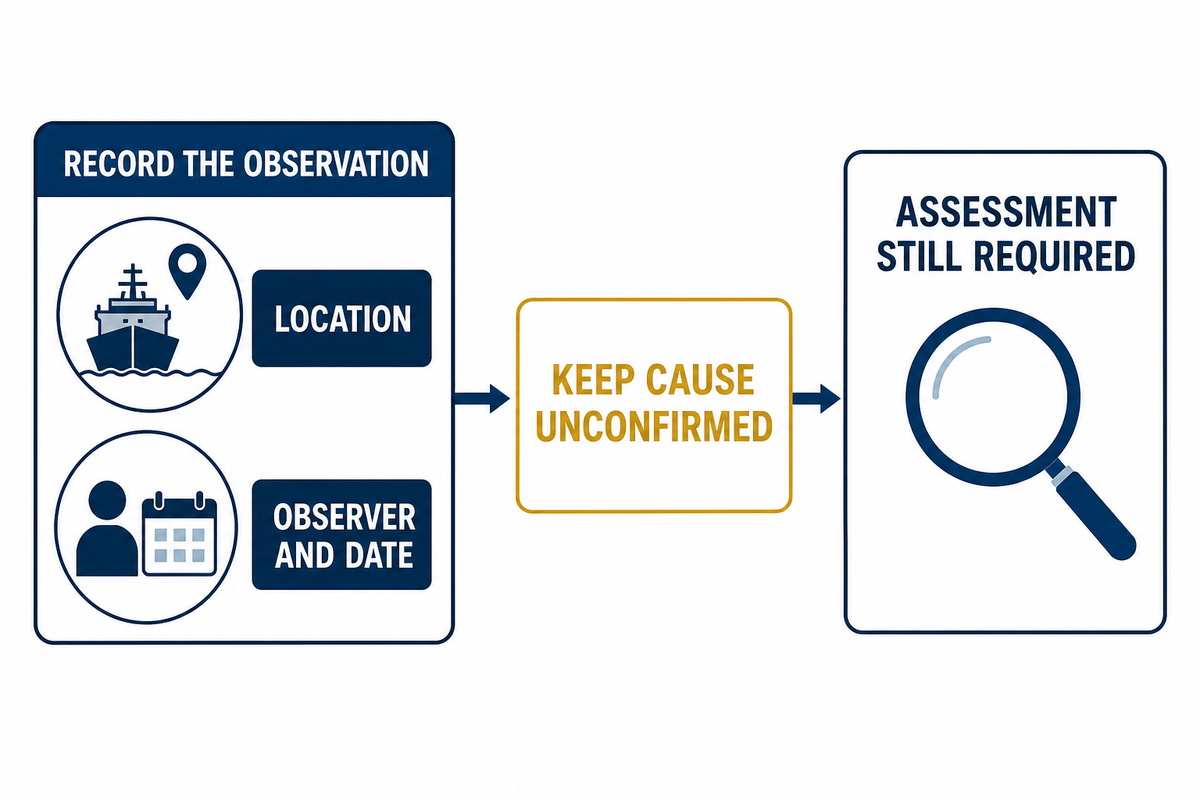
It’s important to separate what has been observed in the field from what a qualified assessment has determined when reporting floor delamination. Take a photograph of the observed condition and indicate the location and date of the report. Leave suspected causes of delamination in a separate field until the service history and the interfaces involved have been determined.
Do
- Describe cracks, lifting, staining or loose edges.
- Locate each observation against a fixed reference.
- Record who observed it and when.
Don’t
- Label every crack as an adhesive failure.
- Treat an intact finish as evidence of sound steel.
- Assume a previous patch resolved the underlying problem.
Photos are more useful with both location and detail. Keep the original images. Identify and describe any shown scale. Document a measured dimension in mm as opposed to a guess. Measured dimensions document observations, not limits of acceptance for a repair.
- Record a visible change in floor level against a fixed reference.
- Describe the specific deck location instead of labeling several compartments as one damaged area.
- Keep synthetic finishes and their bond lines distinct from the cement mortar underneath.
What does a hollow sound prove?
A change in reported sound should be noted with the location and the situation that led to the observation. This observation shouldn’t be interpreted as a failure of a particular bond line, or as an authorization for cutting, drilling, or removing the surface.
A useful scope distinction
NAVSEA Standard Item 009-026, FY-28 Change 1, clause 3.8, calls for inspection of exposed base coat or underlayment for certain resurfacing or partial-replacement work. That requirement belongs to its invoking Navy work item; it isn’t a universal diagnostic test.
When a contractor calls damage “minor,” ask which examined layer and agreed work scope that assessment covers. Using the word “minor” achieves no resolution for the concealed interfaces.
Floor water damage: capture the incident history
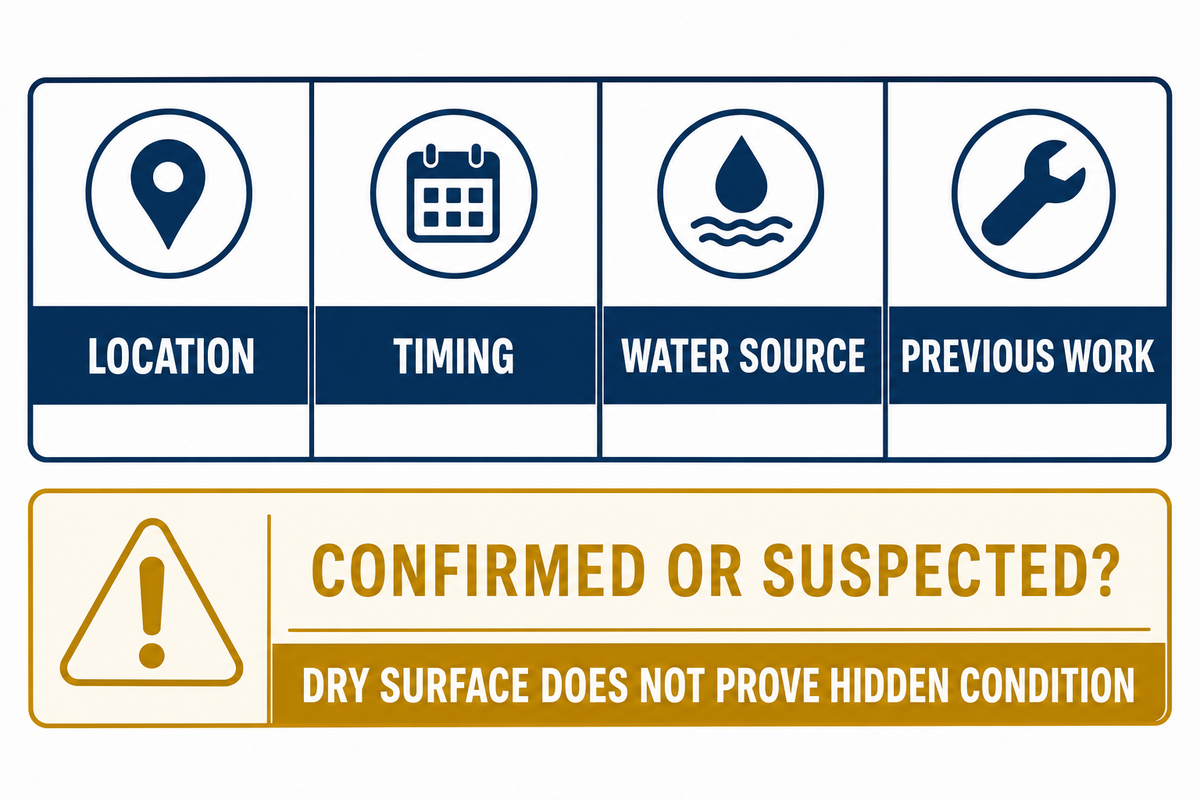
A floor water-damage report should connect the affected area to the known water event and installed floor layers. Indicate when the problem was first noticed, the suspected water entry point, observations of the water drainage path, and the record of previous repairs. Indicate confirmed facts and leave concealed moisture and corrosion as unanswered.
- Location: identify the specific deck, compartment and nearby drain, threshold or penetration.
- Timing: record discovery, reported recurrence and any known shutdown or cleaning event.
- Water source: distinguish a confirmed leak from a suspected route or an unknown origin.
- Previous work: preserve patch, resealing and replacement records, including products where known.
Photographs of a dry surface can’t provide evidence of the condition of an unexposed interface. Don’t allow a product’s setting time or another product’s drying period to determine the release condition of a repaired floor.
What reported repair cases can tell you
SynDeck’s published case studies describe water-related delamination in a Royal Fleet Auxiliary galley with cement screed, standing-water damage in resin underlayment on a US Navy support ship, and steel corrosion beneath rubber tiles on a Daring-class destroyer. These supplier accounts show why a repair inquiry should identify both the water history and the installed layers; they don’t establish failure rates or prove that changing from cement to resin will resolve the cause.
Planning example: recurring water at a galley doorway
An accommodation crew reports water at the same threshold after washing, followed by lifting near the adjoining finish. The handoff records the washing event, visible route and earlier resealing; it doesn’t decide whether the membrane, underlay or steel needs replacement before assessment.
US Coast Guard SFLC Standard Specification 6341 (2022) ties installation conditions and handling within its specific Coast Guard work to manufacturer instructions. Its procedures and material choices shouldn’t be used to address an unrelated passenger vessel repair.
Ask if the quote includes investigating the water route and restoring the visible floor. A finish only scope leaves that query unanswered.
Floor crack repair: define the assessment boundary
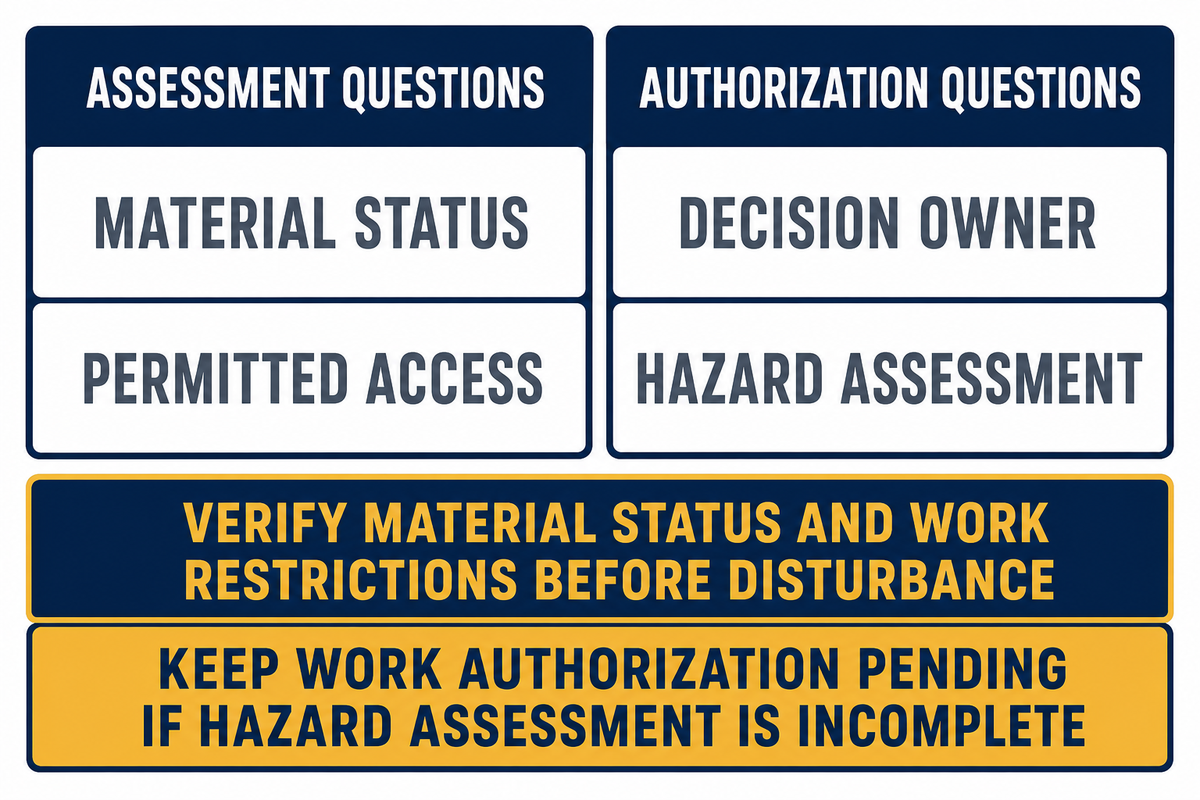
Designation of the agreed extent of the assessment for the repair of the floor crack should include the location, the layers to be investigated, permitted access, and the person with responsibility for the next decision. Establish the status of material and the restrictions which apply to work on the floor, before any one person disturbs the floor. A condition checklist shouldn’t be used as a substitute for the vessel’s work authorization or hazard assessment.
Check legacy materials before disturbance
For covered US shipyard work, 29 CFR 1915.1001(g)(8)(i)(I) presumes resilient flooring or deck material, including associated mastic and backing, in buildings or vessels constructed no later than 1980 contains asbestos unless an industrial hygienist determines otherwise using recognized analytical techniques. This is a specific US rule, not a universal age test; newer construction doesn’t establish that a material is asbestos-free.
Provide the qualified assessor with the available records (if any) pertaining to hazardous materials and advise them of the records which are missing. Don’t advise the crew to grind, sample, or remove a layer if it’s unknown.
| Question | Evidence to request | Decision still required |
|---|---|---|
| What is the existing material? | System records and the applicable hazardous-material assessment | Who may investigate an unresolved layer? |
| Which work method is proposed? | Method description and task-specific hazard assessment | Which controls and permissions apply? |
| What happens if the scope changes? | Named decision owner and variation procedure | Who authorizes additional disturbance? |
- Name the party authorized to assess the existing covering and any exposed steel.
- Define which areas may be accessed, and who may authorize further opening.
- Record work-method restrictions, occupancy and required protection of adjoining spaces.
- Assign responsibility for documenting unexpected conditions and approving a changed scope.
OSHA’s ship-repair surface-preparation guidance differentiates removing a given substance by mechanical, chemical, or solvent means, and in each of these, deems a personal protective equipment hazard assessment to be necessary. Selection of a product doesn’t suffice to resolve these concerns.
Planning example: a corridor must remain occupied
A passenger corridor has a crack near an earlier patch, but the crew needs an access route through the area. The inspection brief identifies the affected location, uncertain patch material and access constraint; the responsible team decides how the assessment can proceed before the repair contractor prices removal.
The supplier’s material quotation and the inspector’s access plan answer different questions. Keep the work authorization pending where the hazard assessment is incomplete, because a price for replacement mortar doesn’t resolve the risk from disturbing an unidentified layer.
Floor repair options: surface work, local repair or renewal?
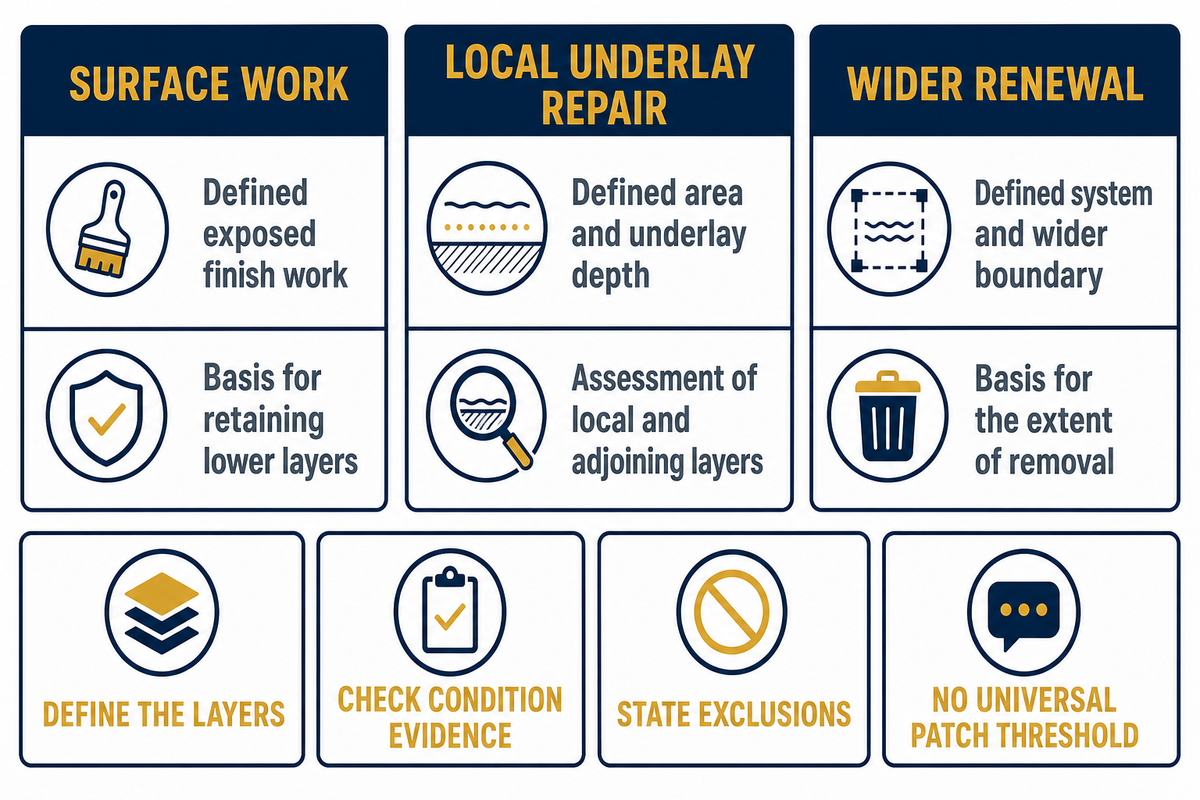
Surface work, local underlay repair and wider renewal describe different extents of work and shouldn’t be treated as a ranking of hazardous methods. Consider the layers, available evidence and unresolved conditions within the extent of work to be undertaken with the appointed repair team. Only then should a route be considered against the applicable system requirements and the assessed condition of the area.
| Comparison point | Surface work | Local underlay repair | Wider renewal |
|---|---|---|---|
| Proposed work | Defined exposed finish work | Defined area and underlay depth | Defined system and wider boundary |
| Condition evidence | Basis for retaining lower layers | Assessment of local and adjoining layers | Basis for the extent of removal |
| Water history | Explain whether water-related issues are resolved | Identify the relevant route and interfaces | Address the cause within the agreed scope |
| Steel work | State whether excluded | Define assessment and possible variations | Separate steel acceptance from floor reinstatement |
| Replacement materials | Identify finish and adhesive | Identify underlay and junction materials | Identify the complete proposed build-up |
| Boundary junctions | Describe finish transitions | Describe old-to-new interfaces | Describe edges, drains and penetrations |
| Approval evidence | Check the retained and changed arrangement | Check the repaired combination | Check the proposed whole system |
| Access and work controls | Agree protection and occupancy limits | Agree disturbance and removal controls | Agree the broader work area and interfaces |
| Release and exclusions | Define finish acceptance and exclusions | Define repair acceptance and unresolved risks | Define system acceptance and responsibilities |
NAVSEA’s cited Standard Item distinguishes complete-system removal from assessment for partial replacement. It offers a good example of why the instruction to ‘repair the floor’ needs a scope, whilst the requirements of a commercial marine deck covering remain those which apply to that vessel and that project.
Can ordinary deck covering be repaired locally?
Local repair may be an option if assessment defines a repair boundary and includes a suitable replacement. This guide provides no universal patch area percentage, bond value or remaining life prediction. An unknown interface is a reason to resolve the scope, not to insert an assumed acceptance value.
Ask about the retained material
A quotation for a durable replacement material should also explain the basis for retaining the adjoining covering. The new product’s advertised property doesn’t establish the condition of the old system.
Flooring adhesive and deck underlayment: check the whole repair system
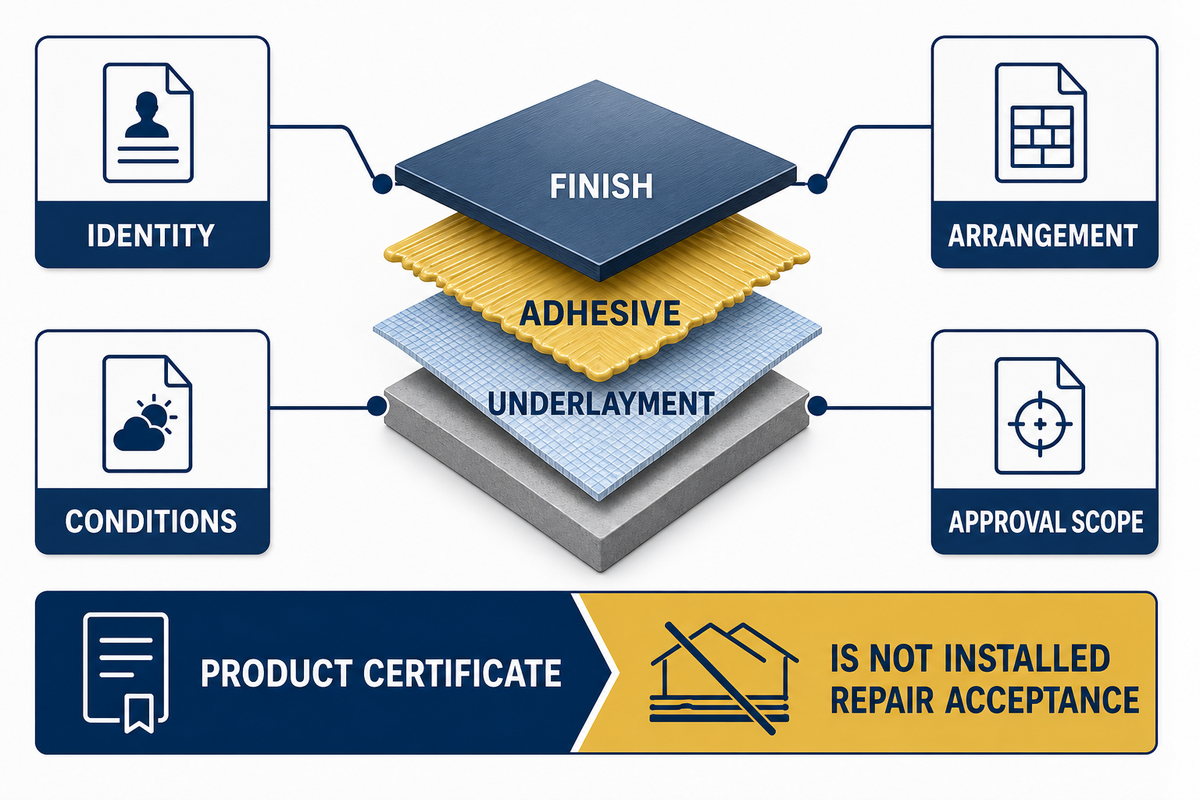
A repair system check should assess the proposed adhesive, underlayment, finish, and their interfaces with adjacent materials that are retained. Match the documents to the actual ship, space and build-up, and identify who confirms the technical suitability and approval applicability; an IMO label or isolated product certificate doesn’t respond to every system concern.
- Identity: match product names, variants and the intended interior or exterior application.
- Arrangement: compare primer, cement or polymer underlay, membrane, adhesive and finish with the documented build-up.
- Conditions: obtain applicable preparation, thickness, application and release requirements.
- Approval: check the relevant test evidence, installation details and certificate scope with the responsible parties.
As stated in USCG guidance for SOLAS floor finishes, adhesives are part of the fire test, with the manufacturer and application rate stated on the type approval certificate. An alteration to a vinyl, PVC or resin finish arrangement necessitates a scope check; the adhesive’s apparent compatibility shouldn’t be taken to certify the changed assembly.
Which primary deck covering documents need checking?
Where the specification cites the International Maritime Organization’s FTP Code, research the test reference and the arrangement detailed in the supporting documents. Keep a product’s certification and acceptance of the installed repair separate. Encourage the involved parties to resolve the difference between the documented and intended build-up.
“Tests with actual substrates and conditions have to be performed to ensure adhesion and material compatibility.”
That quote is a product-specific manufacturer instruction, and can’t replace the project specification. A one-component primer, lightweight composite underlay, or an epoxy system has a specific substrate and a specific application limit.
The newest document may not govern the work
For deck covering materials qualified to military performance specifications (MIL-PRF) under work invoking NAVSEA 009-026 FY-28 Change 1, clause 3.2.2 gives NAVSEA-reviewed F718 sheets priority over other manufacturer F718 sheets even if those are newer, subject to the Standard Item’s stated precedence. Record the governing version and decision owner instead of selecting a download by date alone.
The same care is required for systems developed for thermal or acoustic performance. Review marine acoustic floor systems and direct-bond underlay systems as separate entities. Distinguish marine epoxy floor finishes from the layers beneath them.
Repair quotations: use the 6-Field Deck Repair Handoff
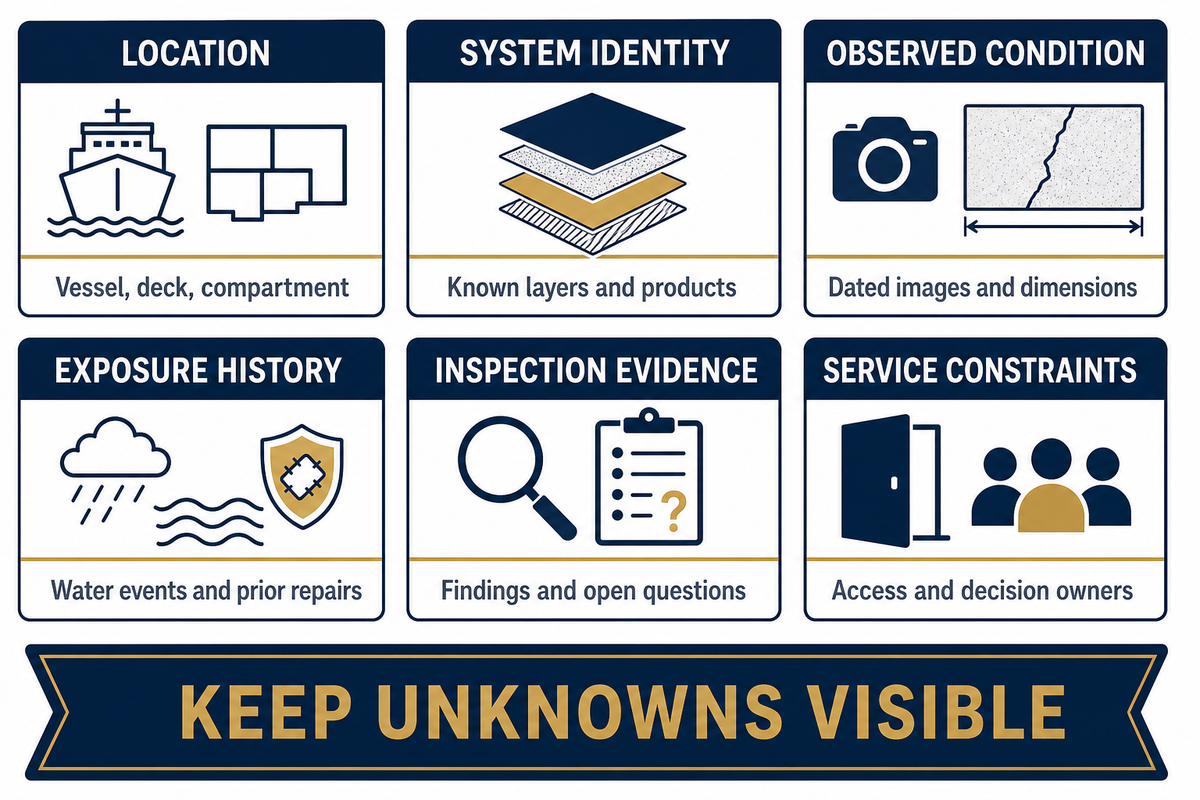
The 6-Field Deck Repair Handoff formats the info needed for a repair discussion as follows: location, system identity, observed condition, exposure history, inspection evidence, and service constraints. Send each supplier or contractor the same record, and keep unknowns visible to allow each to state the work to be done and the work to be excluded.
| Field | Information to supply | Why it matters | Record check |
|---|---|---|---|
| Location | Vessel, deck, compartment and marked area | Defines the place being discussed | Match the plan and photographs |
| System identity | Known layers, products and hazardous-material records | Exposes missing material information | Attach records; mark unavailable items |
| Observed condition | Dated descriptions, images and measured dimensions | Separates evidence from suspected causes | Identify observer and measurement basis |
| Exposure history | Known water events, cleaning and prior repairs | Gives the assessment its service context | Distinguish confirmed events from estimates |
| Inspection evidence | Authorized findings, limitations and open questions | Shows what has actually been assessed | Name the responsible assessor |
| Service constraints | Access, occupancy, permitted methods and decision owners | Defines practical and safety boundaries | Confirm with the responsible project personnel |
This is an editorial checklist, not a validated diagnostic tool or a complete work authorization. Add repair-specific requirements, particularly when the repair impacts an approved arrangement or requires controlled disturbance of existing materials.
Record the operating constraint
State whether the work is planned in dock or while the vessel remains in service, and identify any proposed access near navigation spaces. Keep the schedule’s available work window separate from the product’s setting and release conditions; the repair team must establish whether those constraints can be met.
- Ask whether removal, steel work and finish reinstatement are separate priced items.
- Require the basis for any allowance covering concealed conditions.
- Identify who can approve variations after an area is opened under the agreed controls.
- Separate access availability from product application, curing and final acceptance conditions.
An area rate can be used once the included work is fixed. Comparing two rates without their layer boundaries, exclusions, and inspection assumptions can conceal different scopes; a small rate reduction doesn’t indicate a reduction in the total repair cost.
- Ask each bidder to reduce ambiguity by marking retained and replaced layers on the same scope record.
- Ask what evidence supports any promised improvement in acoustic performance or stability of the repaired surface.
- Keep sustainability claims tied to a stated comparison and project evidence.
When contacting Yibo Marine, use the ordinary deck covering project inputs in conjunction with the condition record. The product discussion and site assessment remain separate tasks.
Marine deck covering maintenance: what is changing?
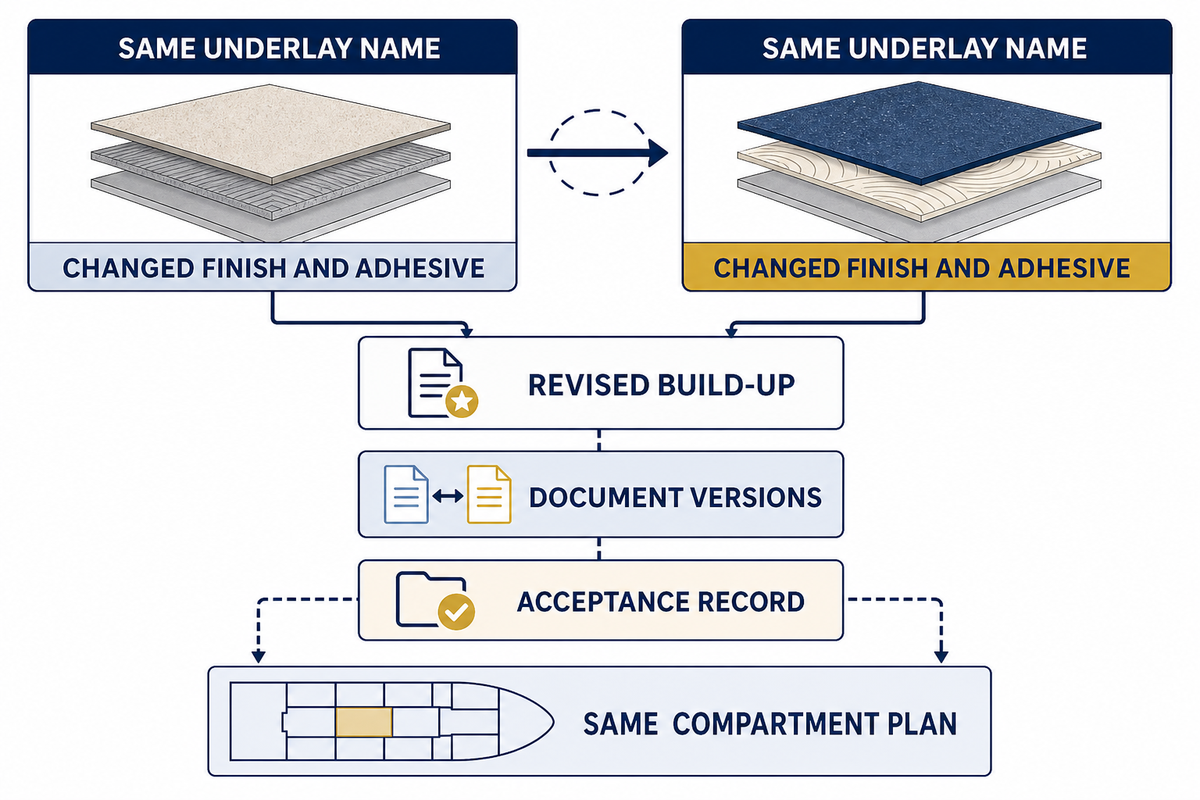
Marine deck covering needs a record of the changes to the actual vessel: materials, repair bounds, versions of documentation and service conditions. Update that record after the work is accepted, so the next assessment starts with the installed arrangement rather than an old product name or an unsubstantiated assumption.
- Keep the accepted repair scope and marked-up location plan.
- Retain product and approval documents with their recorded versions.
- Record unresolved observations and the person responsible for follow-up.
The ISO catalogue identifies ISO 5694:2023 as a cement-type underlay standard, while the cited NAVSEA item carries a 31 March 2026 issue date for its particular work framework. Neither of these dates definitively applies to the next repair, and broad flooring forecasts do not predict the condition of this covering.
Planning example: the product name stays, the finish changes
A vessel’s repair file retains the original underlay name but the accepted work includes a replacement finish and adhesive. Attach the revised build-up and its acceptance evidence to the location record, because a later contractor can’t reconstruct that change from the underlay name alone.
Ask the supplier to identify the revised product documents and keep the inspector’s acceptance record with the same compartment plan. If the finish or adhesive differs from the arrangement described in the approval certificate, record that mismatch for the responsible approval party; an unchanged underlay name doesn’t establish that the revised system is covered.
Frequently asked questions
Can ordinary deck covering be repaired locally?
Local repairs may be an option, but visible defect size isn’t the sole criterion for that selection. Determine the installed layers, document the observed condition, and obtain the assessment to provide the repair boundary; give the contractor the marked plan used by the assessor to locate that boundary. Request the responsible group to identify and document compatible replacement materials, approval restraints and acceptance criteria. Unresolved material hazards or concealed conditions must continue to be explicit in the defined scope.
How do you integrate with our existing flooring supplier?
Provide the same layer records, photos and assessment findings to the current supplier and the proposed repair contractor. Request that they identify responsibility for providing compatibility advice, specifying preparation requirements, reinstating the finish and documenting acceptance. Record disagreements prior to accepting the scope. This method of coordination doesn’t mean one supplier can approve another manufacturer’s product or that Yibo provides all of the site services.
Do you cover design floors as well, or only subfloors?
Request that the quotation state the scope explicitly, since the decorative floor and the underlying deck covering may be separate work packages. Determine what layers are included in removal, repair and reinstatement, and what interfaces other parties are required to accept. Request exclusions for finishes, adhesives and steel work where applicable. A statement of work that only says floor repair leaves these responsibilities unresolved.
Is an IMO label enough to approve a repaired floor?
No. Verify the proposed materials, arrangement and vessel space against the supporting documents with the responsible approval parties, checking the primer, underlay, adhesive and finish together and asking them to resolve differences between the proposed repair and the arrangement described in the approval documents.
What does a hollow sound prove?
A hollow sound documents an observation with a location and an assessment question, not a complete diagnosis or permission to disturb the covering; record the circumstances and ask the responsible assessor which layers and interfaces require investigation under the agreed work controls.
How much does marine deck covering repair cost?
An estimate without defined limits lacks the scope needed for a useful repair quotation. This definition should include removal depth, replacement layers, access, inspection, and finish reinstatement. After a defined scope is decided, area rates may be appropriate. However, this guide isn’t offering a universal price, as it lacks a comparable dataset on project costs; compare included layers, retained material, allowances for unexpected conditions and variation responsibilities against the marked area before treating quoted totals as prices for equivalent work.
Key takeaway
An ordinary deck covering repair inquiry should make the known condition, unknown interfaces and responsible decisions visible. Define the scope before comparing prices, and confirm material, safety and approval requirements before disturbing or replacing the installed system.
Yibo Marine’s ordinary deck covering is part of its marine flooring range. Send available build-up details and condition information to discuss the documented repair scope; provide a description of any missing records so that the next series of questions can be addressed.
Related reading
- Marine deck covering systems: product-family context.
- Marine flooring applications: distinguish the intended vessel space.
References & Sources
Sources were reviewed in September 2026. Contract specifications and US regulations below retain their stated scope; they don’t establish approval of a Yibo product or a particular repair.
- ISO 5694:2023, Ships and marine technology, Deck covering, public scope and catalogue information.
- US Coast Guard, Finish & Furnishing Materials, primary deck covering and SOLAS floor-finish guidance.
- NAVSEA Standard Item 009-026, FY-28 Change 1, dated 31 March 2026, document priority and inspection scope.
- US Coast Guard SFLC Standard Specification 6341 (2022), installation of interior deck covering systems.
- 29 CFR 1915.1001, Asbestos, scope and paragraph (g)(8)(i)(I).
- OSHA Shipyard Employment eTool, Surface Preparation, work-method hazard assessment.
- Sika Marine Primer C, Usage, attributed product-specific compatibility instruction.
Supplier case context: SynDeck, Case Studies. The reported observations are attributed to the supplier and aren’t independent failure statistics.




![Marine PU Floor: Selection & Installation [Guide]](https://yibomarine.com/wp-content/uploads/2026/09/marine-pu-floor-blog-featured-150x150.png)