Get in touch with Yibo Company

Marine Deck System
Ordinary Deck Covering Systems for Commercial Vessels
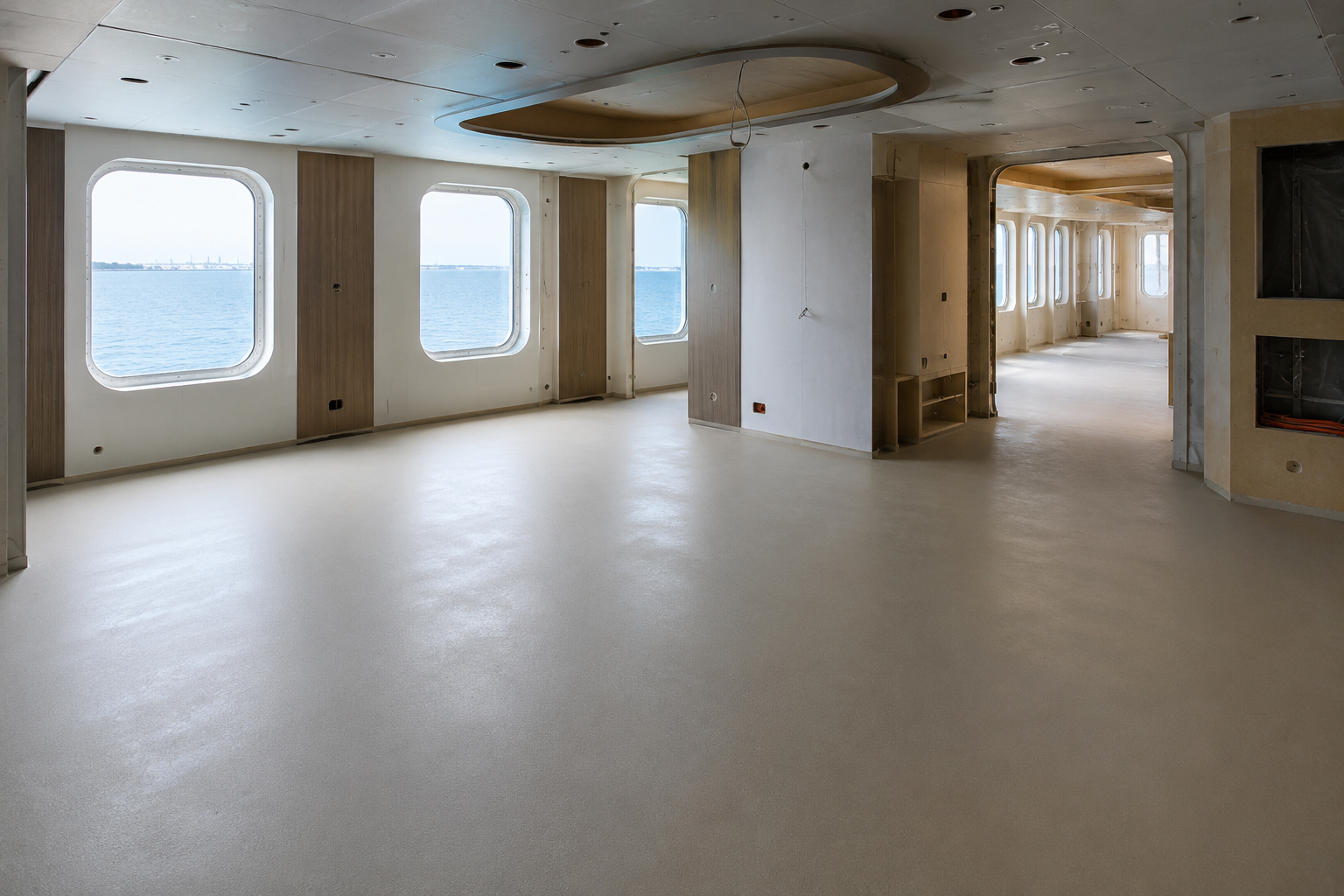
Yibo’s ordinary deck covering range gives shipyards and marine project teams a focused choice of primary, levelling, fire-related build-up, open-deck and damp-cabin products. To prepare a shortlist, we review the deck area, substrate, layer role, target thickness, final finish and document route.
This range is built for commercial vessel deck construction. It is separate from residential deck roofs, leisure-boat foam and decorative marine flooring.
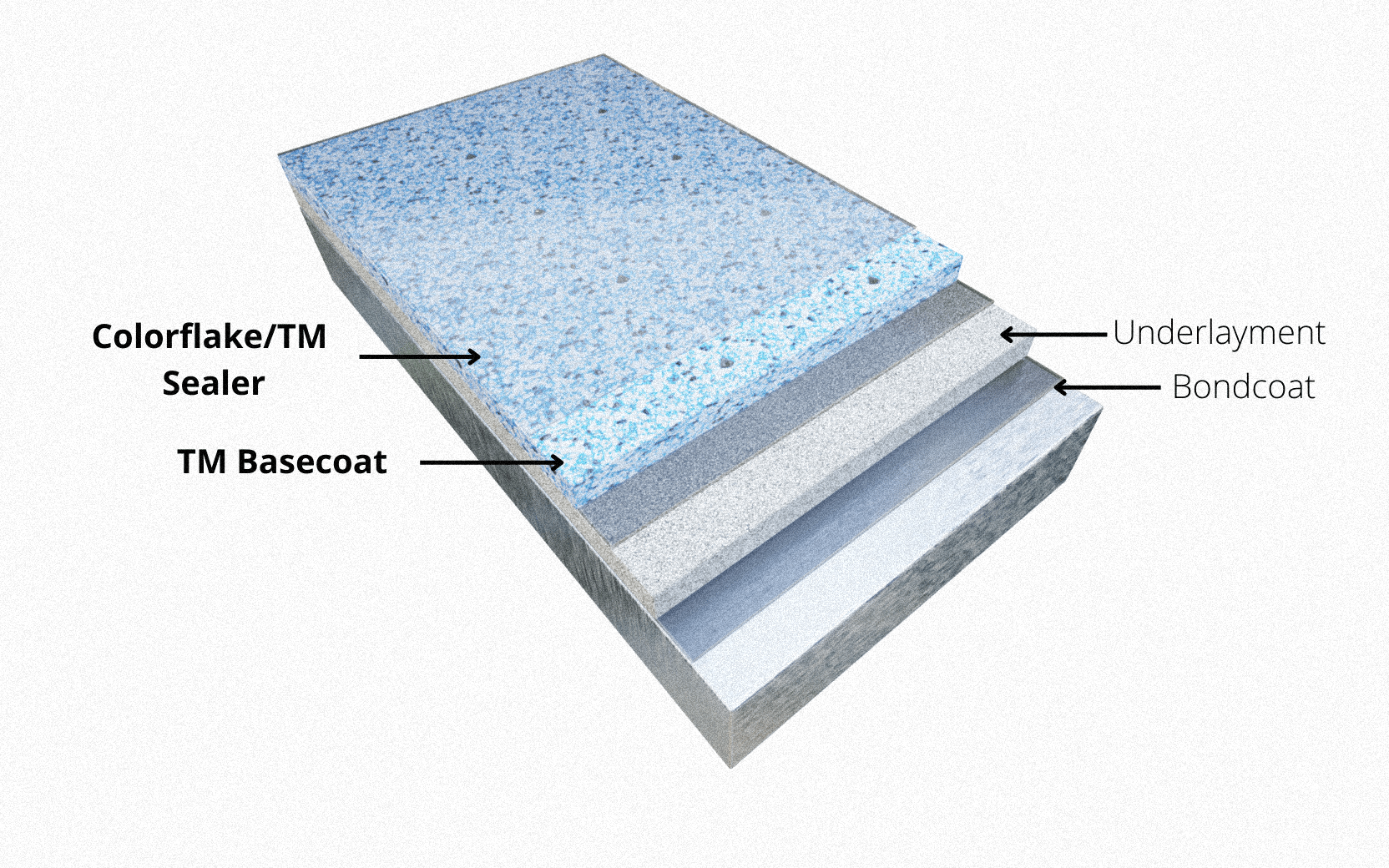
Eight listed products
A single matrix for model, layer role and key figures.
- YB-1 / YB-4Light and super-light primary deck covering options.
- YB-3Catalogue-designated input for a fireproof deck build-up review.
- YB-5A 2–3 mm levelling deck covering.
- YB-6Open-deck covering over steel-deck construction.
- YB-7Cement covering for bow compartments, sanitary spaces and other damp cabins.
- YB-8Strong adhesive for ceramic and tile interfaces.
- YB-9Seam-inserting agent for tile and ceramic decorative materials.
Ordinary Deck Covering Options for Commercial Vessel Areas
The range includes eight YB products, each with a stated layer or interface role. Selection starts with the deck area: an interior underlayment, an exposed open deck and a damp sanitary space face different service conditions.
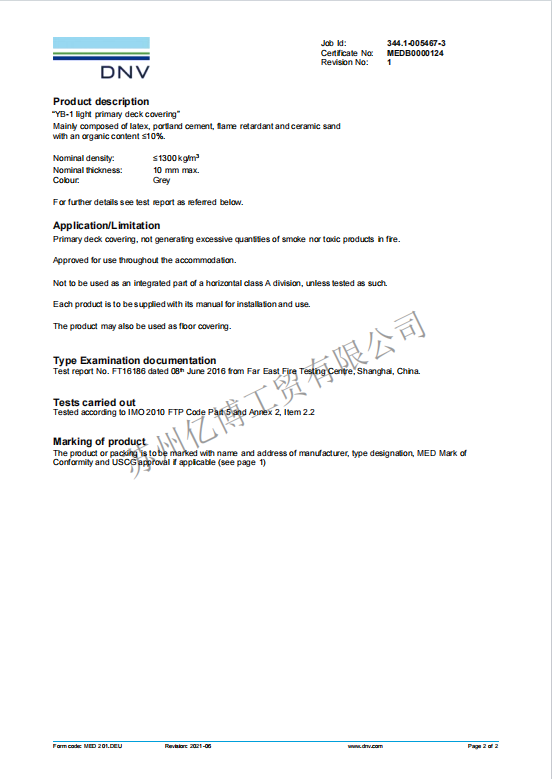
YB-1 Light Primary Deck Covering
- Catalogue-designated primary deck role
- Density: ≤1,300 kg/m³
- Breaking strength: ≥3 MPa
- Compressive strength: ≥8 MPa
- Organic content: ≤10%
YB-4 Super-light Primary Deck Covering
- Catalogue-designated lower-density primary deck role
- Density: ≤800 kg/m³
- Breaking strength: ≥3 MPa
- Compressive strength: ≥8 MPa
- Organic content: ≤10%
YB-3 Fireproof Deck Covering
- Catalogue diagram: 30 mm
- Density: ≤1,000 kg/m³
- Breaking strength: ≥3 MPa
- Compressive strength: ≥8 MPa
- Complete construction and current project documents must be aligned
YB-5 Levelling Deck Covering
- Listed layer: 2–3 mm
- Density: ≤1,800 kg/m³
- Breaking strength: ≥3.5 MPa
- Compressive strength: ≥10 MPa
- Organic content: ≤10%
Selection point
Thirty millimetres of deck covering can become a weight decision, not just a leveling detail. Compare density and thickness together, then check strength, vessel area and the governing document route separately.
Application-led options
- YB-6 for the open-deck role described in the catalogue
- YB-7 for bow compartments, sanitary spaces and other damp cabins
- YB-8 for bonding ceramic ground brick over deck covering
- YB-9 for joints in ground brick, tile and ceramic decorative material
Cement-Based Build-Ups
and Supporting Materials
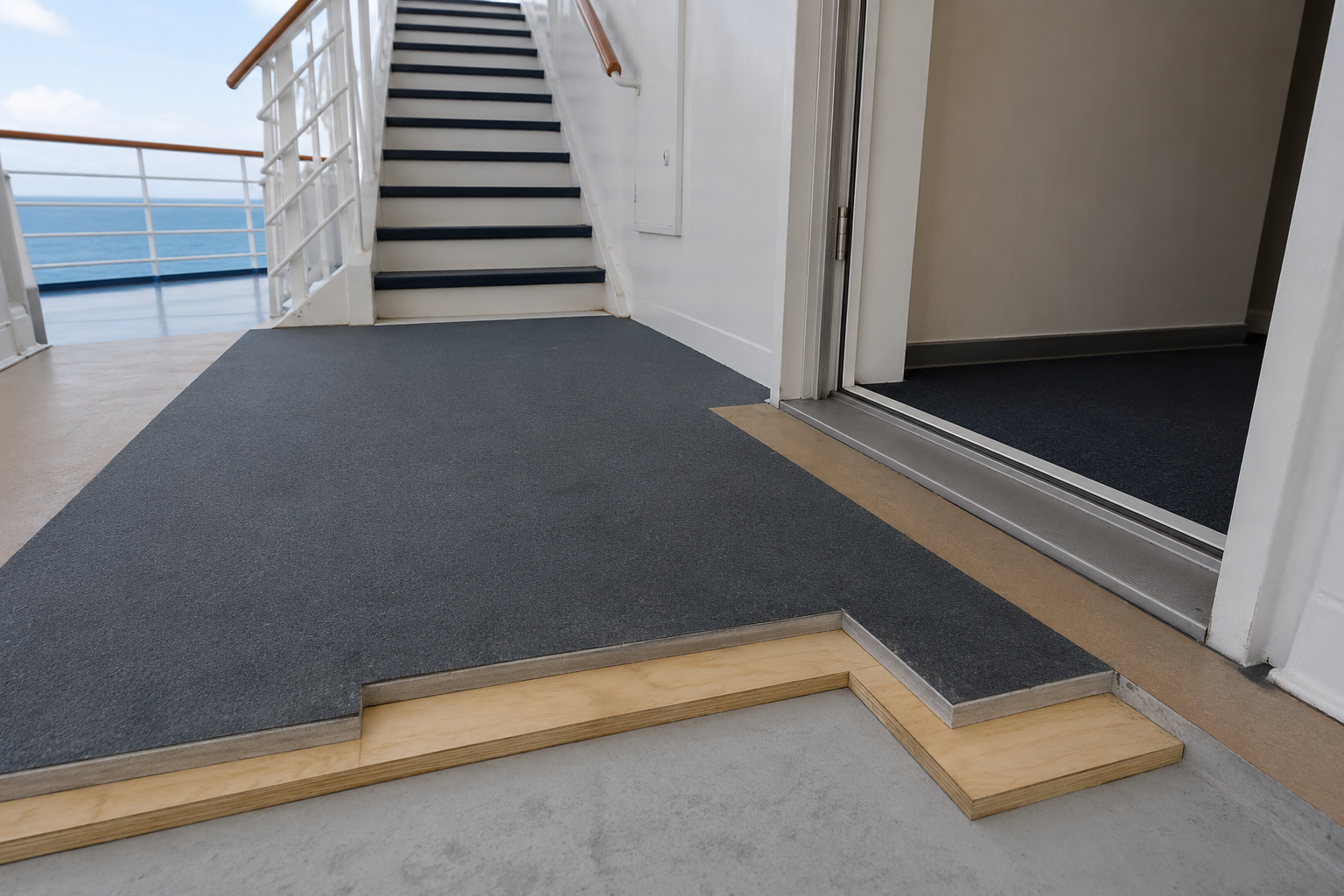
We review the load-bearing or levelling layer separately from the finish interface so every material is considered in its intended role. A primary deck covering can sit on prepared steel beneath vinyl, tile or another specified finish, while an exposed layer needs a separate review.
Build-up risk: A role mismatch can create a problem because the layer function, thickness and finish interface are linked. Yibo Marine Systems lists YB-5 at 2–3 mm; use that figure for this model, not as a universal levelling allowance.
SYS_DATA // COMPONENT SPECIFICATION
Primary covering pair
YB-1 and YB-4 share the same catalogue minima for breaking strength and compressive strength, while the listed density cap changes from 1,300 to 800 kg/m³.
Fireproof-build-up input
We place YB-3 into the shortlist when the project calls for a fire-related construction review. The model name does not replace the tested nominal thickness, components and construction or the product/configuration approval review.
Levelling material
We provide YB-5 as the thin 2–3 mm levelling option in this family. Surface correction beyond that listed role should be defined before model selection.
Open-deck material
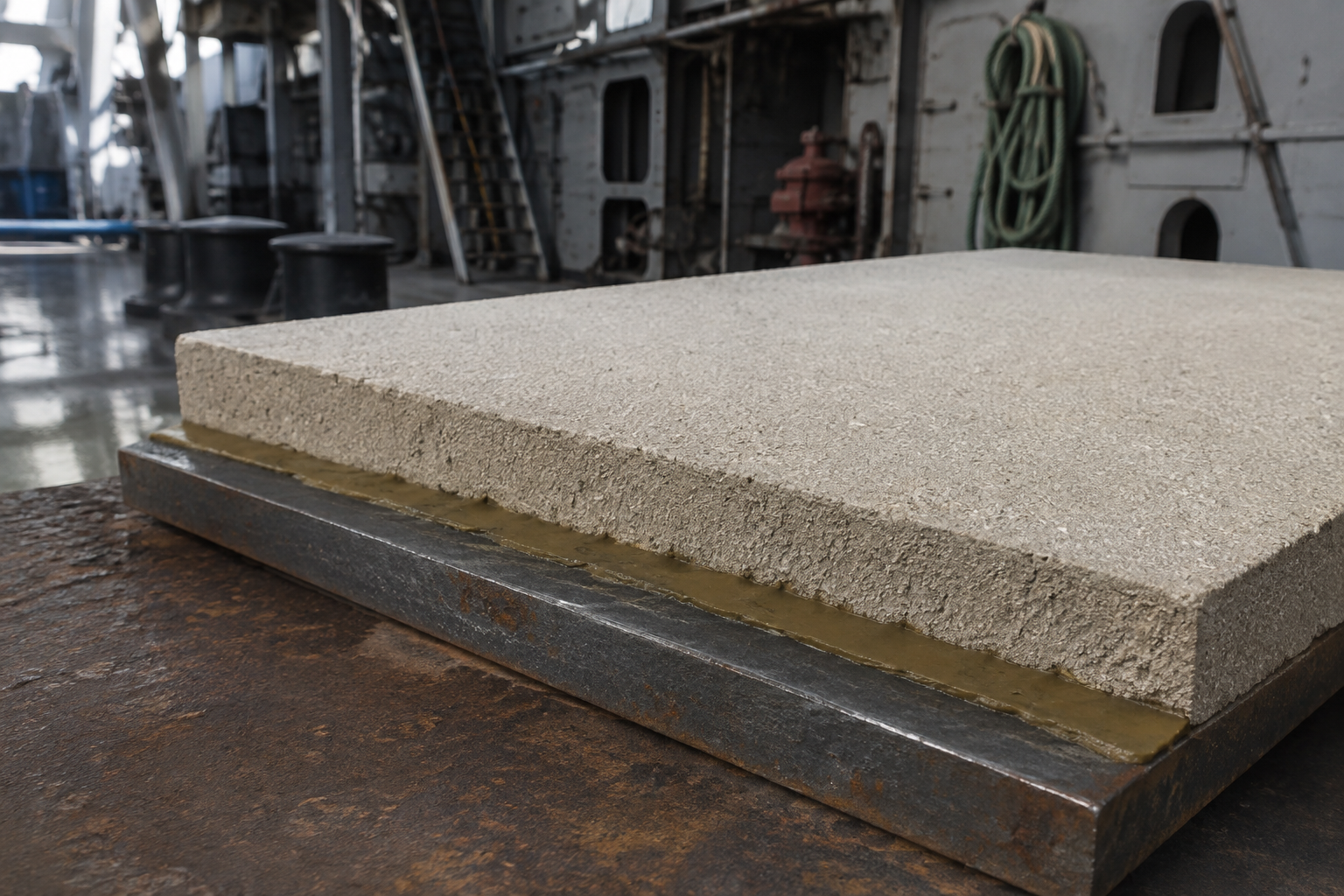
We provide YB-6 for the catalogue’s open-deck application over steel deck and cement saddle-shaped stiffener construction. The listed figures support comparison, while the actual substrate and exposure still belong in the review.
Damp-cabin material
We provide YB-7 for bow-compartment, sanitary-space and other damp-cabin applications stated in the catalogue. Its working-period figure is a handling input, not a project completion time.
Tile interface materials
We supply YB-8 as the adhesive and YB-9 as the seam-inserting agent for the specified tile or ceramic interface. These supporting products remain separate rows because bonding and joint filling answer different requirements.
System boundary: Marine deck flooring may describe the exposed surface, but the primary deck and levelling layers below it have their own functions. State the intended final floor when requesting a shortlist.
Deck Substrates, Vessel Areas and Finish Interfaces
Ship deck flooring installation starts with the substrate and service area, not a model code alone. Send the following site and document inputs so we can check the proposed layer role against the YB range.
Vessel and deck context
- Vessel type and project name
- Flag state and governing maritime administration
- Accommodation, corridor, sanitary, bow, open-deck or other specific deck area
- Interior or exterior exposure
Installed construction
- Steel, aluminium or existing substrate description
- Required primary, levelling, fire-related, open-deck or finish-interface role
- Target thickness, level difference or applied quantity
- Primer, anticorrosive compound, adhesive and adjacent layers
- Final finish such as tile, vinyl or another specified covering
- Drain, penetration, slope and edge conditions
Document route
- Current model-specific approval or fire-test documents requested by the project
- Product technical data and installation instructions
- Safety data sheet and site-control requirements
- Inspection, marking, batch or handover records
- Language and submission format
Site and programme inputs
- Work-area temperature and relative humidity
- Substrate cleanliness and preparation status
- Ventilation and access limits
- Available mixing, moving and application method
- Required inspection and handover sequence
Commercial Vessel Deck Covering Project Input Checklist: Use the interactive version to mark what is ready and identify the gaps before contacting suppliers.
Open the Project Input Checklist
Yibo Ordinary Deck Covering Technical Data
The catalogue lets engineers compare density, breaking strength and compressive strength without mixing different product roles. Every figure below is a stated maximum or minimum, so the inequality sign is part of the specification.
- YB-1
- YB-4
- YB-3
- YB-5
- YB-6
- YB-7
- YB-8
- YB-9
Light primary deck covering
MODEL: YB-1
Density
≤1,300 kg/m³
Breaking strength
≥3 MPa
Compressive strength
≥8 MPa
Other selection figure
Organic content ≤10%
Super-light primary deck covering
MODEL: YB-4
Density
≤800 kg/m³
Breaking strength
≥3 MPa
Compressive strength
≥8 MPa
Other selection figure
Organic content ≤10%
Fireproof-build-up review input
MODEL: YB-3
Density
≤1,000 kg/m³
Breaking strength
≥3 MPa
Compressive strength
≥8 MPa
Other selection figure
Catalogue diagram: 30 mm; organic content ≤10%
Levelling deck covering
MODEL: YB-5
Density
≤1,800 kg/m³
Breaking strength
≥3.5 MPa
Compressive strength
≥10 MPa
Other selection figure
2–3 mm; organic content ≤10%
Open-deck covering
MODEL: YB-6
Density
≤1,800 kg/m³
Breaking strength
≥5 MPa
Compressive strength
≥15 MPa
Other selection figure
Open-deck application stated in catalogue
Damp-cabin cement covering
MODEL: YB-7
Density
≤2,100 kg/m³
Breaking strength
≥5 MPa
Compressive strength
≥15 MPa
Other selection figure
Working period ≤45 min
Strong adhesive
MODEL: YB-8
Density
≤2,000 kg/m³
Breaking strength
≥6 MPa
Compressive strength
≥18 MPa
Other selection figure
Viscosity ≥8,500 Pa·s; adhesion ≥2.8 MPa
Seam-inserting agent
MODEL: YB-9
Density
≤1,900 kg/m³
Breaking strength
≥5 MPa
Compressive strength
≥10 MPa
Other selection figure
Working period ≤45 min
Quotation Scope and Project Timing Inputs
A quote is hard to compare when the vessel area, substrate, thickness, ambient conditions and document scope are not fixed. For a Yibo review, pricing depends on the model, quantity, deck condition, installed thickness, work area, finish, document package and delivery destination.
Factors that shape the quotation
Bronze performance view
Installed mass follows area × thickness × density. Lower density can reduce calculated material mass when area and thickness are unchanged.
$$ \text{mass (kg)} = \text{area (m}^2\text{)} \times \text{thickness (mm} \div 1,000\text{)} \times \text{density (kg/m}^3\text{)} $$
Project timing
- Confirm the selected model and quantity basis
- Close open substrate and construction questions
- Align requested technical documents
- Agree site conditions and delivery destination
- Record the resulting schedule in written quotation
Fire-Test and Project Documentation Inputs
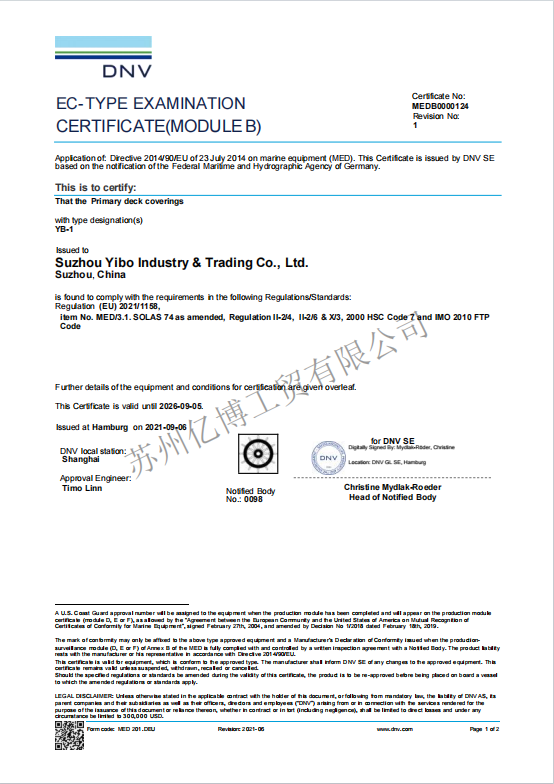
The 2010 Fire Test Procedures Code defines primary deck covering as the first floor-construction layer applied directly to deck plating, including any necessary primer, anticorrosive compound or adhesive. IMO Resolution A.687(17) also links the tested specimen to the nominal thickness, components and construction used in practice.
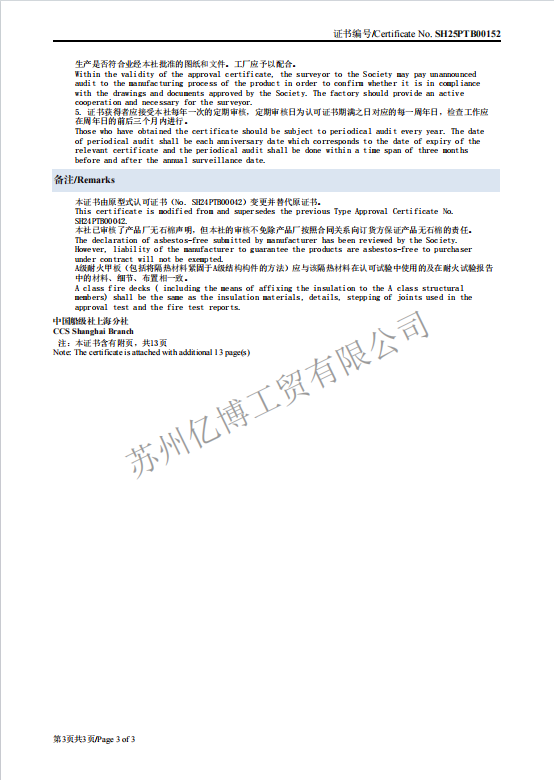
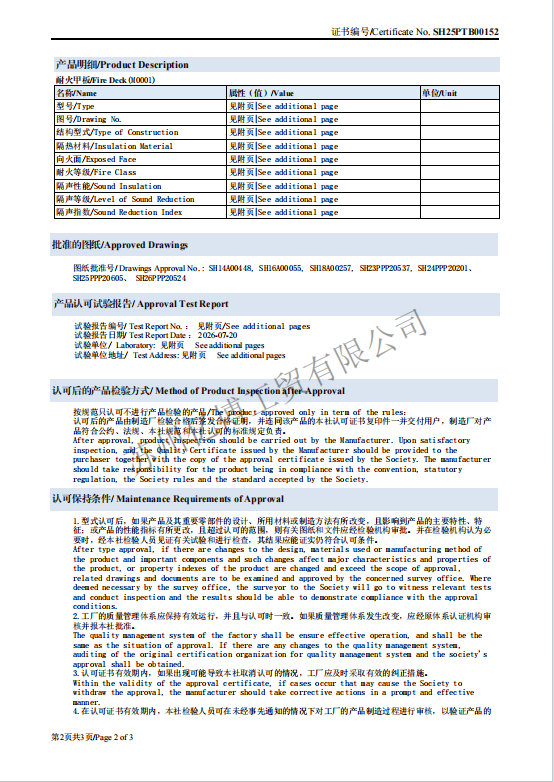
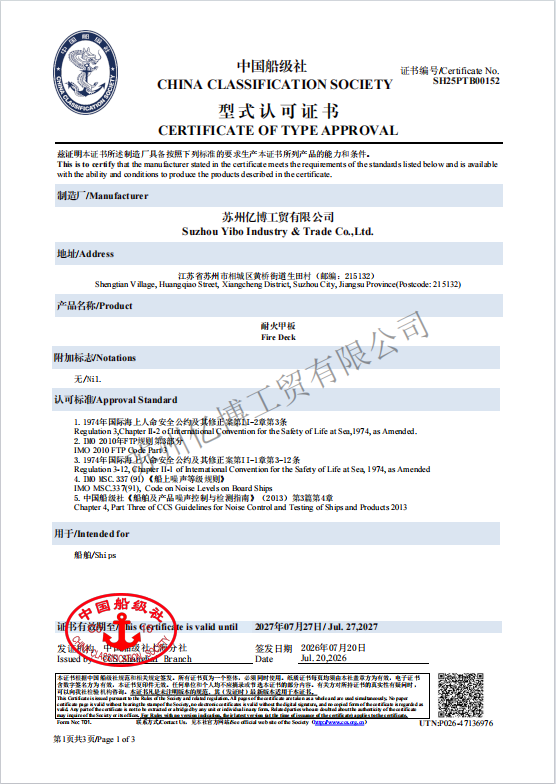
Project-document rule: Ask to see the approval certificate before treating a classification mark as proof. Match the model designation, substrate, complete layer schedule, thickness and stated limitations to the proposed work.
Scope before badge: A logo or general product-family name does not establish project fit. Check the product designation, layer construction, substrate, thickness, applied quantity, limitations and current governing-administration requirement line by line.
Document review sequence
Name the administration.
Record the vessel flag and the authority or recognized organization controlling the project requirement.
Identify the exact product.
Match the YB model and its intended role, without extending a family label to another product.
Define the construction.
List steel deck, primer, anticorrosive layer, adhesive, covering thickness and exposed floor finish.
Check current records.
Review the requested fire-test, approval, technical and safety documents for scope and limitations.
Align site controls.
Record surface preparation, temperature, relative humidity, ventilation, access and application instructions.
Close the handover set.
Agree marking, batch, inspection and installation records required at delivery.
From Deck Inputs to a Product Shortlist
We turn deck information into a reviewable shortlist instead of naming one universal best product. Each step closes a specific decision while leaving unconfirmed commercial terms for the written quotation.
Step 01
Submit the vessel area.
Identify the compartment, exposure and intended floor finish.
Step 02
Describe the substrate.
State deck material, current coating, condition, slope and level difference.
Step 03
Set the layer role.
Choose primary, levelling, fire-related, open-deck, damp-cabin or tile-interface review.
Step 04
Compare YB figures.
Read density, breaking strength, compressive strength and the additional model value together.
Step 05
Map the document route.
Name the administration, requested records and complete proposed construction.
Step 06
Define the quotation scope.
Confirm quantity, target thickness, work-site inputs and delivery destination.
Yibo Manufacturing Background
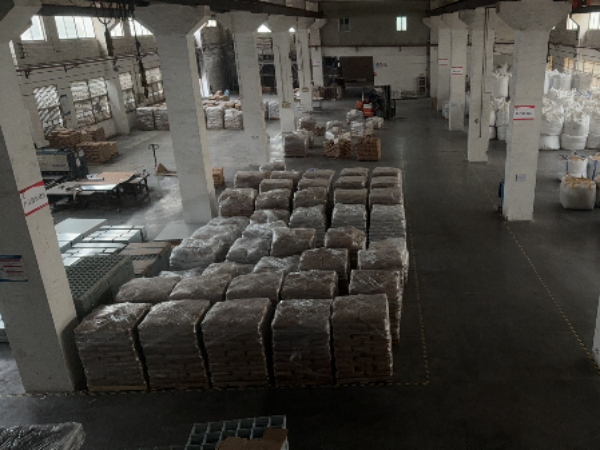
SYS_DATA // YIBO_FACILITY
Company context
Suzhou Yibo Industry & Trade Co., Ltd. was founded in September 2001. Yibo Marine Systems operates from a Suzhou factory site covering more than 6,000 m².
System Focus
Yibo Marine Systems focuses on marine flooring systems, including ordinary deck covering, self-levelling products, damping coatings, floating floors and finish-related products.
Catalogue Claims
This page confines model claims to the supplied YB catalogue data.
EVALUATION NOTE: Evidence that helps a buyer: model-specific figures, a clear installed-construction description and current project documents belong together. A factory photograph establishes identity and context; it does not replace those technical records.
Product Selection Boundaries
Ordinary deck covering is the wrong starting point when another floor system controls the project requirement. Routing that requirement early avoids forcing one catalogue family into a role it was not designed to fill.
Exposed decorative appearance is the main requirement
Why it may not be the full answer
The primary or levelling layer can sit below the visible floor.
Next review route
Define the finish first, then its interface with the YB layer.
Pumped self-levelling application is mandatory
Why it may not be the full answer
The supplied ordinary-deck data does not establish pumpability or the AC-J process.
Next review route
Review Yibo’s self-levelling family as a separate product scope.
High sound insulation or floating-floor performance leads the brief
Why it may not be the full answer
Acoustic isolation depends on a complete layered system.
Next review route
Route the enquiry to the high-sound-insulation floating-floor range.
An exposed exterior deck is specified
Why it may not be the full answer
Interior primary and fire-related roles should not be carried into open-deck exposure by name alone.
Next review route
Start with YB-6 and confirm the actual steel-deck construction and environment.
A damp sanitary or bow space is specified
Why it may not be the full answer
An open-deck model and a damp-cabin cement covering answer different area definitions.
Next review route
Start with YB-7 and submit drainage, substrate and finish details.
A fire division rating is the controlling requirement
Why it may not be the full answer
A named product alone does not establish the complete horizontal construction.
Next review route
Submit the full layer schedule and current project document requirements.
Search-language check
Primary deck covering suppliers address a different procurement need than leisure-boat foam vendors. Use “commercial vessel,” “cement-based,” “steel deck” and the exact layer role in the enquiry.
Selection check
The common assumption that lower density is always the best choice is wrong because it ignores strength, build-up and document scope. Lower density is not always the right call, and a family label cannot correct the wrong material choice. A model code is not a substitute for project inputs; use them to resolve the trade-off and decide which option enters the shortlist.
Ordinary Deck Covering FAQ
Review common specifications, application rules, and interface requirements for the YB product family.
It is Yibo’s commercial-vessel family spanning light primary covering, a fireproof-build-up input, levelling material, open-deck and damp-cabin products, plus tile-interface materials. The exact model role is shown in the matrix rather than inferred from the family name.
Not necessarily. A primary or levelling layer may sit on deck plating and below tile, vinyl or another exposed finish, so the final surface should be named in the enquiry.
The 2010 Fire Test Procedures Code places the primary covering directly on deck plating and includes necessary primer, anticorrosive compound or adhesive. Layers above it are treated as floor coverings in that framework.
Both list breaking strength ≥3 MPa, compressive strength ≥8 MPa and organic content ≤10%. The catalogue density cap is ≤1,300 kg/m³ for YB-1 and ≤800 kg/m³ for YB-4.
Use YB-3 as a shortlist input when the project specifies that role and the catalogue’s 30 mm diagram is relevant to the proposed construction. Then match the complete layer schedule and current documents to the governing administration before stating project fit.
YB-5 is the listed 2–3 mm levelling deck covering in this family. Its catalogue data includes density ≤1,800 kg/m³, breaking strength ≥3.5 MPa and compressive strength ≥10 MPa.
YB-6 is the catalogue’s open-deck covering, with density ≤1,800 kg/m³, breaking strength ≥5 MPa and compressive strength ≥15 MPa. Submit the exposure, substrate and steel-deck construction for review.
YB-7 is described for bow compartments, sanitary spaces and other damp cabins. Its listed figures include density ≤2,100 kg/m³, compressive strength ≥15 MPa and a working period ≤45 minutes.
A certificate or test record can limit the product designation, substrate, layer construction, thickness, application quantity, colour or use. The match must therefore be made against the current project configuration, not a logo or family-level claim.
Send vessel type, deck area, service exposure, substrate condition, layer role, target thickness, final finish, proposed adjacent layers, required documents and delivery destination. Add site temperature, humidity, access and timing constraints when they are known.
![Marine PU Floor: Selection & Installation [Guide]](https://yibomarine.com/wp-content/uploads/2026/09/marine-pu-floor-blog-featured-150x150.png)