Get in touch with Yibo Company


Offshore Platforms: A Practical Flooring and Inspection Guide

Updated September 2026
This educational companion document is intended for the respective owners, engineering teams, shipyards, contractors, inspectors, and buyers with a technical focus.
Offshore platforms are fixed, floating, or mobile marine structures used for oil and gas exploration, offshore drilling, production operations, and related facilities, and they don’t share one flooring environment. Start a usable brief with regulatory status and operating mode, then describe the physical platform context, work area, floor-system family, interfaces, and evidence relevant to the exact installed build-up.
Quick answerChoose no material from the platform label alone. Define the facility, zone, substrate, exposure, drainage, traffic, interfaces, installation window, inspection plan, and governing documents before comparing systems.
Quick Specs for the Decision Brief
- First classification: regulatory status, operating mode, and physical support arrangement
- Unit of selection: one defined zone and one defined floor-system family
- Minimum evidence set: governing basis, product or assembly scope, installation instructions, inspection records, operating acceptance
- Primary stop condition: an unresolved drain, penetration, threshold, support, opening, or adjoining-trade detail before concealment
- Commercial handoff: the completed zone brief, not a request for a generic “heavy-duty offshore floor”
3 axesPlatform, zone, and layer
2 pathsBonded build-up or mechanical grating
1 ruleEvidence follows the exact assembly
Identify Status and Operating Mode Before Platform Type
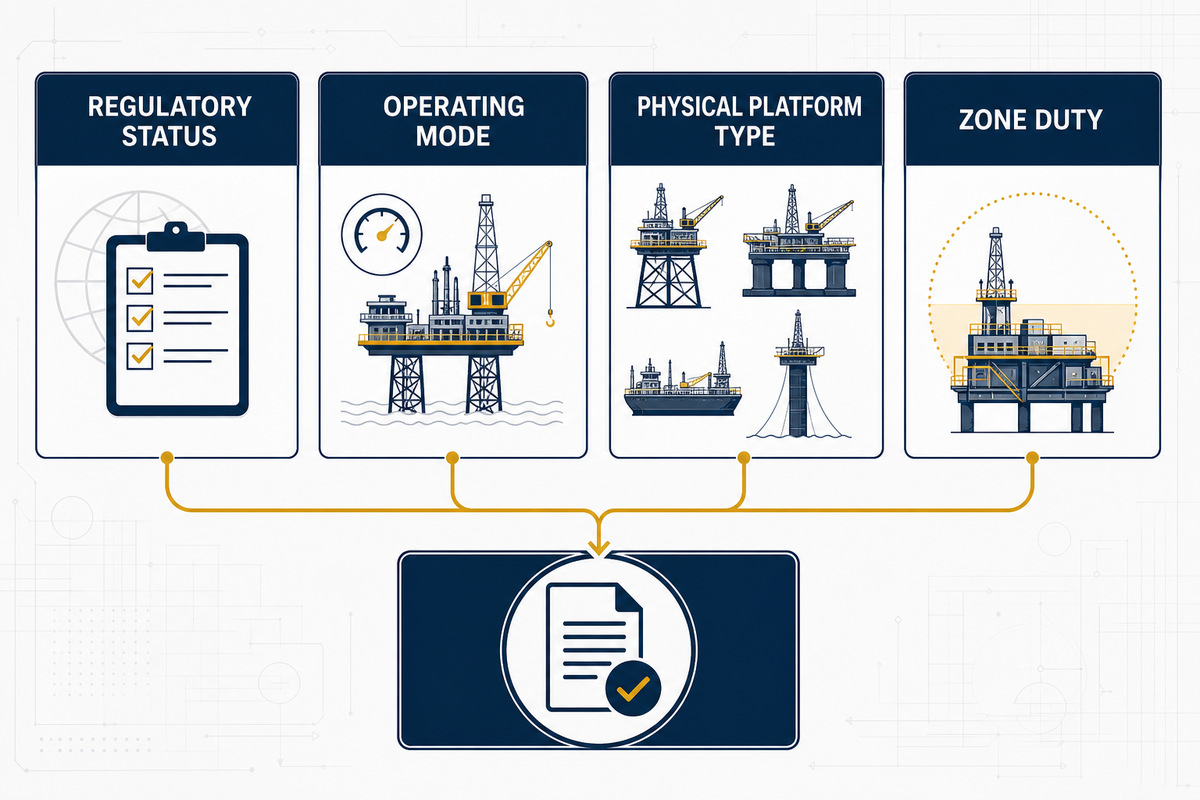
Flooring briefs should separate regulatory status, operating mode, and physical platform type because each can change the governing documents, deck movement, work access, inspection route, and safe treatment of temporary openings. Physical form alone can’t provide a legal or technical basis.
“The employer must ensure that each walking-working surface can support the maximum intended load for that surface.”
A fixed jacket, gravity-based structure, jack-up, semi-submersible, tension-leg platform, spar, drillship, or floating production unit provides limited information. It doesn’t describe whether the relevant area is an open walkway, process deck, accommodation, escape way, or a mechanically fastened grating system.
The Coast Guard’s Outer Continental Shelf guidance provides a constructive warning. Regulatory treatment can differ for units that appear to be similar. Therefore, a team must determine the status of each facility under the relevant jurisdiction, rather than infer it. Drilling rigs can also sit within wider production facilities whose spaces have different owners and duties.
Terminology boundary
Search language often groups oil platforms, an offshore oil platform, oil rigs, and offshore drilling rigs under one label. A technical brief instead distinguishes a fixed offshore platform or jacket platform from a drilling platform, barge-supported unit, spar platforms, and other platform structures. Searches for the types of offshore oil platforms can therefore mix several types of structures. Those structures may serve shallow water or deep water, with support at the ocean floor, tethered to the seabed, or moored to the seabed; the depth of the water does not by itself select a floor system.
Function changes the terminology again. Oil and gas exploration may involve offshore oil drilling, while offshore drilling and production can combine with oil production in oil and gas production facilities or broader drilling and production facilities. Their production operations may process oil, produce oil, handle separation on the platform, and prepare streams for transporting oil from the platform to onshore facilities or oil tankers. Flooring duties still come from the exact zone within those oil and gas facilities and drilling and production operations.
Regional phrases such as gas platforms in the Gulf, production in the Gulf, and federal waters require a named jurisdiction. Likewise, the increased use of subsea facilities or innovation in the offshore petroleum sector may change access and maintenance patterns without creating a universal flooring rule. Oil spills and accidents on the platform are hazard contexts, not material-selection shortcuts. A named asset such as the Troll A platform is an example, not a generic platform category.
Scope benchmark: Coast Guard guidance uses 1,500-3,000 ft as one U.S. compliant-tower example, while the cited deck-covering approval route calls for at least 1 production inspection/year and a 5-year certificate period. These figures define source scope, not flooring service intervals.
Offshore oil and gas production makes the distinction concrete. One facility may combine drilling and production, receive streams from subsea wells, process crude oil and natural gas, and separate its gas production before export; another may only support one step. The Gulf of Mexico examples help explain the terms, but they don’t establish a worldwide rule or determine how teams decommission the asset.
| Platform type / context | Status or mode to confirm | Flooring question | Evidence to request | Limitations / Not suitable for |
|---|---|---|---|---|
| Fixed jacket | Manned or unmanned; producing or shut down | Zone exposure and deck condition | Facility basis and zone schedule | The word “fixed” does not define interior finish or open-deck duty |
| Compliant tower | Movement assumptions and access state | Interface movement and maintenance access | Structural and project movement criteria | Water depth does not select a floor material |
| Gravity-based facility | Jurisdiction and occupancy | Substrate, drainage, and compartment use | Drawings and room data sheets | Concrete support form does not prove a concrete wearing surface |
| Jack-up | Jacked, towing, or manoeuvring | Grating retention and changed access | Mode-specific inspection plan | A static operating check is not enough for a move |
| Semi-submersible | Moored, towing, or relocating | Motion, access, and grating condition | Current operating-mode controls | Design type alone does not set acceptance limits |
| Tension-leg platform | Facility status and structural movement basis | Flexible interfaces and zone use | Project specifications | Do not transfer fixed-jacket details without review |
| Spar | Floating-facility or vessel basis | Movement, interfaces, and compartment duty | Jurisdiction, class, and operator basis | “Floating platform” is not a complete compliance category |
| Ship-shaped unit | Vessel, floating facility, or other status | Hull movement and approved assembly scope | Flag, class, statutory, and project documents | A marine approval does not cover every altered build-up |
| Bridged complex | Status of each connected platform | Bridge, transition, and ownership boundaries | Platform-by-platform basis | One complex name may hide several regulatory objects |
Evidence capsule: Coast Guard guidance places compliant towers in a U.S. example at water depths from 1,500 to 3,000 ft, yet that range describes a structural application, not a flooring threshold. Buyers should use platform taxonomy to ask better questions, never to bypass zone and assembly evidence.
Procurement objection: If a supplier asks for only “fixed” or “floating,” the brief is still incomplete. Add the status, current mode, zone, substrate, exposure, and document hierarchy before requesting a system comparison.
Use the Platform, Zone, Layer Compass
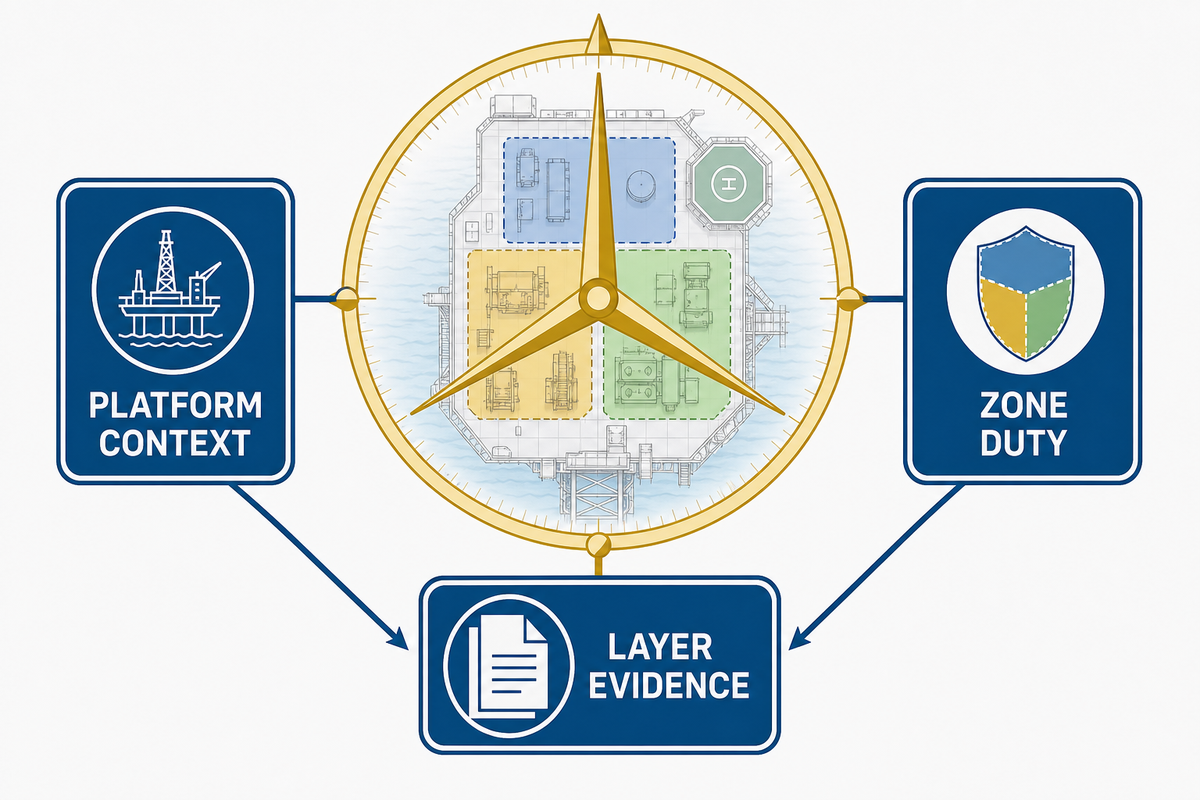
The Platform, Zone, Layer Compass converts a broad facility label into a zone-level decision. Its three axes are platform context, the exact work zone, and the duty of each floor layer or mechanical component. The output is a verification brief, not a product ranking.
The 3-Axis Platform, Zone, Layer Matrix
The 3-Axis Matrix connects one facility, one work zone, and one layer duty with the evidence that must be verified.
The marine flooring application map helps teams separate spaces before discussing construction. For each zone, describe if people walk over structural plate, bonded resin, resilient finish, panels, or open grating. Floors can also incorporate leveling, isolation, load distribution, fire-related, acoustic, hygiene, or containment functions.
1 · Platform context
Confirm status, support arrangement, occupancy, and operating mode.
2 · Zone duty
Map exposure, traffic, drainage, egress, hygiene, and work access.
3 · Layer evidence
Match each layer and interface to a named document and inspection point.
Synthetic scenario 1, for method illustration only: Assume that a 120 m² renovation includes a weather walkway, a 35 m² wet-service room, and a 20 m² control-room approach. Calling all 120 m² “offshore platform flooring” would conceal three exposure sets. The walkway brief describes drainage and contaminated-wet traction; the wet room adds hygiene and perimeter details; the control approach asks about cleanability, cable penetrations, and access restrictions. The Compass doesn’t select a product. It generates three zone sheets and a list of unresolved interfaces for the owner, designer, installer, and inspector.
Planning capsule: In that assumed 120 m² example, separating the area into 3 duty zones avoids one generic material line concealing different drainage and access requirements. Area and zone counts are illustrative inputs, not performance requirements or evidence of a completed Yibo project.
Procurement objection: Splitting a small scope may seem longer. It’s usually quicker because the buyer can reject an unsuitable layer or interface without unpacking the entire platform package.
Translate Offshore Hazards Into Floor Duties
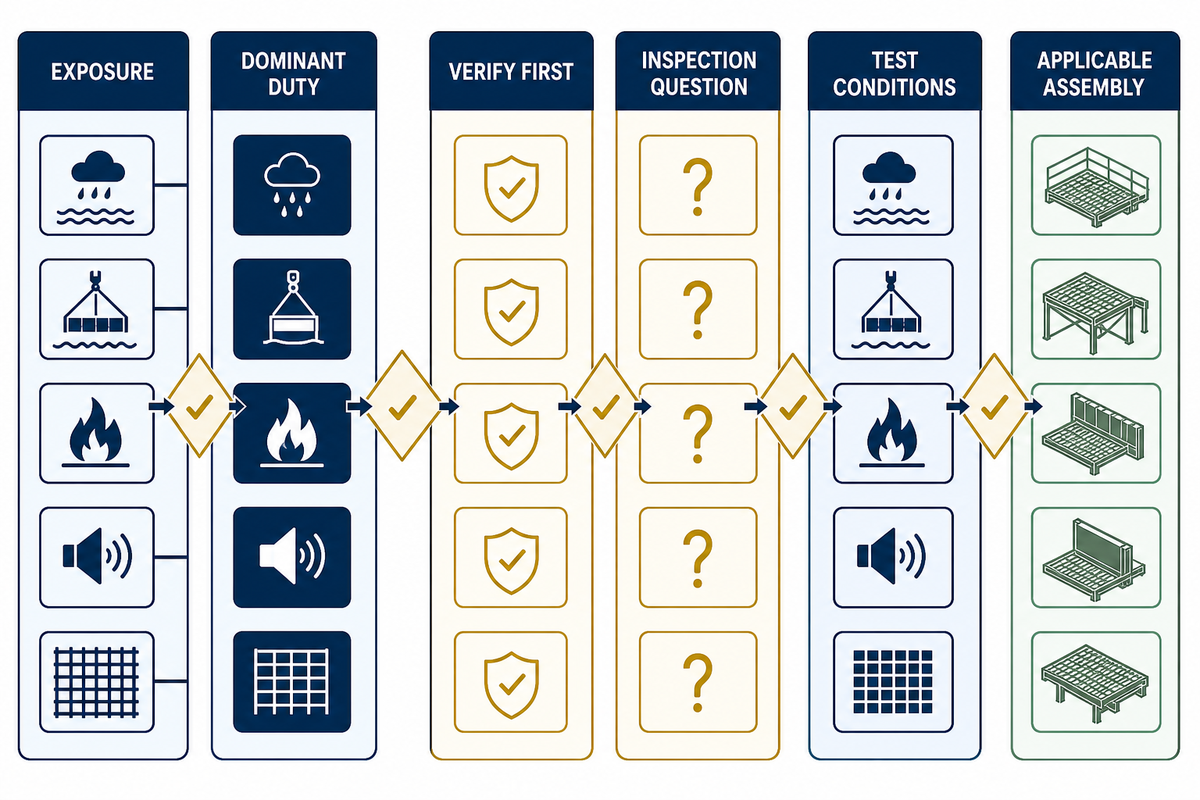
Criteria for flooring become useful only when each hazard is articulated as a duty, a test, or an inspection question. Slip resistance, exposure to chemicals, fire performance, acoustic isolation, cleanability, retention of grating, and prevention of falls are all different outcomes. “Heavy duty” isn’t a good description.
The OSHA rule on walking-working surfaces directly addresses cleaning, drainage, inspection, and maintenance. UK HSE guidance adds that slip risk depends on the interaction among contamination, footwear, the surface, cleaning, and test conditions. Neither source supplies a universal offshore friction number.
| Zone or workfront | Dominant duty | Verify first | Inspection question | Limitations / Not suitable for |
|---|---|---|---|---|
| Exposed weather walkway | Drainage and contaminated-wet footing | Falls, outlets, cleaning, footwear | Where can water or residue remain? | A dry laboratory value alone is not an installed-condition answer |
| Drilling or process area | Chemical, heat, impact, and traffic exposure | Actual substances, temperature, loads | Which exposure reaches which layer? | “Oil resistant” does not cover unnamed fluids or temperatures |
| Open grating and access deck | Support, fastening, retention, opening control | Panel, support, clip, fastener, mode | Can a panel lift, shift, or leave a gap? | Bonded-coating inspection logic is insufficient |
| Accommodation | Leveling, hygiene, comfort, noise | Compartment and assembly duties | Does the tested build-up match? | An acoustic layer does not prove wet-service suitability |
| Galley or wet service | Drainage, hygiene, cleaning, edge continuity | Drains, upstands, thresholds, chemicals | Where does the finish terminate? | Texture alone cannot compensate for poor drainage or cleaning |
| Control or electrical room | Cleanability and equipment interfaces | Cable routes, bases, access, project criteria | Will later work cut the finished system? | Do not infer electrical properties from a resin family name |
| Escape or muster route | Continuous safe access | Route status, lighting, openings, temporary controls | Does the work remove or narrow access? | A normal room closure plan may be unacceptable |
| Helideck | Separate aviation criteria | Applicable aviation authority and current document | Who accepts the landing-area surface? | Ordinary walkway criteria do not settle helideck acceptance |
| Temporary repair workfront | Isolation, opening control, cure, and reopening | Permit, barrier, access, and acceptance owner | What must be true before traffic returns? | A finished appearance is not reopening evidence |
Helidecks deserve their own handoff. The UK Civil Aviation Authority lists CAP 437 version 9.1 as the current criteria route for offshore helicopter landing areas used by UK-registered helicopters; this guide doesn’t restate aviation surface limits or imply worldwide applicability.
Procurement objection: It’s easier to compare one “heavy-duty” datasheet, but it can conceal whether the evidence addresses wet traction, fire, acoustics, or mechanical retention. One claim, one method, one condition, and one applicable assembly at a time should be requested.
Understand What Each Floor Layer Is Supposed to Do
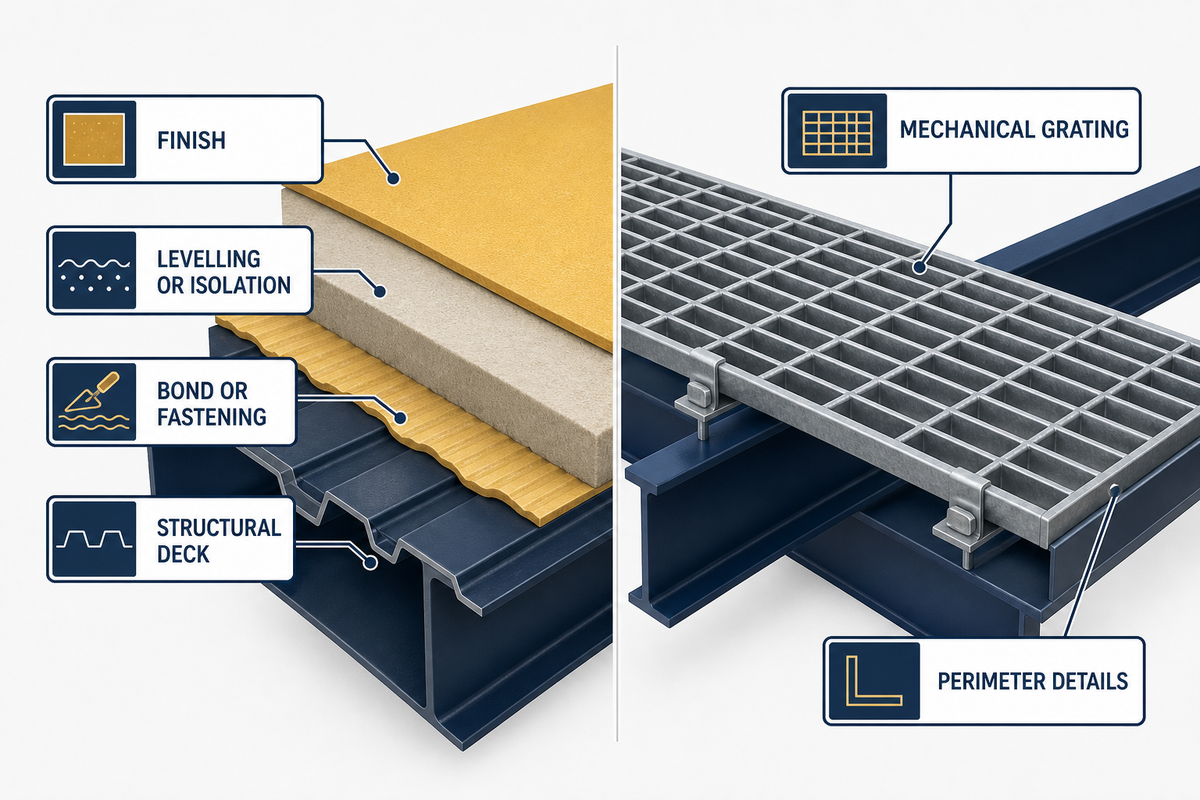
An offshore floor should be taken as an integration of various responsibilities: substrate, preparation, bond or fastening, leveling, isolation, load distribution, finish, texture, and perimeter details. Changing one layer can change the evidence boundary even when the exposed color and product family remain unchanged.
The distinction made by the U.S. Coast Guard between a primary deck covering that’s applied to deck plating, and a floor covering located above the primary deck covering is significant. Fire-related approval of a defined primary covering doesn’t automatically validate a finish, adhesive, substrate, thickness, or mixed assembly outside the certificate and test record.
Deck-covering system families, resin floor build-up information, and marine acoustic floor systems can be used in future discussions of the product. The engineering brief must state what each layer is expected to do, and what document supports that layer’s duty.
Mechanically fastened grating takes another approach. HSE’s offshore alert reports sections that became dislodged where fasteners were absent or positioned contrary to manufacturer guidance or good practice. Inspect panels, supports, clips, fastener location, retention, and any opening created during removal. Don’t consider grating to be a coated plate with holes.
Evidence capsule: According to 46 CFR 164.106, the U.S. type-approval path cited requires, at a minimum, annual production inspections, and an accepted certificate is issued for a 5-year period. These time intervals are associated with that approval and are neither offshore floor inspection nor replacement intervals.
When NOT to buy from a floor-system label
Don’t buy from words such as “marine,” “epoxy,” “polyurethane,” “acoustic,” “non-slip,” or “heavy duty” when the offer omits the exact build-up and use condition. Resin chemistry alone doesn’t state substrate preparation, total construction, reinforcement, perimeter treatment, contamination regime, cure window, or test specimen. An approval number, unaccompanied by a current certificate and associated designation, doesn’t address this.
Put a hold on the purchase when the walking surface is actually grating, when a helideck authority hasn’t accepted the basis, or when the proposed finish alters an approved primary deck-covering assembly. This is also applicable when drains, thresholds, equipment bases, penetrations, or later fixings haven’t been defined. The correct next step is a zone and evidence review, not a wider marketing label.
Procurement objection: An entire assembly schedule may seem excessive for a small repair, but edges and interfaces fail in small areas. At minimum, the assembly schedule should name each retained layer, new layer, termination, fastener, and acceptance record.
Coordinate Interfaces Before Each Irreversible Step
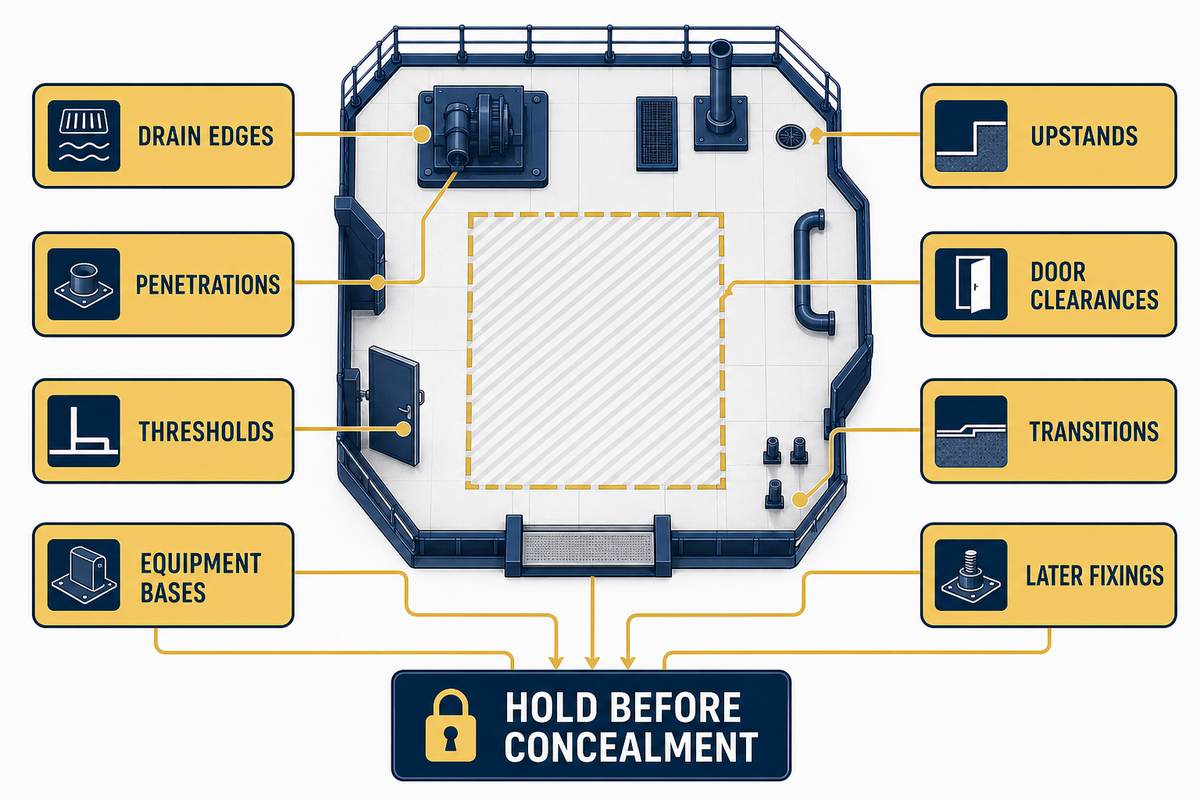
Interface control means resolving or formally holding drain edges, penetrations, thresholds, equipment bases, upstands, door clearances, transitions, and later fixings before the next irreversible step hides them. An approved change can move a decision, but silence can’t.
Current U.S. Navy shipboard deck-covering work provides a narrow example and doesn’t establish a precedent for all offshore facilities. It ties drain-flow checks, exposed penetrations, membrane continuity, and positive drainage to controlled work documents and inspection steps. Separate U.S. guide specifications also link floor drains and slopes to plumbing and installation drawings and equipment-base decisions.
Synthetic scenario 2, for method illustration only: Consider a 240 m² service-deck package with 6 drains, 4 equipment bases, 2 door thresholds, and 8 pipe penetrations. The flooring crew is given a plan showing the finish, but not the final drain-ring elevations. Using a hold point before leveling allows the plumbing lead, deck supervisor and installer to verify each interface. If one drain is changed after release, an authorized field change records the new fall and edge detail before the covering is completed. Without that decision, a smooth looking floor could conceal a drainage defect spanning the entire workfront.
Planning capsule: Assuming a 240 m² workfront, there are 20 named interfaces, and smaller perimeter details will be addressed later. Capturing the owner and release status of each interface helps structure a productive coordination meeting; in this case, the numbers are only examples.
A construction-trade discussion about a floor drain covered across plumbing, concrete, and supervision handoffs illustrates the role of the human factor. This construction example doesn’t prove an offshore criterion. It does show the reason that work packages must be named, include a pre-work check, an agreed upon method to protect the package, and allow the owners the right to stop the work if neighboring work isn’t correct.
Procurement objection: It can look like field flexibility. Flexibility belongs within a controlled hold-point and change-management system; uncontrolled field improvisation prevents the supply chain from confirming the finished interface.
Install and Inspect in Hold-Point Order
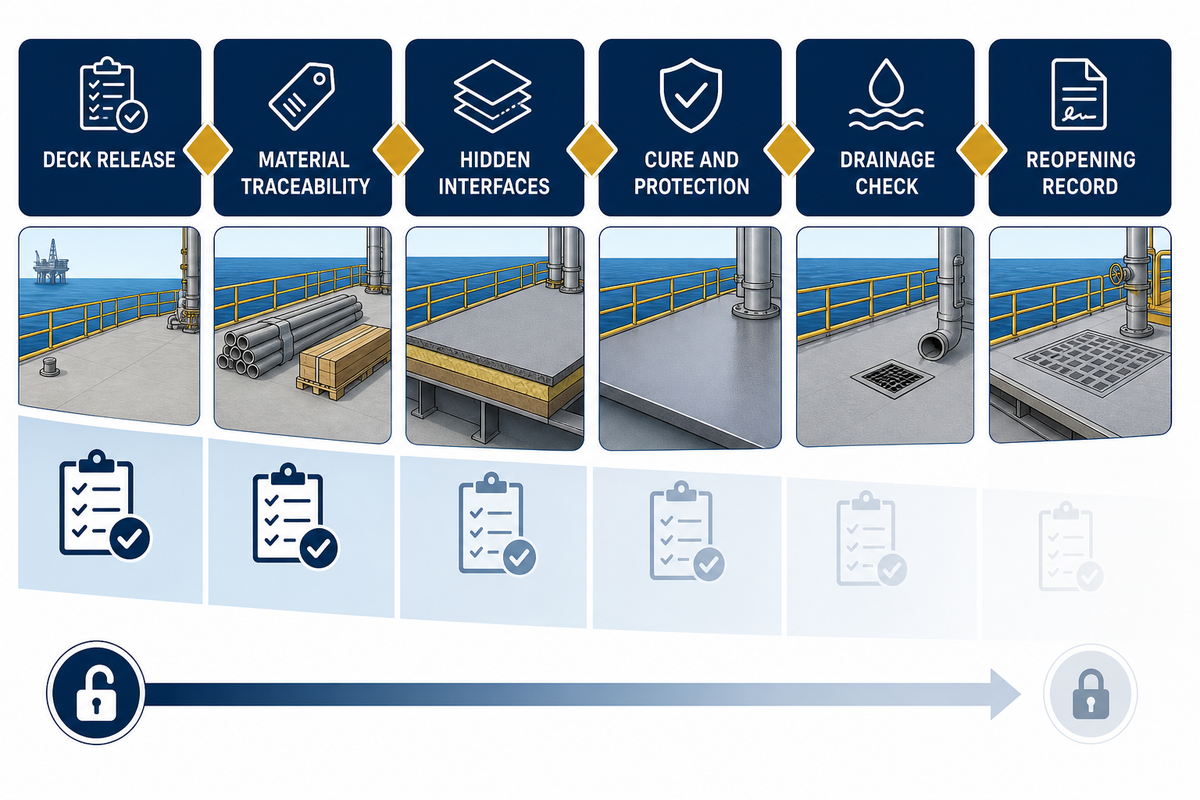
The control order should be based on the sequence in which evidence becomes inaccessible. This order is deck release, surface condition, repairs, environmental limit, batch and mixing records, application quantity/thickness, interfaces, cure, drainage, protection, and reopening. The limits currently stated in the documentation of the selected system will define the actual limits.
- Release the substrate. Document repairs, welds, contamination, existing layers, penetrations, and the specified surface condition.
- Verify the work environment. Measure only the temperature, moisture, humidity, ventilation, or other parameters that are included in the approved installation instructions.
- Trace the material. Link designation, batch or lot, mixing, quantity, and shelf or storage checks to the work area.
- Accept hidden interfaces before concealment. Check drains, boundaries, penetrations, transition, and continuity before concealment.
- Maintain access controls during cure. Protect the system from traffic, washdown, weather, and later trades until the stated acceptance condition is met.
- Reopen with a record. Confirm drainage and visible condition, close hold points, and retain deviations and repairs.
| Illustrative record | Area | Air | Substrate | Relative humidity | Access window |
|---|---|---|---|---|---|
| A | 120 m² | 24 °C | 19 °C | 68% | 18 hr |
| B | 85 m² | 27 °C | 22 °C | 72% | 24 hr |
| C | 60 m² | 21 °C | 18 °C | 64% | 12 hr |
| D | 40 m² | 25 °C | 20 °C | 70% | 16 hr |
The value of each field in a measurement/control record depends on the stated limits and hold points. If the selected system and site-plan limits are documented, each record field has a defined purpose. A field is useful only if the instrument, location, time, and acceptance basis all are documented.
Use a parallel mechanical checklist for grating panels and access control. This includes the correct support of panels, fasteners of the specified type, and edge retention. It also includes safe control of any temporary opening. HSE also advises reassessing access and escape arrangements when rig moves, towing, jacking, manoeuvring, weather, or sea state changes the risk.
Work-window capsule: An assumed 18-hour access window should be divided into preparation, installation, curing or setting, inspection, and reopening blocks before mobilization. The 18-hour duration is an example, and field plans and product documentation will need to provide the actual information.
Procurement objection: A signed completion sheet won’t resolve the situation if it fails to include hidden-stage records. Ask which hold points create evidence before the surface, fastener, or interface becomes inaccessible.
Read the Offshore Floor Defect Fingerprint Before Repair
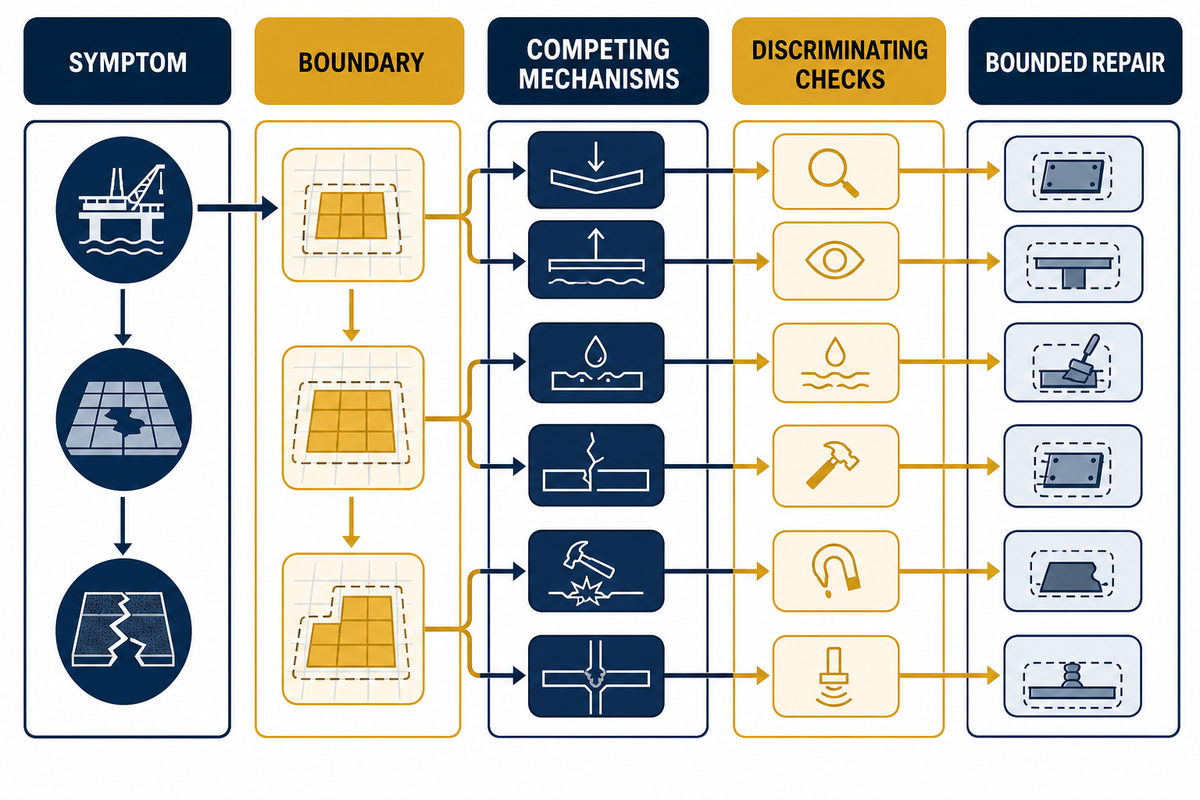
The Offshore Floor Defect Fingerprint is an investigation protocol: record the symptom and boundary, control immediate workplace hazards, perform checks that separate possible mechanisms, review the exposure and installation history, then define a bounded repair. A visible defect doesn’t indicate a sole cause.
Industrial epoxy-floor research by Garcia and de Brito keeps anomalies, possible causes, inspection parameters, diagnostic methods, and repair techniques as separate but related records. That method is useful offshore, although the paper doesn’t establish offshore failure causes. A university concrete-floor case shows that bubbling or delamination can trigger measurement, but it can’t diagnose a steel deck.
- Blisters or bubbles: examine distribution, size and shape, sound or void, prior moisture, potential contamination, and cure records.
- Cracks: note any alignment with threshold, welds, panel joints, supports, or interfaces that can be in motion before filling.
- Ponding or drain-edge breakdown: ascertain the construction of the drain edge and if drainage is obstructed by an inadequate outlet or poor fall.
- Polished traffic lines: separate wear from cleaning residue, contamination, footwear, and original texture.
- Rust staining: Expose enough of the boundary to assess the substrate rather than hiding it under another coat.
- Loose grating: isolate the opening, inspect supports and every specified fastener, then consider impact, weather, and operating-mode changes.
Synthetic scenario 3, for method illustration only: An assumed 12 m² patch shows blisters near one threshold, while an area 20 m away remains intact. The defect map records the boundary, substrate type, cleaning exposure, recent washdown, application batches, threshold movement, and both intact and affected areas. The team compares intact and affected zones before choosing moisture, adhesion, contamination, or movement checks. A cosmetic overcoat is held until the evidence determines which check is relevant. This evidence will determine whether the repair is a small edge repair, a larger removal, or a design correction; the visible defect alone doesn’t determine the final repair.
Diagnostic capsule: Comparing a 12 m² affected area with an intact control area 20 m away adds location and contrast to the existing information. The sampling logic is illustrated, but the proper inspector will set the test boundaries and survey plan.
Procurement objection: The temporary cosmetic overcoating provides a quick appearance repair; however, it may alter or erase critical evidence and maintain an active mechanism. Remember to define the boundary of the investigation, and then price the restoration of safe temporary control and the final repair.
Plan Maintenance Around Exposure and Access
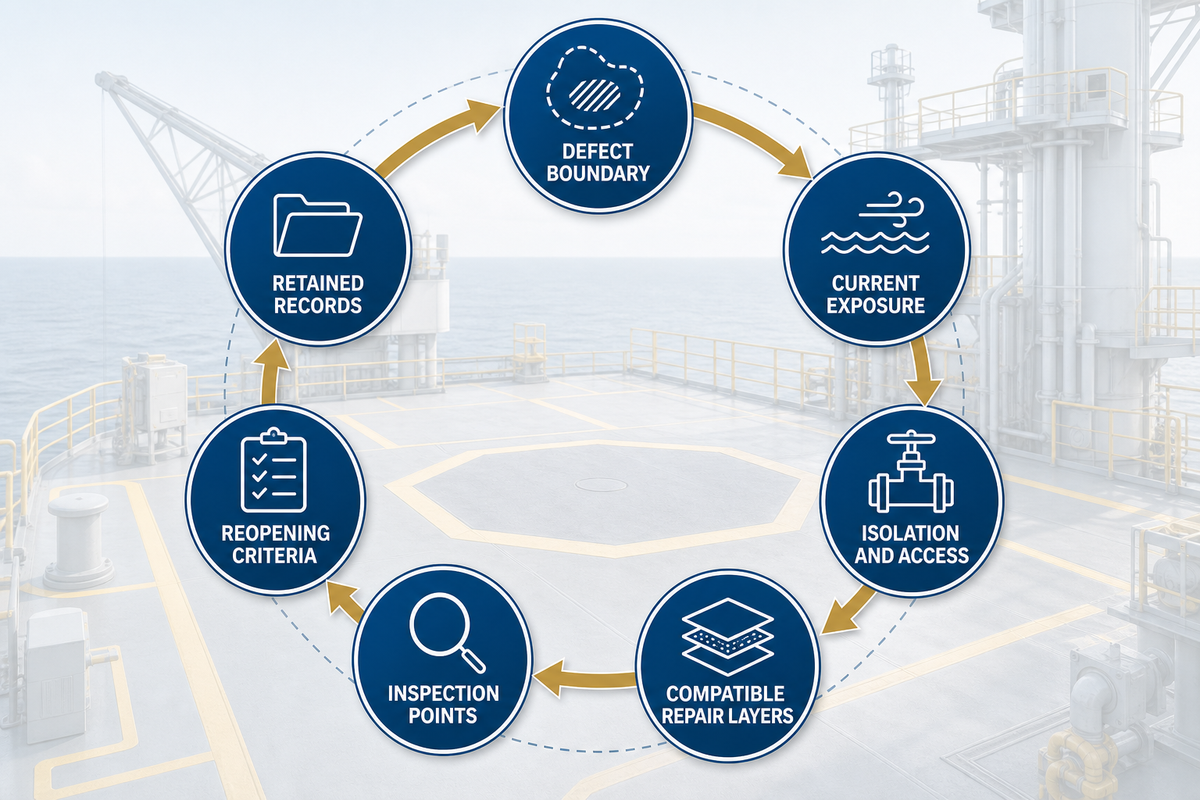
A maintenance scope should connect the defect boundary to current exposure, isolation, access, compatible repair layers, inspection points, curing or setting conditions, reopening criteria, and retained records. A cosmetic overcoat shouldn’t be applied if the mechanism or substrate boundary is unknown.
Change control techniques should be included in the maintenance plan. New openings, new equipment, new cleaning chemicals, hot work, modified drainage, restricted access, or new production activity can affect floor duty. Towing, jacking, or semi-submersible movement can change grating or escape-route risk before a material visibly fails.
The 2025-2026 research set included many general market forecasts, but there were no reliable offshore flooring forecasts that would influence maintenance decisions. Exposure and access records provide stronger evidence. BSEE links annual operator self-inspection documentation for fixed platforms in United States federal waters to agency oversight; teams outside that scope should determine their governing frequency and evidence route.
Access capsule: An assumed 36-hour repair window isn’t 36 hours of application time. For an assumed 36-hour repair window, the buyer should allocate measured time for isolation, preparation, installation, cure, inspection, and reopening rather than promise 36 hours of application. The division still depends on the system and site; therefore, the tender should specify who bears the risk of delay and reinspection.
Procurement objection: A standard repair rate may help budgeting, but it can’t include access, isolation, curing, or hidden work. Ask suppliers to separate known area, assumed boundaries, access assumptions, and change conditions.
Verify the Evidence Boundary Before Approval
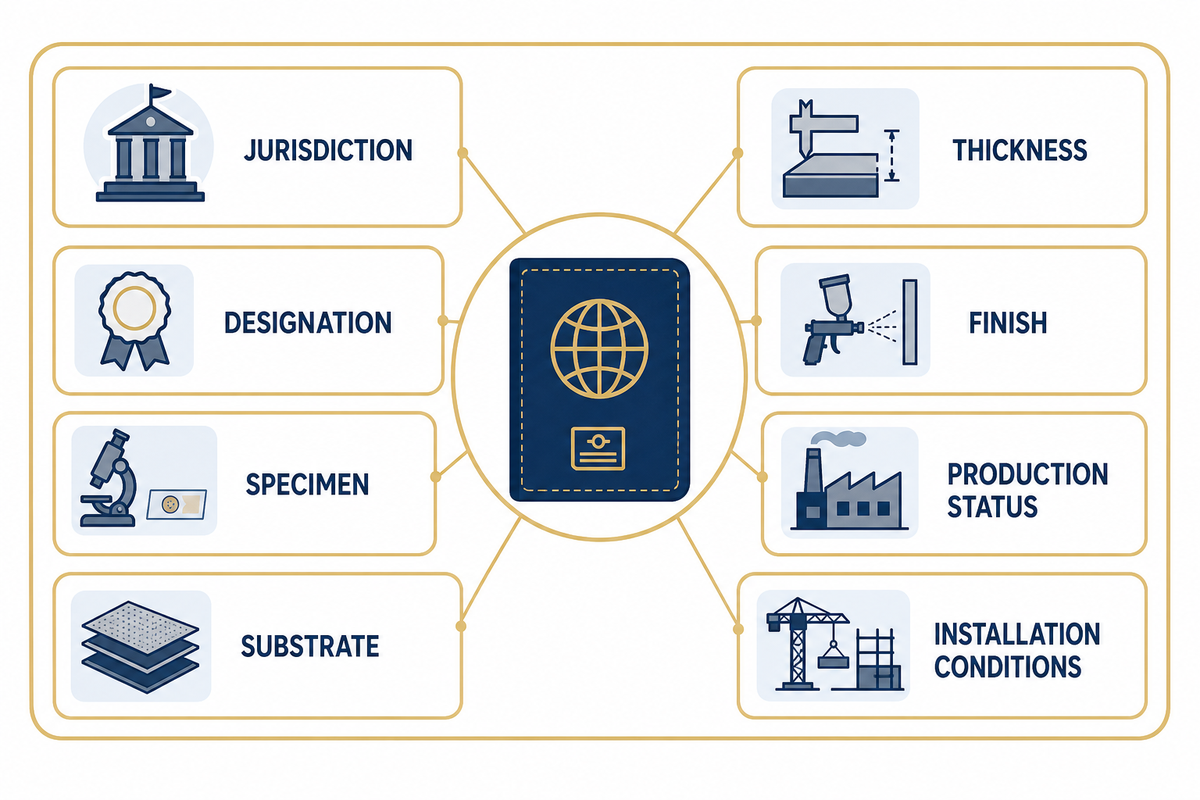
Evidence is fit for approval only when the document’s jurisdiction, product designation, specimen, substrate, thickness, finish, production status, and installation conditions match the proposed work. Certificate titles and platform labels can’t prove altered assemblies.
Begin with the actual controlling basis for the facility. The Coast Guard’s MODU guidance correlates different MODU Code versions to construction dates in its scope, while 46 CFR 164.106 addresses the approval of primary deck coverings for SOLAS vessels in a defined U.S. route. Neither of these statements establishes a single document that’s applicable to fixed installations, floating facilities, or every offshore oil and gas platform.
Accept as evidence
- Current governing document and applicability note
- Matching designation and complete build-up
- Test or certificate scope
- Batch, installation, and inspection records
- Closed deviations and operating acceptance
Do not substitute
- Logo lists without the document
- A chemistry name for an assembly
- A vessel certificate for an unnamed facility
- A laboratory result without method and condition
- A clean appearance for hidden-stage records
Sufficient evidence also requires production context. The U.S. rule requires initial factory inspection, tests by an accepted independent laboratory, at least annual production inspections, marked packaging, and a certificate with a 5-year validity period. This illustrates the need for buyers to review the current designation and scope rather than reuse a screenshot.
Procurement objection: When full evidence required for an award is requested, there’s an inherent delay for a bid. A pragmatic approach would be to require the scope critical documents at the technical evaluation, then batch and installation records at the manufacturing and site hold points.
Build a Handover Brief Without Recreating the Solution Page
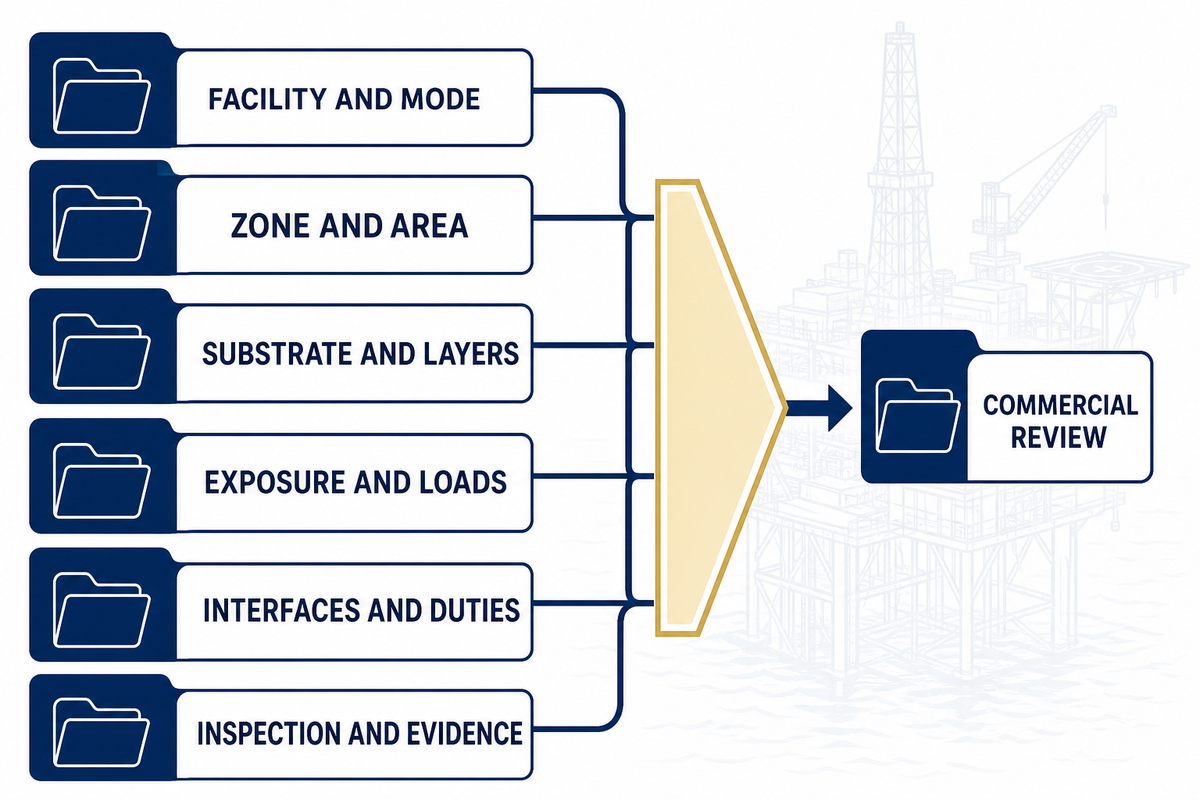
A good handover brief should specify the facility and jurisdiction, operating mode, zone schedule, area, substrate, retained layers, exposure, traffic and loads, drainage, interfaces, fire or acoustic duties, work window, inspection plan, and required evidence. It shouldn’t preselect a product family.
Copy-ready request checklist
- Facility status and location
- Current operating mode
- Zone names and measured areas
- Substrate and retained build-up
- Contaminants and cleaning regime
- Traffic, wheel, point, or impact loads
- Drainage and falls
- Drains, penetrations, bases, and thresholds
- Fire, acoustic, hygiene, or egress duties
- Access, isolation, and work window
- Inspection and hold points
- Required test, approval, and handover records.
This brief should be used to initiate a technical review. Yibo’s offshore platform flooring solutions page owns the next-stage system discussion, current specifications, document-scope review, and project-fit questions. Maintaining the information in this section will prepare the project brief for the solutions page to address the same facility, zone, evidence, and commercial activity.
Briefing capsule: The 12-field request checklist allows easy review for omissions before quoting. Twelve is an editorial choice and isn’t a regulatory requirement. Projects should include requirements from the owner, designer, applicable jurisdiction, classification society, selected system, and operator.
Have a defined platform and zone brief?Send the facility basis, zone schedule, interfaces, and evidence requirements for a focused technical discussion.Discuss the Project Brief
Frequently Asked Questions
What are the types of offshore platforms?
Short answer
Common groups include fixed or bottom-founded production platforms, jack-up mobile units, semi-submersible platforms, tension-leg and spar facilities, and ship-shaped units such as drillships or floating production, storage, and offloading vessels. These labels describe support and operating arrangements, but they don’t create a flooring specification. Confirm facility status, jurisdiction, work zone, deck construction, exposure, movement, traffic, fire and escape duties, and required evidence.
Is offshore platform flooring the same as ship flooring?
Short answer
The technologies can overlap in accommodation, service spaces, and ship-shaped floating units, but the terms aren’t interchangeable. Fixed installations, mobile offshore drilling units, and vessels can follow different regulatory, class, operator, and project specifications. Movement, substrate, drainage, process exposure, and inspection access also differ by zone. Treat a marine test report or approval as evidence only for its stated specimen and scope.
Which floor system is best for an offshore platform?
Short answer
There’s no defensible best system without a zone-level duty brief. Open walkways may prioritize drainage, corrosion resistance, and contaminated-wet footing; process spaces may add chemical, heat, or impact exposure; accommodation may add leveling, hygiene, comfort, or acoustic duties; escape routes carry separate access requirements. Define the substrate, exposure, traffic, interfaces, work window, and governing evidence before comparing matching systems.
Do fixed and floating offshore facilities follow the same flooring rules?
Short answer
No. Facility status, location, flag, class, operator rules, and the installed build-up may change the governing basis. Confirm applicability before comparing or approving flooring evidence.
What should an inspector check when offshore flooring blisters or cracks?
Short answer
First record the defect’s boundary, size, shape, location, and immediate safety effect. Photograph and map the affected area before disturbing it, then compare it with an intact control area exposed to similar service. Review the substrate, retained layers, moisture and contamination history, cleaning, temperature or movement exposure, application batch, mixing, cure, and work records. Cracks aligned with thresholds, welds, supports, or panel joints justify different checks from random map cracking. Blisters near a wet boundary may justify moisture and adhesion measurements, while rust staining may require controlled exposure of the substrate. Keep each possible mechanism separate until an inspection result discriminates between them. A symptom narrows the investigation; it doesn’t prove cause before those checks are completed.
What belongs in an offshore flooring request for quotation?
Short answer
Include facility and jurisdiction, operating mode, zone schedule and measured area, substrate and retained layers, exposure and cleaning, traffic and loads, drainage, interfaces, fire or acoustic duties, access and installation window, inspection hold points, and the required test, approval, installation, and handover documents. Identify unresolved details instead of hiding them inside a general product request.
A Better Decision Starts With a Better Brief
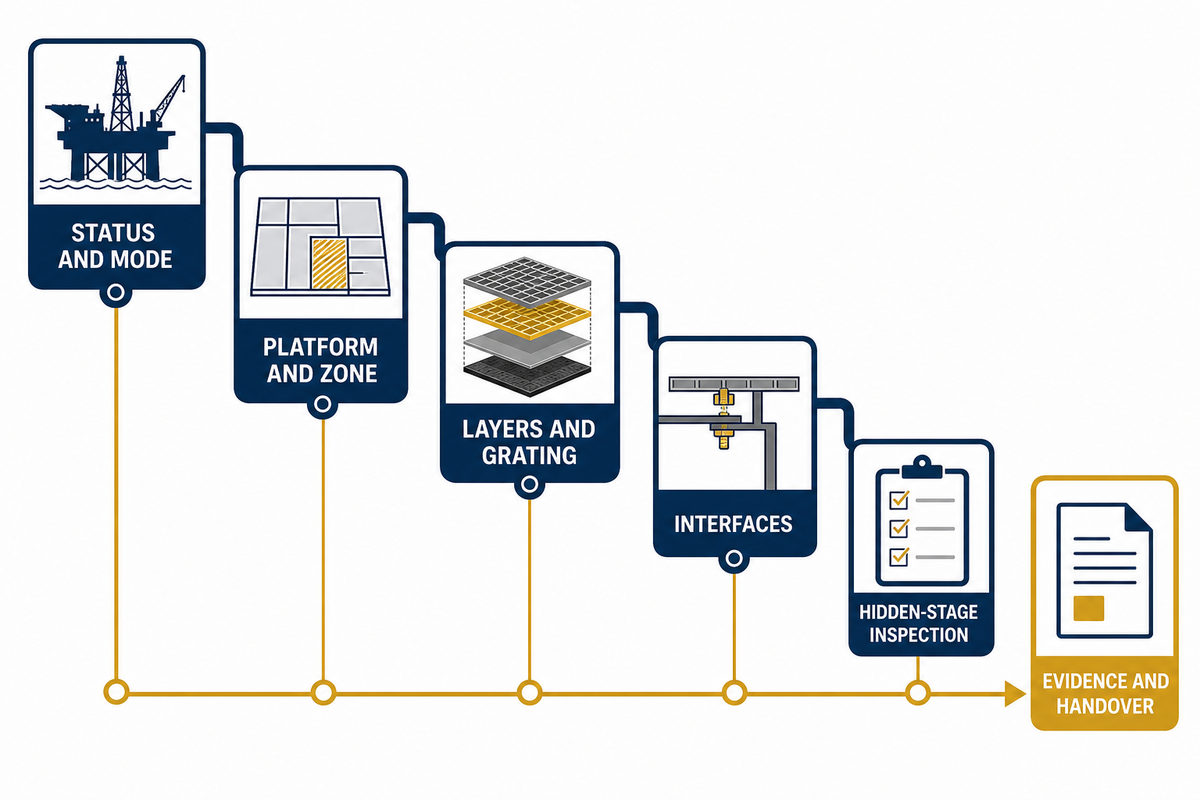
Reliable flooring decisions for offshore platforms follow a defined path. Status and operating modes need to be confirmed. The physical context and work zone need to be defined. Bonded layers of flooring need to be differentiated from mechanical grating. Interfaces need to be accommodated. Hidden-stage inspections need to be planned. All claims need to be substantiated.
This sequence replaces the universal-product shortcut with a decision record that the owner, designer, installer, inspector, and supplier can challenge. It also keeps educational intent separate from commercial selection. After completing the zone brief, the project team can compare systems without asking one label to cover drainage, fire, acoustics, hygiene, movement, access, and approval duties that it may never have been tested to meet.
References & Sources
- 29 CFR 1910.22, General Requirements U.S. Occupational Safety and Health Administration
- Types of Fixed Outer Continental Shelf Facilities U.S. Coast Guard
- Floating Outer Continental Shelf Facilities U.S. Coast Guard
- Assessing and Improving Slip Resistance UK Health and Safety Executive
- CAP 437: Offshore Helicopter Landing Areas UK Civil Aviation Authority
- Primary Deck Coverings and Floor Coverings U.S. Coast Guard
- 46 CFR 164.106, Primary Deck Coverings for SOLAS Vessels Electronic Code of Federal Regulations
- ED1-2023: Floor Grating Systems UK Health and Safety Executive
- Standard Item 009-026, Deck Coverings Naval Sea Systems Command
- ED09-2023: Grating Systems During Rig Moves UK Health and Safety Executive
- Inspection and Diagnosis System for Epoxy Resin Industrial Floor Coatings Journal of Performance of Constructed Facilities
- Fixed Platform Self-Inspection Program and Oversight U.S. Bureau of Safety and Environmental Enforcement
- MODU Code Applicability U.S. Coast Guard
Commercial marine flooring systems
Plan the deck build-up before the workfront is released.
Yibo manufactures commercial marine flooring systems in Suzhou for vessel projects that need a coordinated deck-covering, resin-floor, or acoustic-floating-floor build-up.
Review marine deck covering systems, marine resin floor systems, and marine acoustic floor systems against the vessel area and planned application sequence.
Project enquiry
Give the engineering team the inputs that shape the system review.
Include the vessel area, substrate or deck condition, intended floor build-up, fire or acoustic target, and project schedule so the enquiry can begin with the relevant deck constraints.
Send Your Deck Schedule


![Marine PU Floor: Selection & Installation [Guide]](https://yibomarine.com/wp-content/uploads/2026/09/marine-pu-floor-blog-featured-150x150.png)