
Get in touch with Yibo Company


Updated September 2026
Ferry flooring is more complex than just picking carpet, vinyl, resin, synthetic teak, or anything of that sort. The specifications include service duty, substrate, every layer, drains and thresholds, installation controls, approval scope, records of acceptance, and plans for upkeep of that specific location.
This guide offers a common planning sequence to owners, shipyards, naval architects, outfitters, inspectors and procurement teams. It suggests no material as the best choice for all situations. It also provides information to preserve evidence for hidden work, diagnose defects, and prepare a project-control handoff. Selecting a product and providing a quotation are separate from this guide and remain on the commercial application Page.
Key takeaway
Specify one floor build-up for one ferry space at a time. Record the duty, interfaces, evidence owner, workfront release, concealed-layer witness points, and handover records before anyone compares finishes.
Ferry Flooring Defined Build-Up: Set the Evidence Boundary
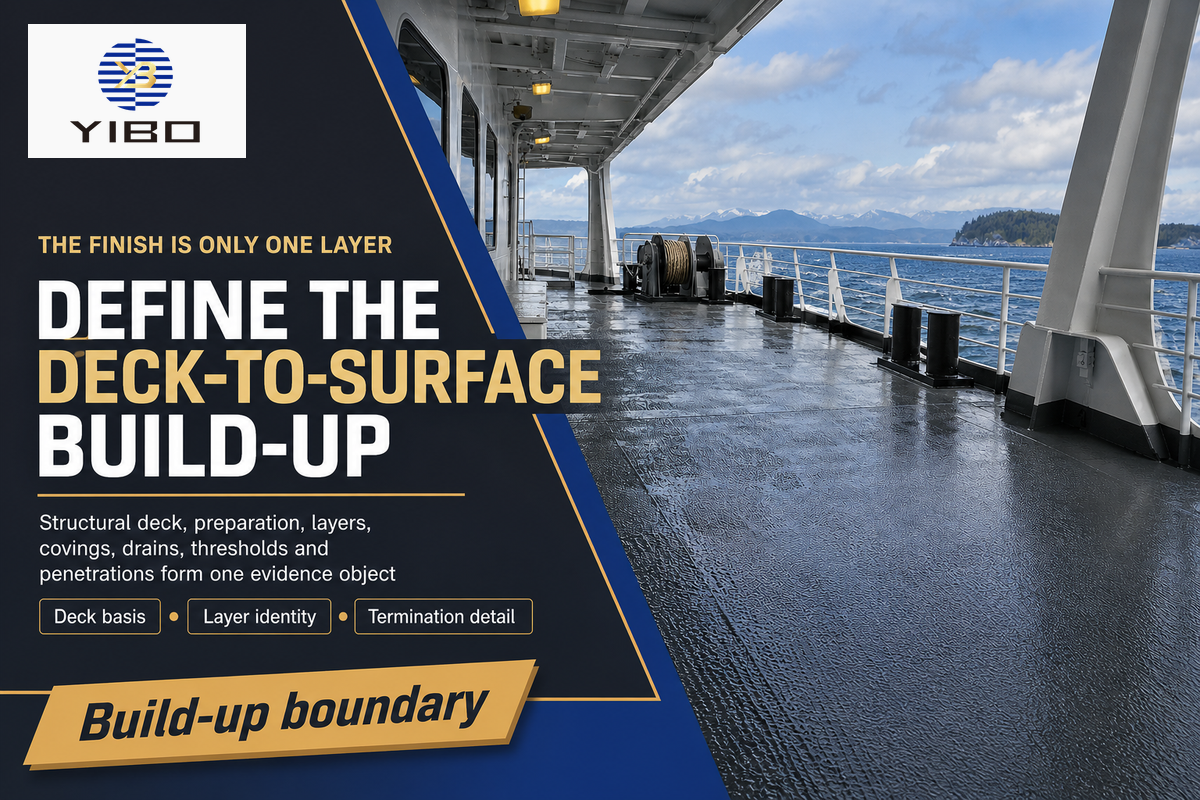
Each ferry floor system extends from the structural deck to the exposed surface and its terminations. Steel condition, preparation, primer, levelling or acoustic layers, adhesive, finish, coving, drains, thresholds, and penetrations all affect whether the construction matches the drawings and supporting information.
Layer names also carry legal or approval scope. In the current United States example, 46 CFR subpart 164.106 sends a primary deck covering through Part 5 flame-spread procedures and Part 2 smoke-density and toxicity criteria of the 2010 Fire Test Procedures Code. That mapping describes a defined approval route, not every ferry everywhere.
“This subpart prescribes requirements for approval of primary deck coverings for SOLAS vessels.”
Adding government-hosted access to the 2010 Fire Test Procedures Code introduces some limits. More specifically, a surface-material certificate identifies the represented substrate, and a significant product alteration can invalidate an approval. Therefore, a visual similarity of a different adhesive, substrate, or supporting layer may fall outside the scope of evidence.
| Construction point | Question to freeze | Evidence to retain | Limit or objection |
|---|---|---|---|
| Structural deck | What material, geometry, damage, repairs, and prior coating are present? | Survey and release record | Clean appearance does not rule out salts, oil, movement, or weak coating. |
| Preparation | Which method and acceptance source apply? | Method, observation, measurement, reviewer | Do not copy a preparation grade from another system. |
| Primer | Is it part of the selected system and compatible with the deck? | Product and batch identity | Primer names alone do not prove intercoat compatibility. |
| Levelling layer | What geometry and load-transfer job must it perform? | Survey, drawing, application record | One nominal depth cannot describe an uneven deck. |
| Resilient or acoustic layer | Which noise path, boundary, and load case are represented? | Assembly drawing and relevant test | One isolated product value is not a vessel result. |
| Adhesive or body coat | Which finish, backing, and service condition does it join? | Approved system and application record | Substitution can change both bond and fire-test scope. |
| Exposed finish | Which traffic, water, cleaning, access, and appearance duties apply? | Finish schedule and service evidence | “Marine grade” does not define a test or location. |
| Edges and covings | Where must the system stop, turn up, or remain separated? | Detail and hidden-work photograph | Continuous appearance can hide a failed termination. |
| Drains, thresholds, and penetrations | Who owns geometry, sealing, movement, access, and release? | Interface drawing and signed inspection | Flooring cannot correct an unresolved multi-trade interface alone. |
Scope capsule: there are nine construction points between a steel deck and the finished floor of a ferry. Procurement may argue that a layer register slows review; however, it exposes exclusions before proposal handoff and prevents one finish name from carrying claims that belong to a complete tested construction.
Prepare Ferry-Zone Control Inputs Before Work Starts
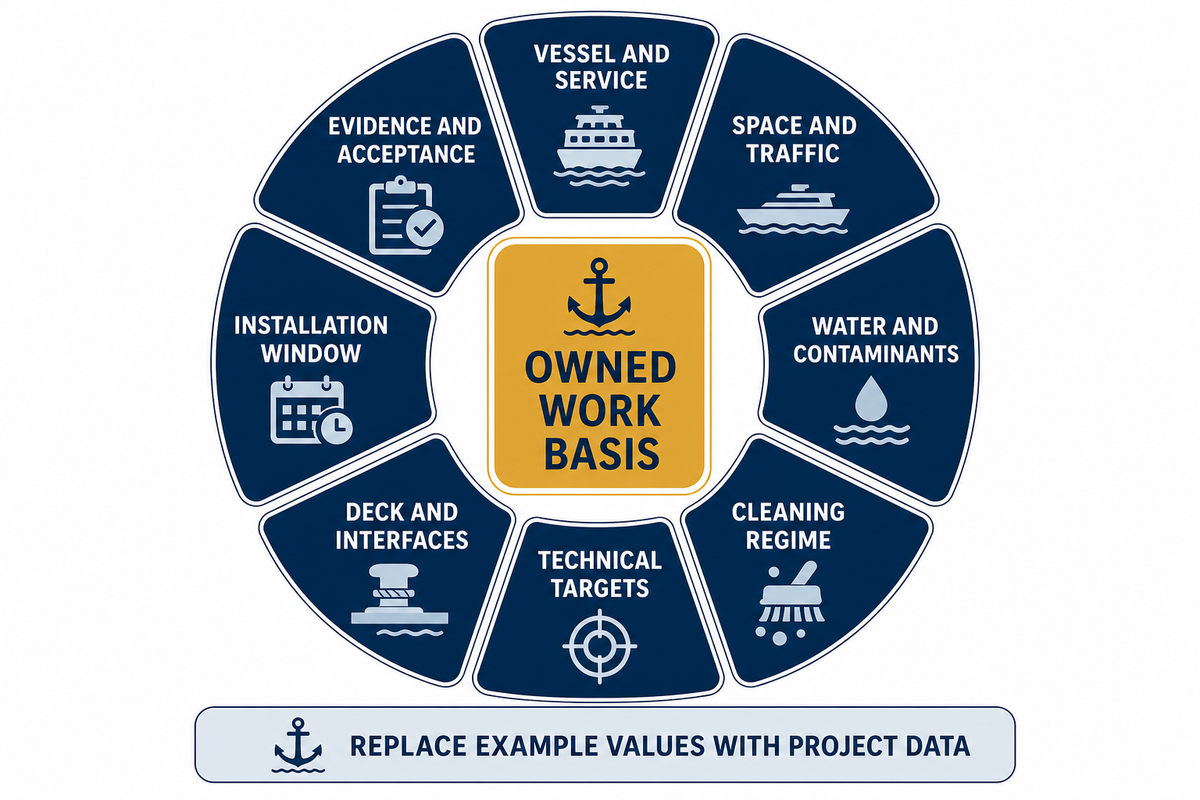
Use a ferry-zone record as an intake method for turning a broad flooring request into owned project inputs. Every field receives a source, responsible party, or open-item label. Its work-control record then follows passenger space, vehicle or ro-ro space, vessel, contract, and applicable jurisdiction.
| Field | Inputs to record | Evidence owner | Open-item trigger |
|---|---|---|---|
| 1. Vessel and service | Ferry type, route, operating profile, flag, class, build or refit | Owner and naval architect | Applicability route is not named. |
| 2. Space and traffic | Passenger flow, crew work, carts, baggage, mobility devices, vehicles | Operator and layout owner | A “public area” label hides actual traffic. |
| 3. Water and contaminants | Tracked water, wash-down, salt, oil, food soil, cleaning residue | Operator and safety lead | Wet or contaminated conditions remain unspecified. |
| 4. Cleaning regime | Chemistry, tools, frequency, rinse, drying, access window | Housekeeping and product adviser | Shortlisting omits cleaning compatibility. |
| 5. Technical targets | Fire, accessibility, acoustic, load, weight, hygiene, appearance | Named discipline owner | The target lacks a method, scope, or reviewer. |
| 6. Deck and interfaces | Condition, geometry, drains, thresholds, doors, penetrations, equipment | Shipyard and adjacent trades | One interface has no release owner. |
| 7. Installation window | Access, climate, ventilation, cure, protection, follow-on work | Production planner | Service return is confused with next-layer readiness. |
| 8. Evidence and acceptance | Tests, approvals, drawings, witness points, acceptance authority | Designer, inspector, owner, class or flag as applicable | Document titles are accepted without scope matching. |
Illustrative planning scene: a terminal entrance team records a 24 m² wet zone, 3 door thresholds, 2 drain bodies, a 90-minute overnight cleaning window, an observed 18 °C to 23 °C work range, and a 40-hour protected period before peak passenger traffic. Those figures are not acceptance limits. They indicate the drawings, product data, scheduling, and witnesses that the project will need to obtain.
Fictional duty-board row: training data might describe 28 m² beside a 12 m route, a 2.4 m doorway, local build-up options of 7 mm, 12 mm, or 19 mm, a 250 kg cart, a 90 kg mobility-device case, observations at 22 °C and 65% relative humidity, a 90 min cleaning slot, and candidate work holds of 6 hr, 24 hr, or 4 days. None of these values is a recommendation, acceptance criterion, or Yibo project result; replace every value with sourced project data.
Accessibility belongs in field 5 only when the applicable route or project calls for it. As a planning example rather than a current project requirement, the archived U.S. Access Board passenger-vessel draft guidance addresses stable, firm, slip-resistant deck surfaces and securely attached carpet. Its advisory text notes that carpet and backing can change wheelchair rolling effort. Clarify the responsible authority, applicable method, and vessel-specific scope before using the guidance.
Control record capsule: eight completed fields create one owned work basis, not one worldwide specification. Product-fit review remains on the commercial Page; this register only shows whether each field has an owner, source, or visibly open status and whether each zone follows its governing workstream.
Record Control Questions for Proposed Material Families
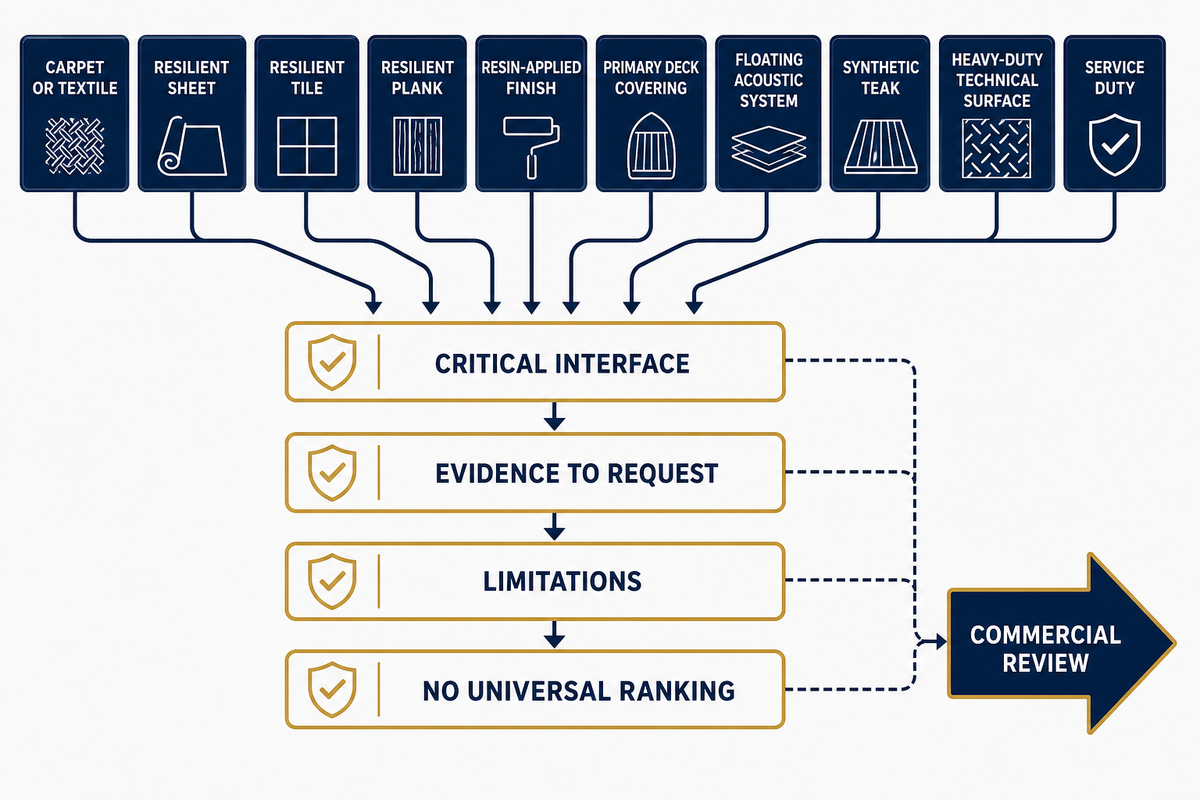
Material families assist in organizing project-control records, but this guide does not rank them across ferry spaces; product-fit review follows each space’s duty on the commercial Page. When a schedule proposes “ferry carpet,” record the exact face, backing, adhesive, edge, cleaning, rolling-effort, and evidence questions after proposal. Passenger cabins and boarding stairs, wet entrances, sanitary compartments, exterior accessways, vehicle decks, and acoustic spaces place different demands on seams, backing, cleanability, movement, weight, comfort, repair access, and the represented fire-test construction.
| Family | Control question after proposal | Critical interface | Evidence to request | Limitations / not suitable for |
|---|---|---|---|---|
| Carpet or textile | Does passenger comfort outweigh soil, moisture, rolling effort, and replacement concerns? | Backing, adhesive, edge trim, transitions | Exact build-up, cleaning route, access evidence | Do not select for persistent wet or oily duty without project proof. |
| Resilient sheet | Can seams, covings, and repair patches be controlled in the service zone? | Welded seams, drains, door tracks | Finish, adhesive, substrate and seam scope | A sheet surface does not make unresolved penetrations watertight. |
| Resilient tile | Will modular repair help more than added joint exposure hurts? | Tile joints, backing, local replacement | Attachment and maintenance compatibility | Not interchangeable with a tested sheet construction. |
| Resilient plank | Does the appearance brief fit the traffic, access, and evidence route? | End joints, perimeters, substrate flatness | Marine project documents for the exact plank system | Consumer vinyl plank data cannot prove ferry suitability. |
| Resin-applied finish | Can preparation, layer control, curing, and local repair be managed? | Deck coating, drains, terminations | System procedure, batches, test and approval scope | Joint-minimized appearance does not remove movement joints or penetrations. |
| Primary deck covering | Which first-layer, fire-test, levelling, or protection role is specified? | Steel preparation, primer, next layer | Current record for product, use and build-up | Do not treat it as proof for every finish above it. |
| Floating acoustic system | Which source, receiving space, path, load, and boundary must change? | Perimeters, partitions, penetrations, equipment feet | Full assembly and relevant design or test evidence | No fixed dB result transfers to a different vessel arrangement. |
| Synthetic teak or decorative exterior | How will heat, water, wear, repair edges, and cleaning be handled? | Adhesive, margins, fittings, scuppers | Exact exterior system and maintenance route | Appearance does not prove slip, fire, or water-path performance. |
| Heavy-duty technical surface | Which wheel loads, oil, impact, fire system, and cleaning events apply? | Ramps, lashing points, scuppers, adjacent coatings | Vehicle-space design basis and inspection method | Passenger-space criteria cannot size vehicle-deck drainage. |
Visual contrast is also highly specific. Archived U.S. Access Board passenger-vessel draft guidance places contrast conditions on named weathertight thresholds and gangway transition plates. Used here only as a scope-reading example, it doesn’t establish a current universal material-family rule. Record the actual transition and its controlling provision.
Why a sample alone cannot close the project record
One sample shows colour, texture, and a small part of the finish construction, but it shows none of the surveyed deck, adhesive, acoustic perimeter, drain detail, batch traceability, work window, or acceptance route. Do not close the project record from a sample, even when every stakeholder prefers the same appearance.
Coordinate Slip, Passenger-Space Drainage and Cleaning
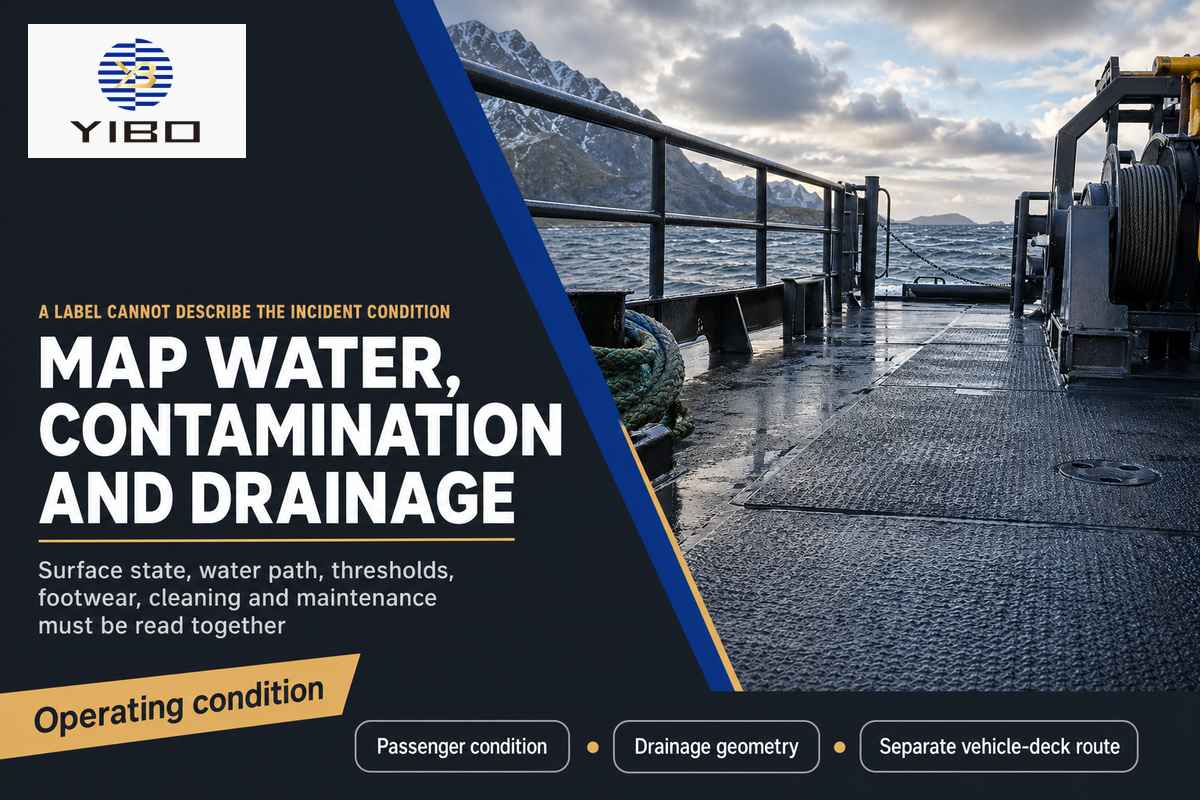
Passenger-space slip control only functions when surface condition, water path, drain geometry, thresholds, contaminants, footwear, cleaning chemistry, tools, and maintenance are considered together. A laboratory label or fresh texture may answer one test question, but the operating route can create a different wet or contaminated condition.
The United Kingdom Health and Safety Executive identifies wet or tidal conditions, contaminants, inappropriate surfaces, and poor maintenance as related port slip or trip factors. Applied carefully, that operational lesson provides a practical checklist for ferry planning. It does not provide a portable, universal slip rating for ferries.
Do
- Name the wet or contaminated service condition.
- Map falls, drains, thresholds, and cleaning sequence.
- Record footwear and wheeled traffic during incident review.
- Check the installed surface with the agreed method and condition.
Don’t
- Turn “non-slip” into an absolute safety promise.
- Use a dry result to explain a contaminated event.
- Assume texture compensates for standing water.
- Call an exposed finish waterproof without checking interfaces.
Illustrative operations scene: a passenger gangway landing sees 6 mm of tracked rainwater near a worn edge, a 13 mm drainage opening, 4-minute peak boarding waves, and cleaning 25 minutes before departure. The investigation captures these conditions along with the footwear mix, the state of the drains, and the cleaning agent. Those observations do not establish a cause from texture or a single photograph.
Vehicle and ro-ro decks require a separate workstream. An official International Maritime Organization summary describes drainage work for closed vehicle, ro-ro, and special-category spaces intended to prevent water accumulation on vehicle decks. Therefore, drainage-system design and size cannot be based on the passenger cleaning routine; vehicle-deck drainage and fire-system flow instead follow applicable ship rules and space geometry.
Operating capsule: passenger-floor grip, drainage, and cleaning are captured in one operating record, while vehicle-deck fire-water drainage is a separate engineering workstream. A customer may request a single “wet-safe” value; however, the project defines the condition, test purpose, geometry, contaminants, footwear, and responsible authority.
Specify Evidence for the Exact Build-Up
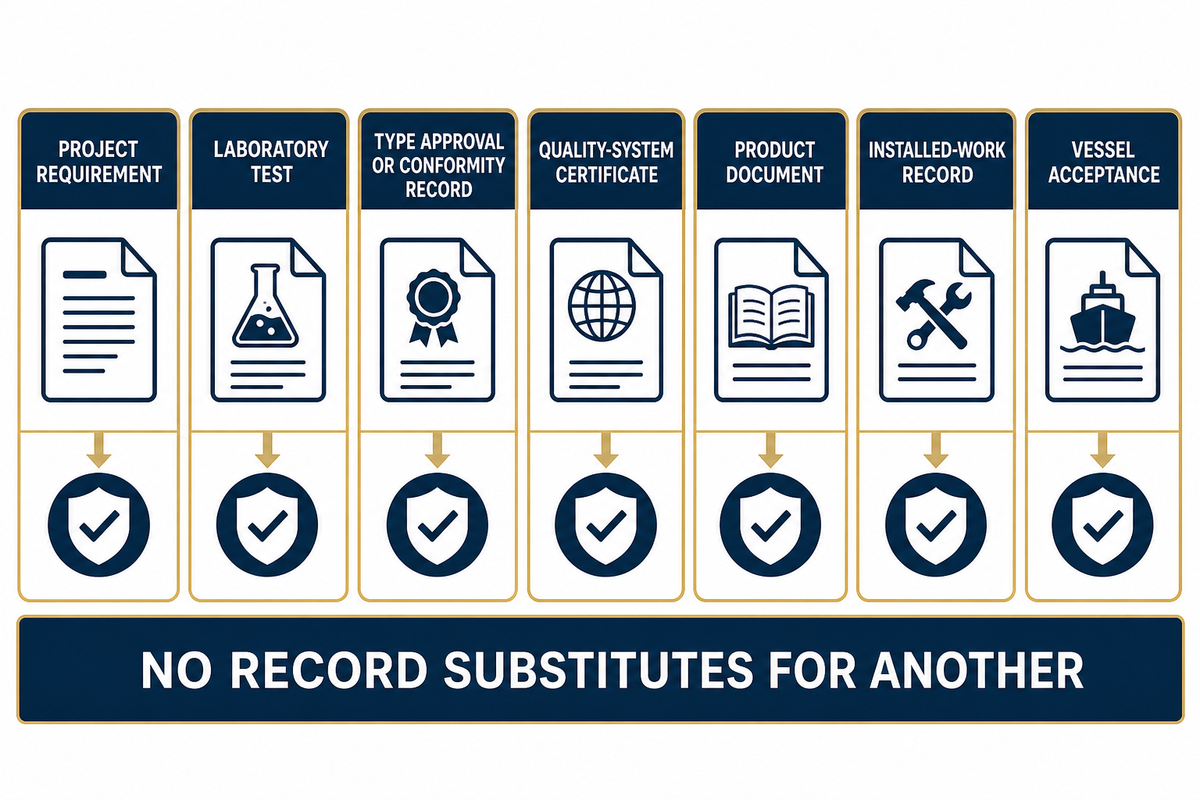
When every document is tied to the product, assembly, substrate, test condition, revision, date, issuing organization, and the project decision it represents, an evidence pack becomes useful. Fire testing, type approval, acoustic evidence, a quality-system certificate, product data, and installed-work acceptance are related records, but none can substitute for another.
| Evidence item | Question answered | Scope check | Overreach to avoid |
|---|---|---|---|
| Project requirement | What must this vessel space achieve? | Vessel, zone, revision, authority | Treating a generic brochure value as the requirement |
| Laboratory test | What did a defined specimen do under a named method? | Layers, substrate, conditioning, result | Promising the same outcome in every installation |
| Type approval or conformity record | What product or construction is recognized within a stated route? | Issuer, identity, use, date, validity | Extending a logo to an unnamed variant |
| Quality-system certificate | What management system and organizational scope were assessed? | Entity, site, activity, validity | Using it as installed-performance proof |
| Product document | What does the manufacturer state for the named product? | Revision, substrate, method, limits | Mixing different editions or product families |
| Installed-work record | What was actually prepared, mixed, placed, and observed? | Area, batch, time, reading, reviewer | Assuming factory evidence proves workmanship |
| Vessel acceptance | Who accepted the defined work against the project route? | Area, drawing, criteria, deviations | Converting one vessel decision into a universal claim |
Issuing-party portals, such as DNV Approval Finder, aid a project team in their search for a named record. The portal doesn’t confirm that an unnamed Yibo system, finish, adhesive, or complete built-up assembly, for example, is currently approved. Search for the complete name of the system and carefully read the scope of the approved record.
Evidence capsule: seven questions are answered by seven document types. While procurement might prefer a one-page certificate bundle, the useful index identifies product, assembly, substrate, method, issuer, revision, date, scope, and the decision each record supports. Unresolved mismatches remain open rather than disappearing under “marine approved.”
Freeze Substrate, Interfaces, Noise and Weight Inputs
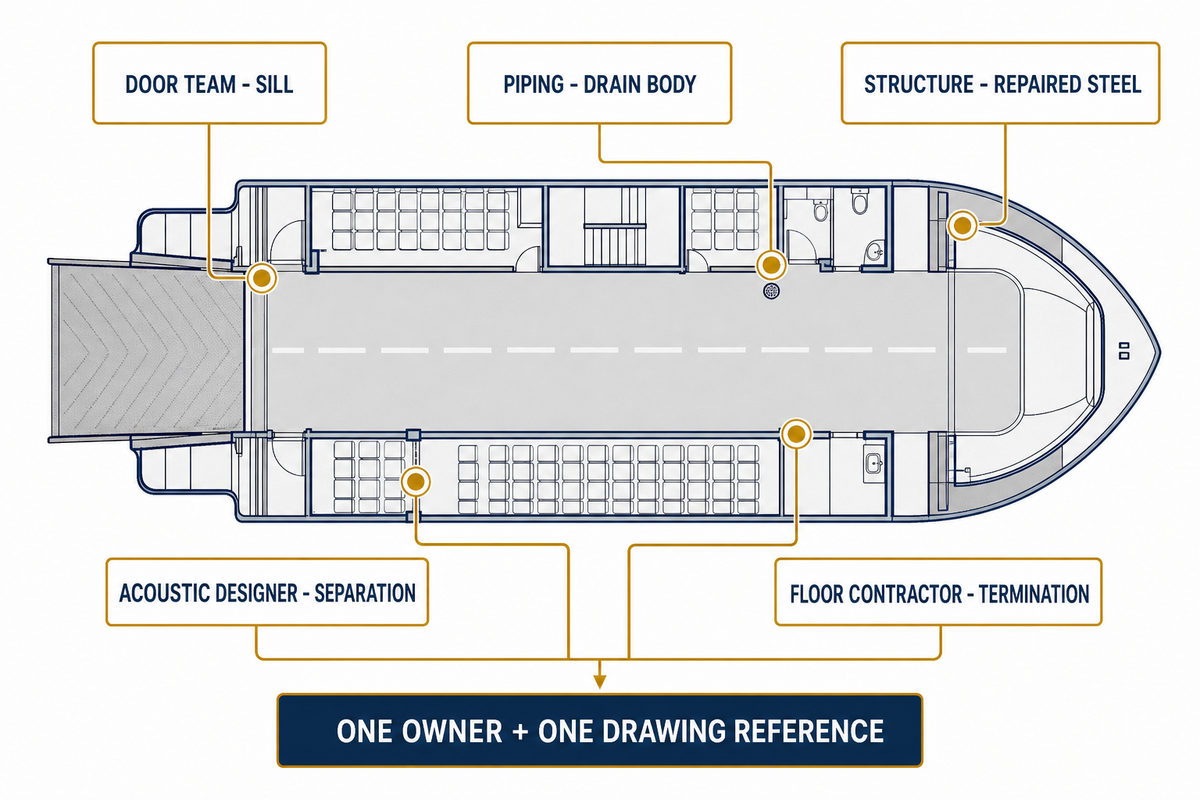
Substrate and interface inputs must be released before flooring work begins because later layers can hide corrosion, contamination, weld repairs, joints, drain geometry, threshold conflicts, penetrations, equipment bases, and rigid acoustic bridges. Noise and weight targets belong to a complete construction and stated operating case, not to a material label.
The current U.S. primary deck-covering procedure also treats a deck covering as a defined construction. This jurisdiction-specific example supports checking the full assembly; it does not set a universal acoustic or weight limit.
A responsible interface owner and one drawing reference should be recorded for every interface. Responsibility is divided among trades: the door team handles door movement and sill requirements; piping owns the drain body and connection; structure addresses repaired steel and local movement; the acoustic designer defines separation details; and the floor contractor controls its stated preparation and termination. Shared interfaces still require a named release decision.
Illustrative coordination scene: a cabin corridor survey finds an 8 mm local deck step across 1.6 m, 5 cable penetrations, a 32 kg equipment foot near the partition line, and a 45-minute inspection slot before levelling starts. All of the figures shown are fictional planning examples and should not be construed as project limits. They tell the team which trades must close geometry, load, and acoustic-edge questions first.
Do
- Release a named deck area against a named method.
- Mark drains, thresholds, penetrations, and equipment bases on the same drawing.
- Trace acoustic evidence to the full boundary condition.
- Record weight by layer and zone when the designer requests it.
Don’t
- Replace a survey with “visually clean.”
- Let adjacent trades cut a finished system without review.
- Quote one dB value without its test arrangement.
- Hide unresolved load or height conflicts inside a levelling allowance.
Interface capsule: a buyer may believe early coordination meetings are a hindrance. The alternative is paying for floor removal after a drain, sill, partition foot, or equipment base proves incompatible. Release the physical interface once, then pass its evidence forward before later coverage removes access.
Release and Control the Installation Workfront
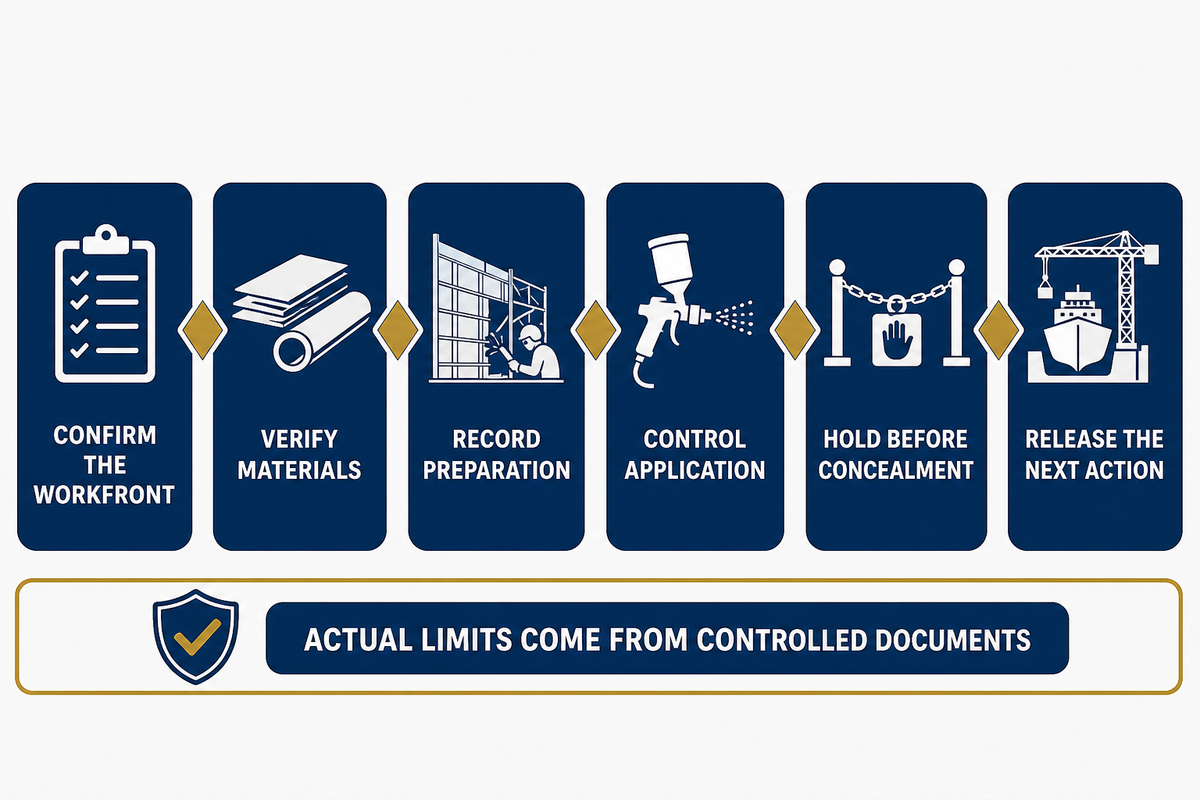
Workfront control transforms the selected build-up into a repeatable installation record. The team identifies the area, approved method, substrate release, product and batch, preparation, environmental readings, mixing or adhesive controls, layer checks, application time, the next-layer decision, service return, deviations, and the person authorized to release the work.
A current NAVSEA preservation work item provides a government process example: it names cleanliness, intact labelled containers, multi-component proportioning, monitored conditions, and inspection points. Naval product values don’t become ferry limits here; the transferable lesson is disciplined identity and release.
- Confirm the workfront — match deck area, drawing revision, substrate release, and open interfaces.
- Verify materials — record product, batch, condition, storage, and approved substitution status.
- Record preparation — capture the method, observations, measurements, contamination findings, and repair disposition.
- Control application — follow the selected system procedure for mixing, placement, adhesive, layers, and environmental limits.
- Hold before concealment — complete the named witness point and close deviations.
- Release the next action — distinguish next-layer readiness, protection, floor traffic, service return, and any atmosphere release.
Fictional workfront-log shape: a training entry could contain 20 °C, 55% relative humidity, an 8 kg kit, a 3 min mix record, a 30 min observation, two measured layers of 2 mm and 4 mm, a 12 m² batch area, a 1.5 m reference edge, and release checkpoints at 6 hr and 48 hr. It could also flag a 6 month document-review date. The fictional figures demonstrate traceable fields, and the selected product documents and project authority must provide all actual limits and decisions.
There are several distinct milestones: working time, next-layer readiness, safe foot traffic, equipment loading, cleaning, and vessel service. Values for each come from product and project documents for the actual conditions. The statement “the floor feels hard” can’t substitute for specified release criteria or atmosphere controls in an enclosed work area.
Workfront capsule: six installation releases cover area, materials, preparation, application, hidden-work hold points, and the next permitted action. No generic article can supply the exact temperature, humidity, thickness, mix ratio, cure time, or loading time for an unidentified system.
Use a Record Before the Next Trade Conceals the Work
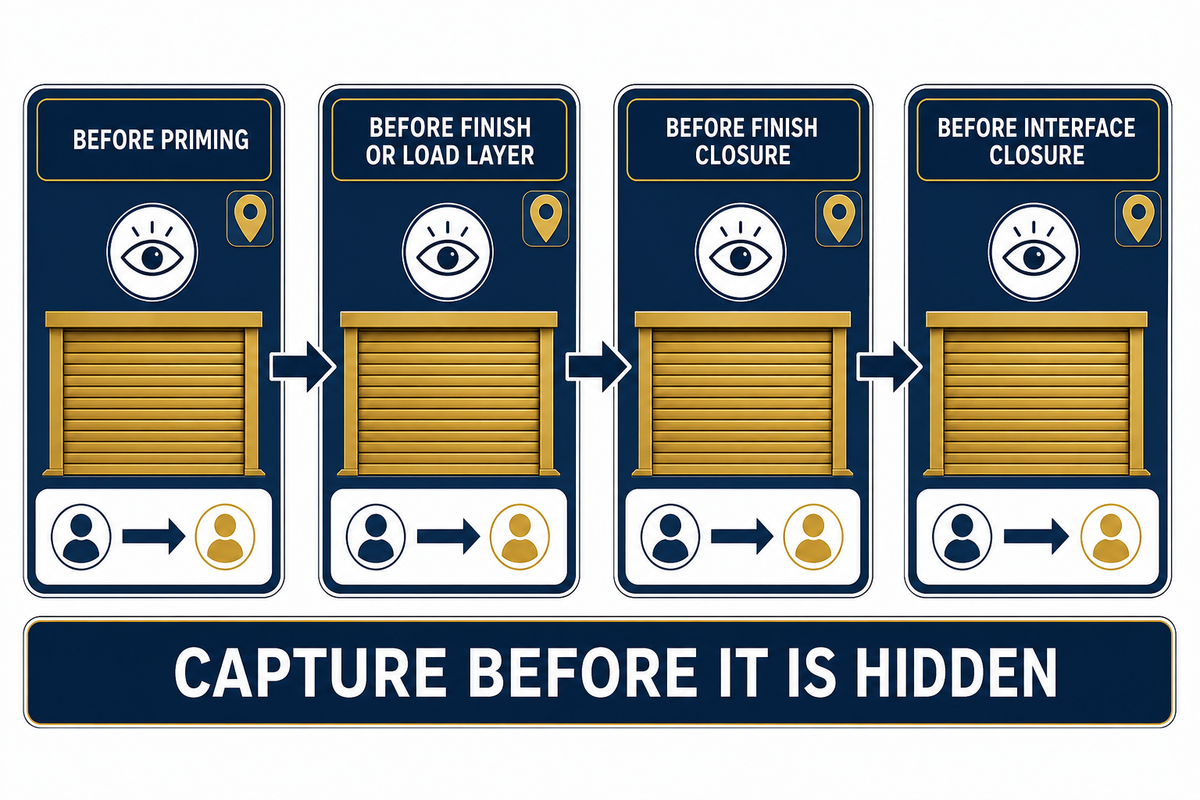
A concealment release record captures a condition while it can still be seen and passes that evidence to the next trade or acceptance owner before the condition is hidden. A witness window closes when primer covers preparation, levelling covers repairs, a finish covers adhesive, or closure hides a drain or penetration detail.
The cited NAVSEA work item is contract-specific, but its material identity, monitored-condition, inspection, and checkpoint records illustrate why evidence is captured before the next operation hides it.
Each relay entry captures area ID, layer or interface, previous state, product and batch, observation or measurement, governing reference, deviation status, reviewer, and time. The next owner signs or records the release. An image without location, orientation, scale, or decision reference remains an image, not an acceptance record.
| Window | Condition still visible | Relay record | Receiving owner | Do not release when |
|---|---|---|---|---|
| Before priming | Steel condition, repairs, cleanliness, geometry | Area, state, method, observation, measurement, reference, reviewer, time, deviation | Primer or flooring team | Contamination, damage, or ownership remains open. |
| Before finish or load layer | Levelling, acoustic elements, perimeters, joints | Same 9 fields plus layer identity and repairs | Finish installer and acoustic owner | A bridge, height conflict, or soft area is unresolved. |
| Before finish closure | Adhesive or body coat, seams, edge preparation | Batch, application state, coverage check, time | Finish and inspection owners | Open time, contamination, or substitution lacks disposition. |
| Before interface closure | Covings, drain rings, thresholds, penetrations | Detail, orientation, seal or joint, responsible trades | Shipyard interface owner | The drawing or adjacent trade has not accepted the detail. |
Concealment capsule: four release points preserve nine fields before concealment. To some buyers, inspection may appear costly, but the record is cheapest while the condition is still visible. Later destructive openings cost time, create repair work, and still may not recreate the original preparation or application state.
Build an Acceptance Record That Survives Handover
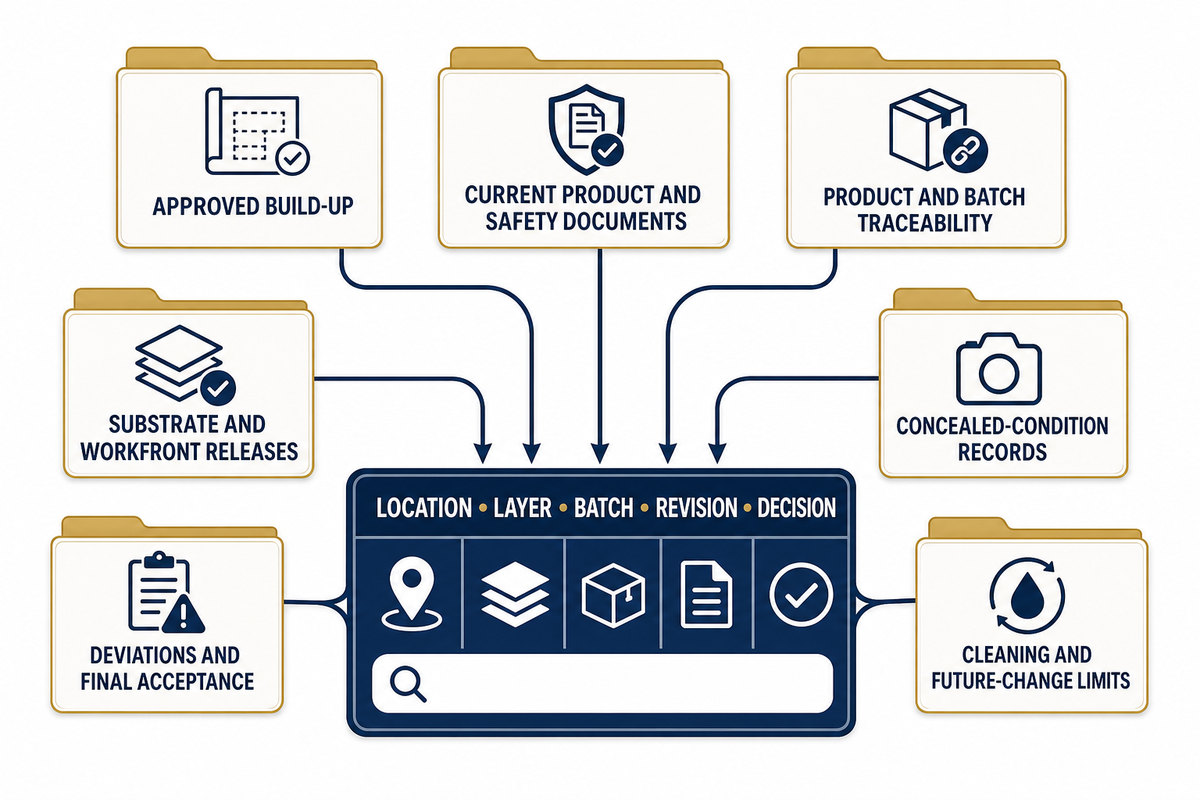
An acceptance record should let a future operator or repair yard identify what was approved, installed, inspected, changed, and released in each ferry zone. The package links drawings, product identity, batch records, workfront releases, hidden-layer evidence, deviations, repairs, final checks, maintenance limits, and relevant approval records.
The same U.S. approval procedure separates approval of a represented construction from production controls. A ferry project still needs its own location, revision, deviation, inspection, and release index for handover.
Index every item by location and revision. Mark which document is current, which organization issued it, which product or assembly it covers, and which decision it supports. A certificate can remain valid while the installed combination falls outside its scope; a correct combination can still fail because the substrate or workmanship wasn’t accepted.
Handover file check
- Approved build-up and location schedule
- Current product and safety documents
- Product and batch traceability
- Substrate and workfront releases
- Concealed-condition records and interface photographs
- Deviations, repairs, reinspection, and final acceptance
- Cleaning, maintenance, and future-change limits
Handover capsule: seven file groups connect design intent with installed history. The claim that “all certificates are in one folder” still misses the location and scope connection. A searchable index must indicate which record corresponds to which zone, layer, batch, revision, and acceptance decision.
Record Failure Evidence Before Repair
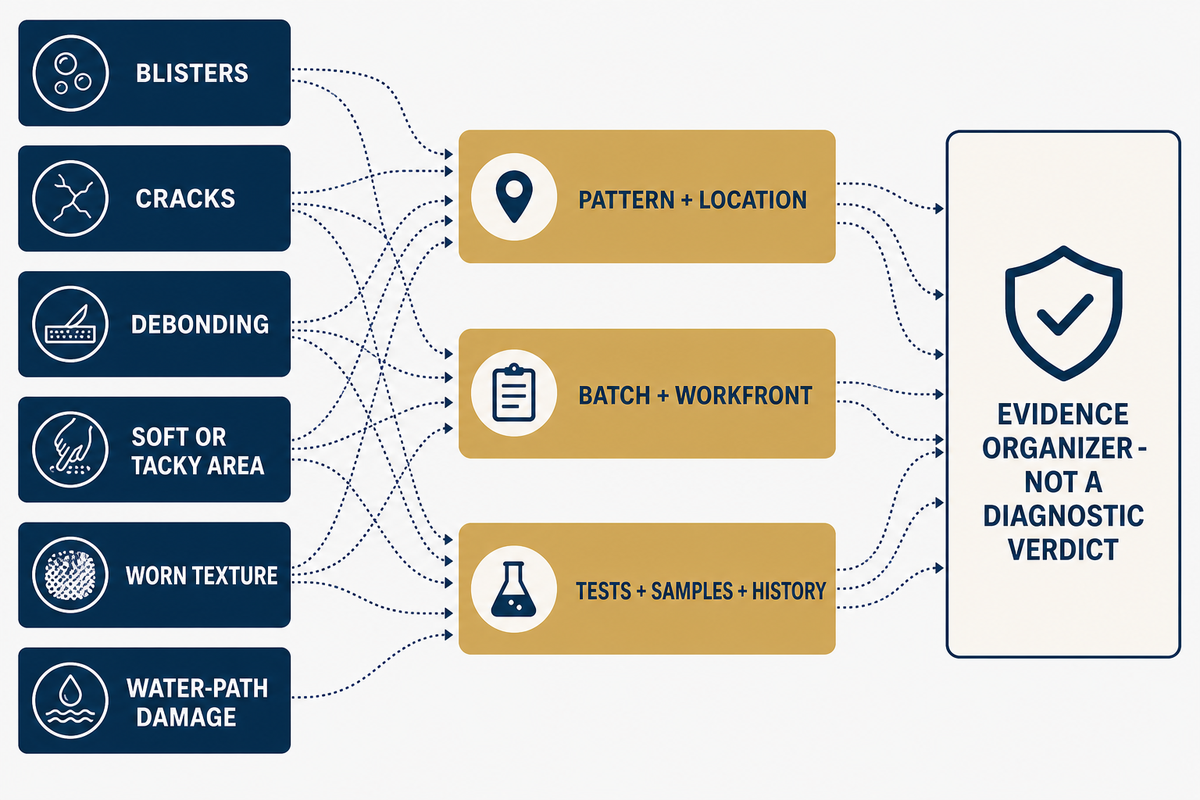
The failure record is an evidence organizer and not a diagnostic verdict. Record pattern and location, affected layer, time of appearance, water or contamination path, batch and workfront, temperature or moisture history, traffic or impact event, and photographs taken before removal.
The public ISO 4628-1:2016 page supports consistent coating-defect designation by quantity, size, and appearance intensity. That vocabulary helps teams describe what they see; it does not identify the root cause. Cause is assessed through tests, samples, build records, service history, and the elimination of competing explanations.
| Symptom | Possible cause families | Evidence to collect | Immediate boundary |
|---|---|---|---|
| Blisters | Water path, vapour, contamination, mix, cure, heat | Pattern, underside, leak route, batch, environment, sample | Do not seal before the pressure or liquid path is understood. |
| Cracks | Deck movement, restraint, impact, joint detail, thickness change | Map, geometry, load event, drawing, controlled opening | Do not fill while movement ownership remains open. |
| Debonding | Preparation, contamination, moisture, compatibility, loading | Failure plane, surface state, batch, cure and traffic history | Retain representative samples before broad removal. |
| Soft or tacky area | Mix ratio, temperature, incompatible layer, contamination, early service | Batch, mix, temperature, hardness map, product review | Quarantine use and avoid spreading contamination. |
| Worn texture | Traffic, cleaning abrasion, soil, maintenance, local wheel path | Traffic map, cleaning history, incident condition, surface check | Do not infer safe wet performance from appearance. |
| Water-path damage | Drain, threshold, seam, penetration, leak above, trapped moisture | Source tracing, falls, interface opening, records, adjacent spaces | Stop cosmetic repair until the path is controlled. |
Illustrative defect scene: a 1.2 m by 0.7 m soft area appeared 9 days after a nearby repair, 2.5 m from a threshold, following a 6-hour wash-down event. The team logged 4 batches, 3 environmental readings, and the failure plane from 2 approved sample openings. These facts narrow possible causes, but they do not establish a diagnosis.
A Federal Highway Administration diagnostic method offers a deliberately cross-domain analogy: visual observations generate hypotheses, then tests, samples, elimination, and history examine them. Although ferry flooring uses different materials and rules, the distinction between observation and cause remains useful.
Triage capsule: eight clue groups and at least two plausible cause families should be considered before a broad repair. When a client asks a contractor to “fix the blister,” removal may damage the evidence. Begin by agreeing on the investigation boundary, hazardous-material check, sample plan, and decision owner.
Plan Service-History Records and Refit Around Service Windows
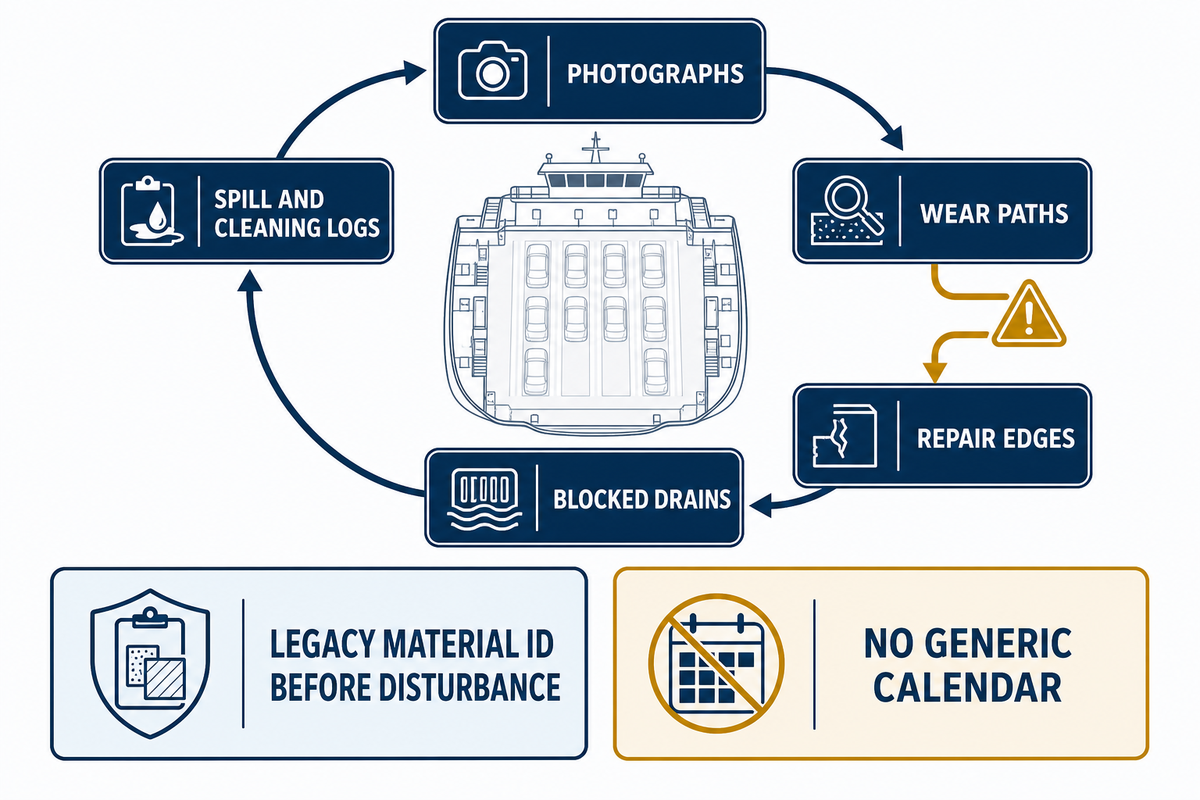
Maintenance commences with the accepted build-up and not with a generic calendar. Inspection and cleaning depend on the traffic, moisture, contamination and the finished state as well as the manufacturer’s instructions and the vessel procedures, repair compatibility, drain and edge detail, and the service window. A new penetration or new cleaning materials may influence the situation and affect the hidden layers.
Track floor condition by zone. Photographs, spill and cleaning logs, wear paths, repair edges, blocked drains, sealant changes, and reports from passengers or crew members assist a later investigation. A fixed lifetime isn’t credible without the product, construction, load, environment, maintenance history, and acceptance basis.
Prior to sanding, scraping, or performing any other removal method on a floor in a legacy refit, it’s necessary to know what flooring was installed initially. In cases of work performed by US shipyards, 29 CFR 1915.1001 includes a condition specific presumption for resilient flooring or deck material in vessels constructed no later than 1980 as well as the associated mastic and backing. Other territories require a determination specific to them.
That specific example isn’t a removal method for a broad audience. It illustrates that the project must identify legacy materials, competent parties, occupied-space boundaries, dust and ventilation controls, waste routes, and applicable law before disturbance. An urgent sailing date won’t make unknown backing materials routine debris.
Maintenance capsule: condition, cleaning, spill, repair, and change records connect the floor’s service history to its accepted build-up. Though procurement may favor a fixed replacement interval, a condition-led plan provides each zone with an inspection trigger, escalation owner, compatible repair route, and documented service window.
Transfer the Control Pack into a Project-Fit Handoff
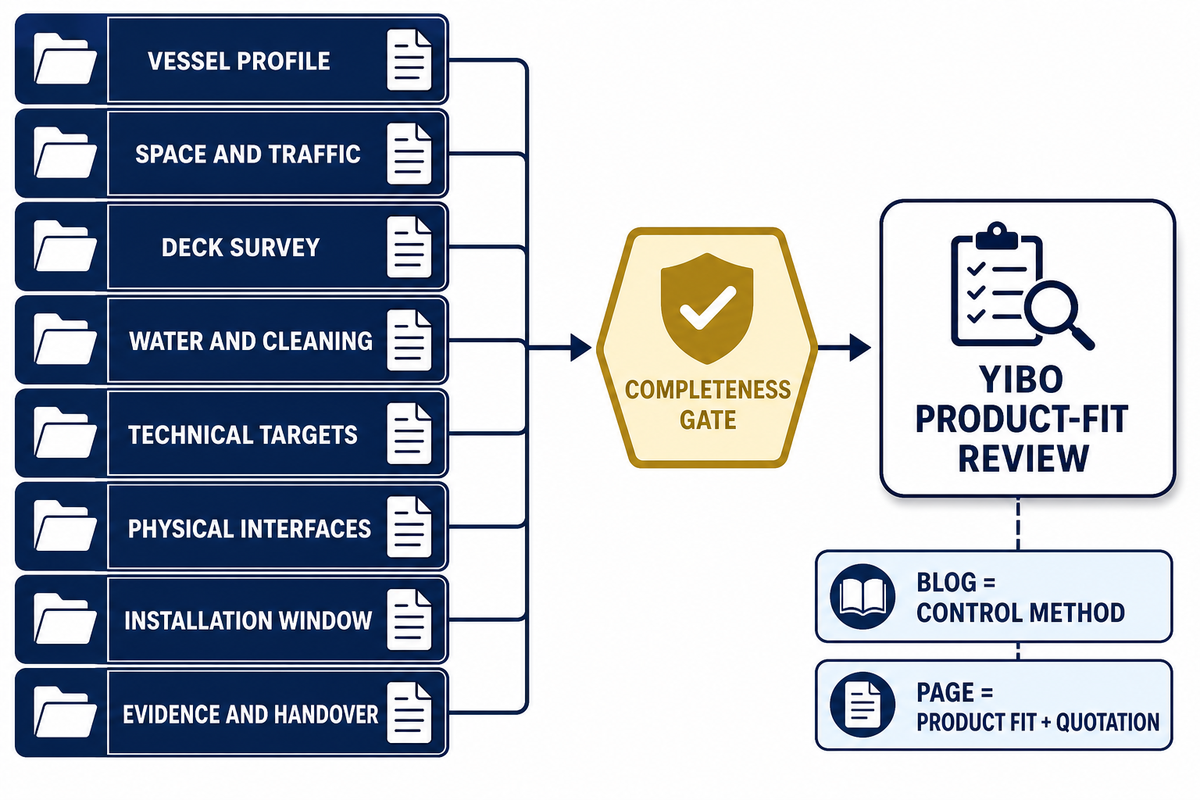
A detailed control pack for ferry flooring will provide the commercial reviewer with a vessel, zone schedule, deck condition, area and geometry, exposures, cleaning regime, technical targets, interfaces, installation window, witness plan, evidence list, and acceptance owners. Unknowns will remain visible so the commercial Page can review product fit, assumptions and exclusions within the given information.
Copy these records into the product-fit handoff
- Vessel type, service, flag, class, newbuild or refit status
- Space schedule, traffic, wheeled loads, footwear, and access needs
- Deck survey, repairs, prior coatings, area, falls, and geometry
- Water, contaminants, cleaning chemistry, tools, and drying window
- Fire, acoustic, accessibility, weight, load, hygiene, and appearance targets
- Drains, thresholds, doors, penetrations, partitions, and equipment bases
- Installation access, environment, cure protection, and return-to-service milestones
- Evidence scope, witness points, reviewers, deviations, and handover format
Once the control pack is ready, send it to Yibo’s ferry product-range and project-fit review. The linked Page owns product families, current project documents, fit review, and quotation. This guide owns workfront control, evidence boundaries, installation records, failure evidence, service history, and handover—not material selection or quotation.
Related system routes: after the control pack is complete, compare the recorded service duty with Yibo’s acoustic floor system overview, primary-deck underlayment options, self-levelling preparation route, and resin floor family overview. These are commercial system routes; this guide continues to own the neutral planning method.
Suzhou Yibo Industry & Trade Co., Ltd. states that it was founded in September 2001 in Suzhou and supplies marine floating floors, deck coverings, damping coatings, polyurethane levelling coverings, polyester underlayments, and imitation teak floors. The company also reports a site exceeding 6,000 m². Please check each current certificate and product approval of the exact entity, product, build-up, scope, and project route.
Bring the Control Pack to Technical Review
Please send your vessel profile, zone schedule, workfront and interface records, target evidence, installation window, and remaining issues. Yibo can review product range and project fit from a defined control pack without turning a generic finish into a promise of suitability.
Handoff capsule: eight project-input groups make the control pack comparable without reproducing product selection or quotation content from the commercial Page.
Frequently Asked Questions
These answers address common ferry floor planning questions at the level a general guide can support. Vessel-specific suitability, numeric installation values, approval, hazardous-material work, and final acceptance still belong to current project documents and the responsible flag, classification society, designer, shipyard, inspector, operator, and product supplier.
What flooring is used on passenger ferries?
Passenger ferries use several floor families because each space creates a different duty shaped by traffic, moisture, cleaning, interfaces, acoustic needs, fire-test scope, repair access, and accessibility.
Common families include textile, resilient, resin-applied, primary deck, floating acoustic, synthetic teak, and heavy-duty systems. Compare each complete build-up against the passenger or vehicle zone, traffic, water, cleaning, accessibility, fire, acoustic, weight, interface, installation, and evidence requirements. Material families also need compatible substrates, adhesives, terminations, and maintenance routes; none is a universal ferry-wide answer.
How do you choose flooring for a ferry deck?
Start a ferry floor project with a control record for each ferry zone, then confirm the deck, interfaces, service condition, workfront release, evidence owner, and approval route before sending the record to product-fit review.
Record the vessel and service profile, space and traffic, water and contaminants, cleaning, technical targets, deck and interfaces, installation window, and evidence owners. Do not use the register to rank products; send sourced and visibly open inputs to the commercial Page for project-fit review. Keep vehicle-deck drainage, accessibility, acoustic design, and hazardous legacy materials in their applicable specialist workstreams.
What documents should be checked before accepting ferry flooring?
Acceptance checks should cover the approved build-up, product identity, installation history, hidden work, deviations, and final records, with each record linked to the exact zone, layer, batch, revision, witness, and acceptance decision.
Check drawings, location schedules, current technical and safety documents, exact product and batch traceability, substrate release, application and environment records, concealed-layer witness entries, interface photographs, deviations and repair dispositions, final inspections, cleaning and maintenance limits, and the relevant test or approval documents. Confirm scope, issuer, date, revision, substrate, represented assembly, and decision owner. Index each record to its ferry zone and layer, distinguish a laboratory result from installed-work acceptance, and identify superseded documents. Preserve the reason for every authorized deviation, the repair method used, the reinspection result, and the person or organization that released the next action. If a certificate or approval names a different substrate, adhesive, variant, or use, treat that mismatch as an open technical decision instead of assuming equivalence.
Is non-slip ferry flooring always safe when wet?
No generic non-slip label can establish safety across wet or contaminated ferry conditions because actual safety also depends on drainage, footwear, cleaning method, wear state, and the agreed test condition.
Safety depends on the test condition, installed texture and wear, water path, drainage, threshold geometry, contamination, footwear, cleaning chemistry, tools, and maintenance. Define the service condition and acceptance method. Investigate an incident in its actual state rather than transferring a dry or differently contaminated result to it.
When should ferry flooring be repaired instead of replaced?
Repair scope follows the affected layer, extent, mechanism confidence, interface condition, and compatible repair route; confirm the cause and repair build-up before opening the area or committing to replacement.
Map the symptom, preserve samples and records, identify water or contamination paths, review build-up and batch history, and test competing causes before removal. A bounded surface defect may permit local repair; widespread interface, substrate, or hidden-layer failure may require a larger scope. Complete the hazardous-material review first when legacy construction is unknown.
How This Ferry Guide Was Framed
The editorial method used in this guide separates the ferry-duty and evidence-planning task from Yibo’s commercial solution Page. Regulatory examples are labelled by jurisdiction, while product and approval claims remain document-specific. Its control registers and evidence-recording sequences are editorial planning aids rather than class forms or product-selection tools.
References & Sources
The sources listed below address issues of layer scope, space duties, accessibility examples, vehicle-deck drainage, workfront control, defect description, diagnostic method, slip context, and legacy-refit boundaries. They don’t approve a Yibo product or select a build for a particular ferry.
- 46 CFR subpart 164.106 The procedure for approval of primary deck-covering systems in the United States.
- 2010 Fire Test Procedures Code Fire test construction code (represented text) published by the government.
- United Kingdom Maritime and Coastguard Agency MSN 1844 jurisdiction-specific space, floor, cleaning, and drainage duties.
- Archived U.S. Access Board passenger-vessel draft guidance, Chapter V3 deck-surface and carpet provisions with a wheelchair rolling-effort advisory.
- Archived U.S. Access Board passenger-vessel draft guidance, Chapter V4 named threshold and transition contrast examples.
- International Maritime Organization SLF 51 summary closed vehicle and ro-ro space drainage context.
- NAVSEA Standard Item 009-032 FY26 – example of a government process-control scope.
- ISO 4628-1:2016 public scope page coating-defect observation vocabulary, not causal diagnosis.
- Federal Highway Administration Distress Diagnosis Method – diagnostic analogy that crosses domains.
- United Kingdom Health and Safety Executive: Slips and Trips in Ports – wetness, contamination, surface, footwear and maintenance.
- 29 CFR 1915.1001 – US Shipyard Asbestos Rule and boundary of condition specific flooring.
- DNV Approval Finder – route to check a named record for which approval is issued.
Editorial Method Note: The ferry workfront records, concealment records, and pre-repair evidence sequence in this guide are editorial planning aids. They aren’t forms issued by the International Maritime Organization, a flag administration, or a classification society, and they do not replace product-fit review on the commercial Page.

![Marine PU Floor: Selection & Installation [Guide]](https://yibomarine.com/wp-content/uploads/2026/09/marine-pu-floor-blog-featured-150x150.png)