Get in touch with Yibo Company


100% Solid Epoxy Flooring: Volume Solids, Dry-Film Thickness Mils, and Coverage Balance

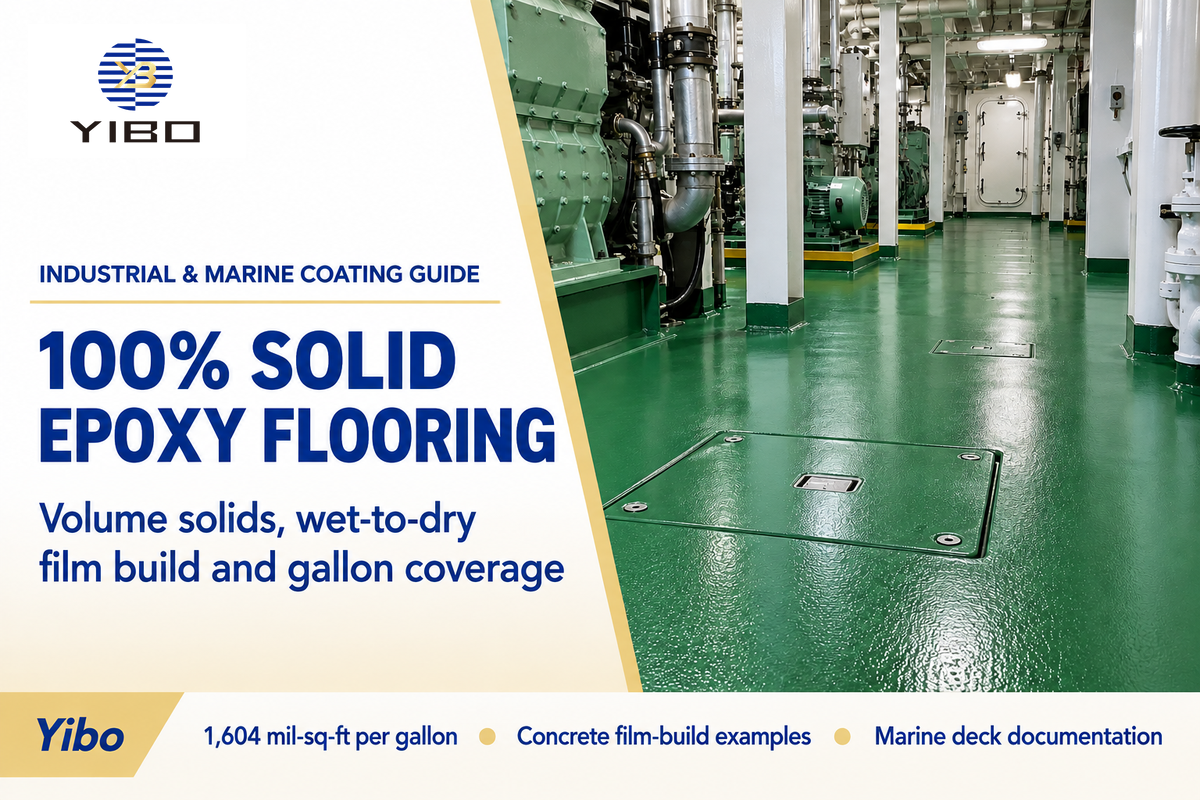
A 100% volume-solids epoxy can build a thicker dry film per coat than many carrier-based products. Check the product data sheet separately for its volatile organic compound content. According to Top Epoxy Flooring, a single basecoat cures at 10 mils or more. Retail water-based coatings often finish around 1 to 3 mils total. Engineers and shipyards specify marine epoxy floor coating systems and high-build concrete coatings where thin hardware-store epoxy paint would fail.
Key Engineering Takeaways (At a Glance)
- For a 100% volume-solids epoxy, 16 wet mils yields approximately 16 dry mils on a non-absorptive surface (One Stop Epoxy). ASTM D2697 measures solids by volume under laboratory conditions.
- Under the 1,604 mil-square-feet-per-gallon constant, one theoretical gallon covers 160 square feet at 10 mils (One Stop Epoxy). That same gallon covers 100 square feet at 16 mils or 80 square feet at 20 mils.
- According to Stellar Surfaces, Southern California installation examples range from $3 to $12 per square foot. Those installations last 10 to 20 years in residential settings and 5 to 10 years in heavy commercial settings.
- Before priming, compare slab moisture readings with the coating system’s limits. One supplier uses a moisture vapor barrier above 75% relative humidity or a moisture vapor emission rate of 3 lb per 1,000 sq ft in 24 hours. Check the limits for the system you plan to install (Xtreme Polishing Systems, ASTM F1869).
What Does 100% Solid Epoxy Flooring Mean for Film Build?
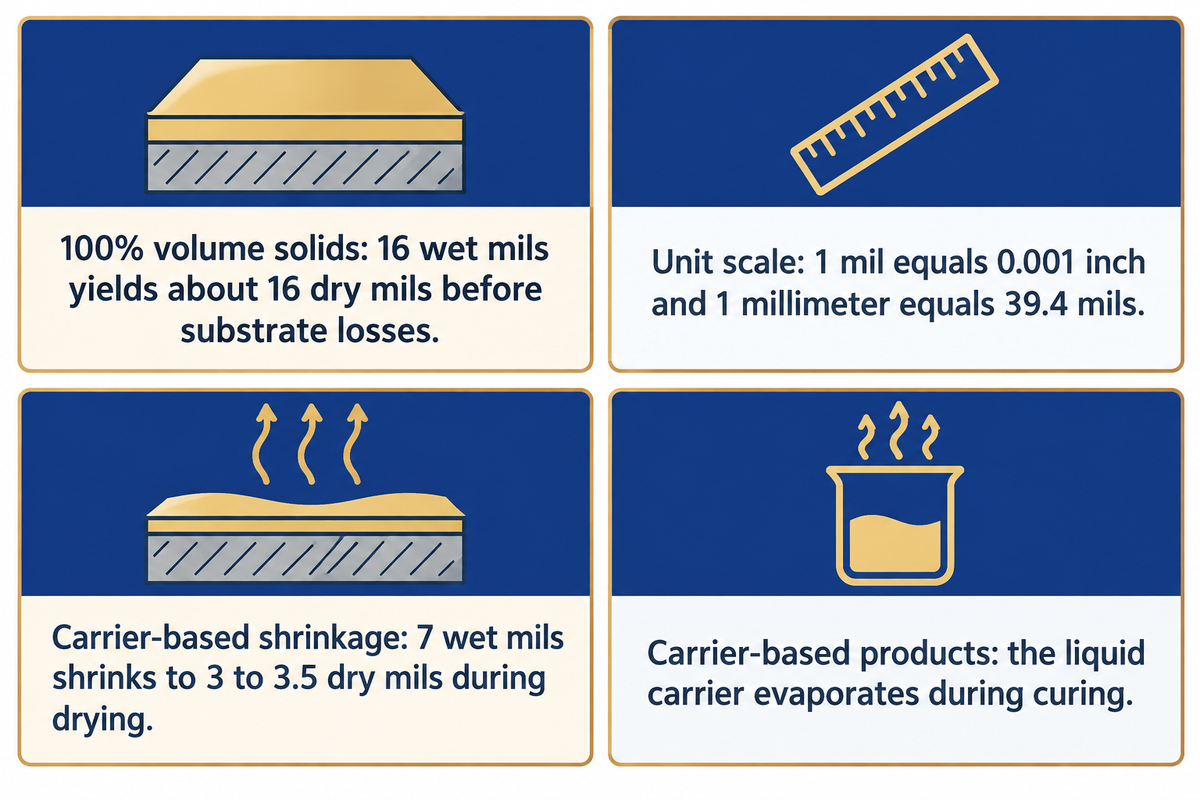
Verify the reported volume solids for a coating labeled 100% solids using ASTM D2697. At 100% volume solids, a 16-mil wet coat yields approximately 16 dry mils before substrate losses (One Stop Epoxy).
Understanding film build on the jobsite starts with unit conversion. One mil equals 0.001 inch, and one millimeter equals approximately 39.4 mils (One Stop Epoxy). Installers spread a carrier-free 100 percent solids epoxy across prepared concrete floors. Curing then happens through chemical cross-linking between Part A epoxide resin and Part B amine hardener. No water or solvent carrier has to evaporate for the wet epoxy to harden.
Buyers often confuse retail garage paint labels with true volume-solids formulations. Water-borne and solvent-borne products suspend epoxy resin inside a liquid carrier that evaporates during curing. According to Sherwin-Williams High Performance Flooring, a carrier-based epoxy applied at 7 mils wet film thickness shrinks to 3 to 3.5 mils dry film thickness.
An AlphaGarage contributor notes that the liquid carrier evaporates as the coating dries and describes microscopic channels in the cured film.
A 100% solids epoxy base coat can build a thicker film on residential and commercial concrete at the same wet thickness. Compare each product’s test data for the chemical exposure you expect (Sherwin-Williams).
Volume Solids Material Balance: Wet-Film vs. Dry-Film Thickness Math
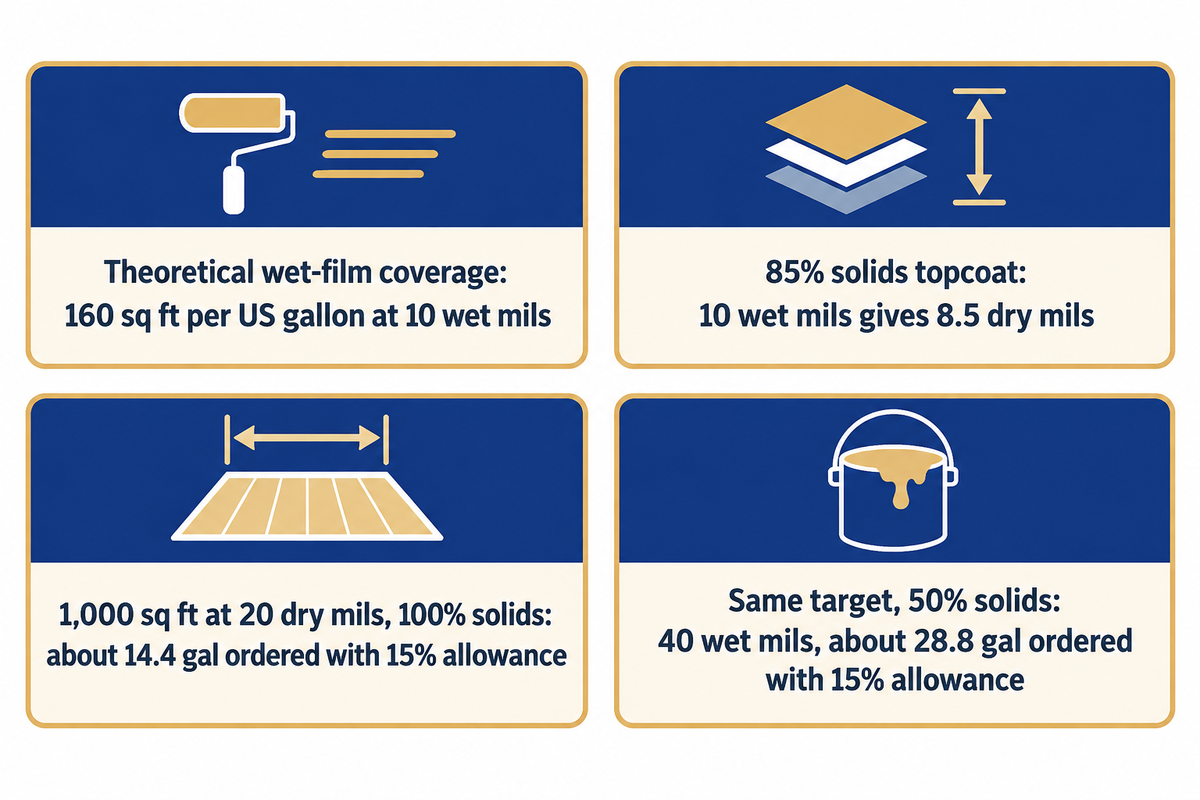
A 100% solids epoxy applied at 16 wet mils yields approximately 16 dry mils before surface texture and absorption. One theoretical gallon covers 160 square feet at 10 mils, or 100 square feet at 16 mils (One Stop Epoxy).
We refer to this volume relationship as The 1,604 Mil-Gallon Conservation Law. Because one U.S. gallon equals 231 cubic inches, spreading that volume across 1 square foot yields a theoretical constant of 1,604 mil-square-feet per gallon. For wet-to-dry thickness and coverage calculations, use solids by volume because solids by weight does not give retained film volume. For example, One Stop Epoxy notes that an 85% volume-solids coating applied at 10 wet mils theoretically produces 8.5 dry mils.
Worked Example: 1,000 sq ft Floor at 20 Mils Target Dry-Film Thickness
Assumed inputs cover a 1,000-square-foot concrete slab prepared to ICRI CSP 2–3 with a 20-mil dry-film target. We add an illustrative 10%–15% purchasing allowance for concrete surface texture, pore space, and mixing waste.
- Option 1 uses a 100% volume-solids epoxy where one theoretical gallon covers approximately 80 square feet at 20 mils on a smooth non-porous surface (One Stop Epoxy). Dividing 1,000 square feet by 80 square feet per gallon gives a 12.5-gallon theoretical mixed-coating volume or 14.4 gallons ordered with a 15% purchasing allowance for ICRI CSP 2-3 texture, concrete porosity, and application waste in one high-build base coat.
- Option 2 uses a 50% volume-solids water-based epoxy where half of the wet film evaporates during cure. Reaching 20 dry mils requires 40 wet mils total across multiple passes. That equals 25.0 gallons of mixed coating before allowance, or 28.8 gallons ordered with a 15% allowance, with additional application passes.
On mechanically ground concrete, contractors must adjust theoretical smooth-plate coverage to account for concrete condition, surface profile, and roller retention.
| Coating Tier & Chemistry | Volume Solids | Applied Wet Film | Cured Dry Film | Cure Loss | Published Benchmark Note |
|---|---|---|---|---|---|
| Retail Water-Based Coating | 40%–60% | 6 mils | 2.4 to 3.6 mils, theoretical | Up to 60% loss | Retail water-based finish (Top Epoxy Flooring) |
| Carrier-Based Epoxy Coat | 50% | 7 mils | 3.5 mils, theoretical | 50% carrier loss | Carrier evaporation benchmark (Sherwin-Williams) |
| High-Solids Solvent Epoxy | 70%–97% | 10 mils | 7 to 9.7 mils | 3%–30% theoretical loss | High-solids shrinkage range (ArmorGarage) |
| Polyaspartic Topcoat (PolyGloss 85) | 85% | 10 mils | 8.5 mils | 15% carrier loss | 10 wet mils × 0.85 = 8.5 dry mils (One Stop Epoxy) |
| 100% Solids Epoxy (Thin Seal) | 100% | 10 mils | 10 mils | None (neat resin) | 160 square feet per gallon (One Stop Epoxy) |
| 100% Solids Epoxy (Standard Build) | 100% | 16 mils | 16 mils | None (neat resin) | 100 square feet per gallon (One Stop Epoxy) |
| 100% Solids Epoxy (High Build) | 100% | 20 mils | 20 mils | None (neat resin) | 80 square feet per gallon (One Stop Epoxy) |
| Industrial Warehouse System | 100% base | Varies by coat | 25–30 mils | Multi-coat build | Warehouse build with aggregate (ArmorGarage) |
| Heavy Tonnage Forklift System | 100% base | Varies by coat | 30–35 mils | Multi-coat build | Forklift & heavy equipment build (ArmorGarage) |
Dry-Film Thickness Mils and Gallon Coverage by Traffic Load
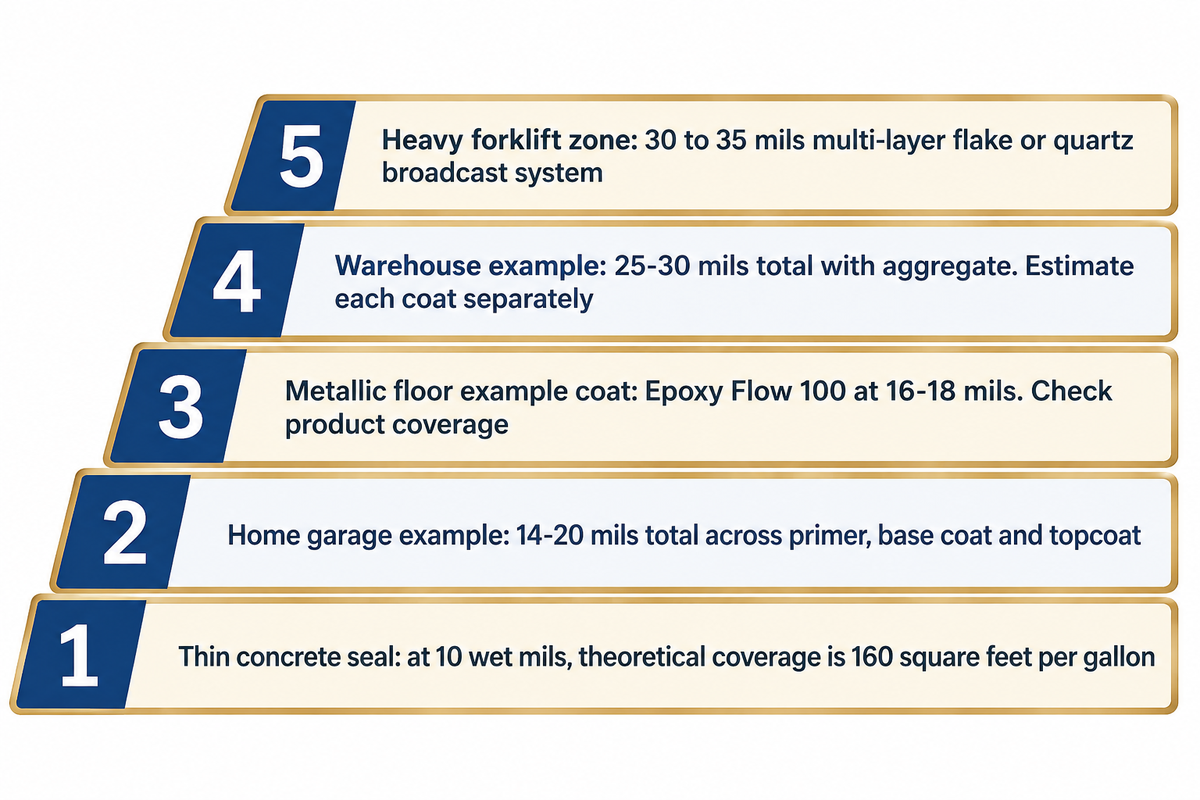
According to ArmorGarage, home garage floors take 14–20 mils total build, industrial warehouses need 25–30 mils, and heavy forklift zones call for 30–35 mils. One theoretical gallon covers 160 square feet at 10 mils or 100 square feet at 16 mils (One Stop Epoxy).
ArmorGarage adds that home garage floors use 14-20 mils total build, across primer, epoxy base, and topcoat. Industrial spaces, like warehouses and manufacturing plants, take 25-30 mils, often with aluminum oxide or quartz aggregate. Heavy tonnage industrial zones with forklifts take 30-35 mils with a wear resistant topcoat.
In field application, coverage rate varies by decorative system and wet-film pull. Concrete Floor Supply recommends 16–18 mils per coat for its cycloaliphatic amine epoxy, which equals approximately 89–100 square feet per gallon on a theoretical volume basis. Field datasheets also list 100–125 square feet per gallon at thinner pulls for solid color epoxy and flake epoxy floors, or 80–100 square feet per gallon for metallic epoxy systems.
| Facility Traffic Class | Target System Build or Example Coat | Coverage Rate (Theoretical Unless Noted) | Recommended System Architecture |
|---|---|---|---|
| Thin Seal / Penetrating Base | 10 mils | 160 square feet per gallon | Single seal coat over prepared concrete slab |
| Home Garage Floors & Light Workshops | 14–20 mils | Approximately 89–100 square feet per gallon (at 16–18 mils) | Primer + epoxy base + partial flake floors or clear coat |
| Metallic Epoxy Showroom Floors | 16–18 mils for the example coat | Manufacturer’s metallic spread rate for Epoxy Flow 100: 80–100 square feet per gallon | Primer with background color + self leveling metallic build |
| Industrial Warehouses & Manufacturing | 25–30 mils | 80 square feet per gallon (at 20 mils base) | Primer + high build body coat + aluminum oxide aggregate |
| Heavy Tonnage Forklift Zones | 30–35 mils | Varies by layer and product | Full flake epoxy or quartz broadcast to rejection + topcoat |
How Many Gallons of 100% Solids Epoxy Do You Need for 1,000 sq ft?
Coating 1,000 square feet requires 10 theoretical gallons at 16 mils (100 square feet per gallon) or 12.5 theoretical gallons at 20 mils (80 square feet per gallon) (One Stop Epoxy). This example adds a 10%–15% purchasing allowance. Concrete pores and surface texture can increase consumption, so use the project’s measured spread rate when available.
When ordering a commercial gallon kit or a complete flooring kit for a 1,000-square-foot epoxy project, match volume to each layer. Full broadcast systems need separate quantities for the epoxy base coat and the finish. For a solid color epoxy floor or a decorative flake floor pulled at 16 mils, 10 gallons of mixed epoxy will cover 1,000 square feet before waste. For full vinyl-flake broadcast systems, One Stop Epoxy packages 3 gallons of base coat to cover 400 to 450 square feet as a flake receiver.
100% Solids Epoxy vs. Water-Based, Solvent-Based, and Polyaspartic Coatings
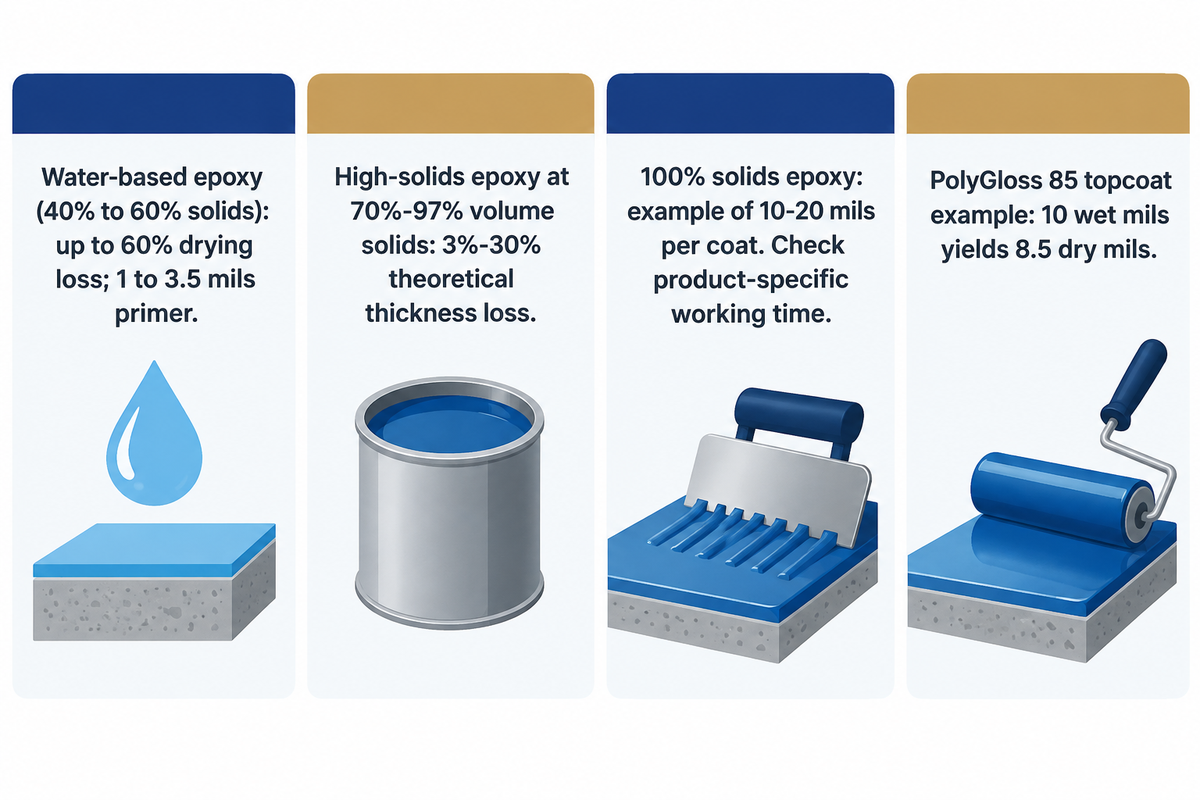
A 100% volume-solids epoxy has approximately the same wet and dry thickness under ideal conditions (One Stop Epoxy).
Rather than treating these chemistries as interchangeable substitutes, experienced epoxy installers combine them into a multi-layer floor system. According to ArmorGarage, water-based epoxy (40–60% solids) loses up to 60% of its applied volume during drying. That leaves 40%–60% of the wet film thickness as the cured film. High-solids epoxy at 70–97% volume solids has a theoretical thickness loss of 3–30%. Check the product sheet before choosing a primer or build coat.
At the surface of the system, aliphatic polyurethanes and polyaspartic coatings shield the epoxy base from sunlight and abrasion. Industrial polyaspartic topcoats such as PolyGloss 85 (85% solids) can be applied up to 10 wet mils in one pass under the product’s stated conditions (One Stop Epoxy). On steel ship decks, specifiers evaluate flexible marine polyurethane floor systems where deck flex requires higher elongation.
| Performance Metric | 100% Solids Epoxy | Water-Based Epoxy | High-Solids Epoxy | Polyaspartic (PolyGloss 85) |
|---|---|---|---|---|
| Published Solids Range | 100% | 40%–60% | 70%–97% | 85% |
| Evaporation Shrinkage | No carrier evaporation | Up to 60% loss | 3%–30% theoretical loss | 15% carrier loss |
| Cured Film Build | 10–20 mils per coat | 1–3.5 mils | Intermediate build | Up to 8.5 dry mils at 10 wet mils |
| Published Working Time | Product-specific. Check the pot life and floor time separately | About 2 hours in the cited carrier-based example | Carrier-dependent | 60 minutes up to 85°F (Slow Go) |
| UV Light Stability | Ambers when exposed to UV light | Moderate | Chalks and yellows | UV stable aliphatic |
| Primary System Role | High-build body & flake receiver | Thin primer or light sealer | Intermediate industrial coat | UV & abrasion wear topcoat |
What Is 20 Times Stronger Than Epoxy Flooring, and Does It Replace a 100% Solids Basecoat?
No – the term “20 times stronger” is a marketing claim for polyurea or polyaspartic coatings rather than a universal engineering rating. Allowable build (such as 10 mils per pass for PolyGloss 85) and basecoat rules depend on each system (One Stop Epoxy).
Aliphatic polyaspartic topcoats generally improve UV stability and surface abrasion resistance compared with bare aromatic epoxy. Allowable one-pass thickness and bubble controls are governed by each product’s application datasheet. Multi-layer commercial systems commonly pair a 16-mil 100% solids pigmented epoxy build coat underneath an 85% solids polyaspartic finish.
Resin Chemistry and Mechanical Specifications (Shore D, Adhesion, Abrasion)
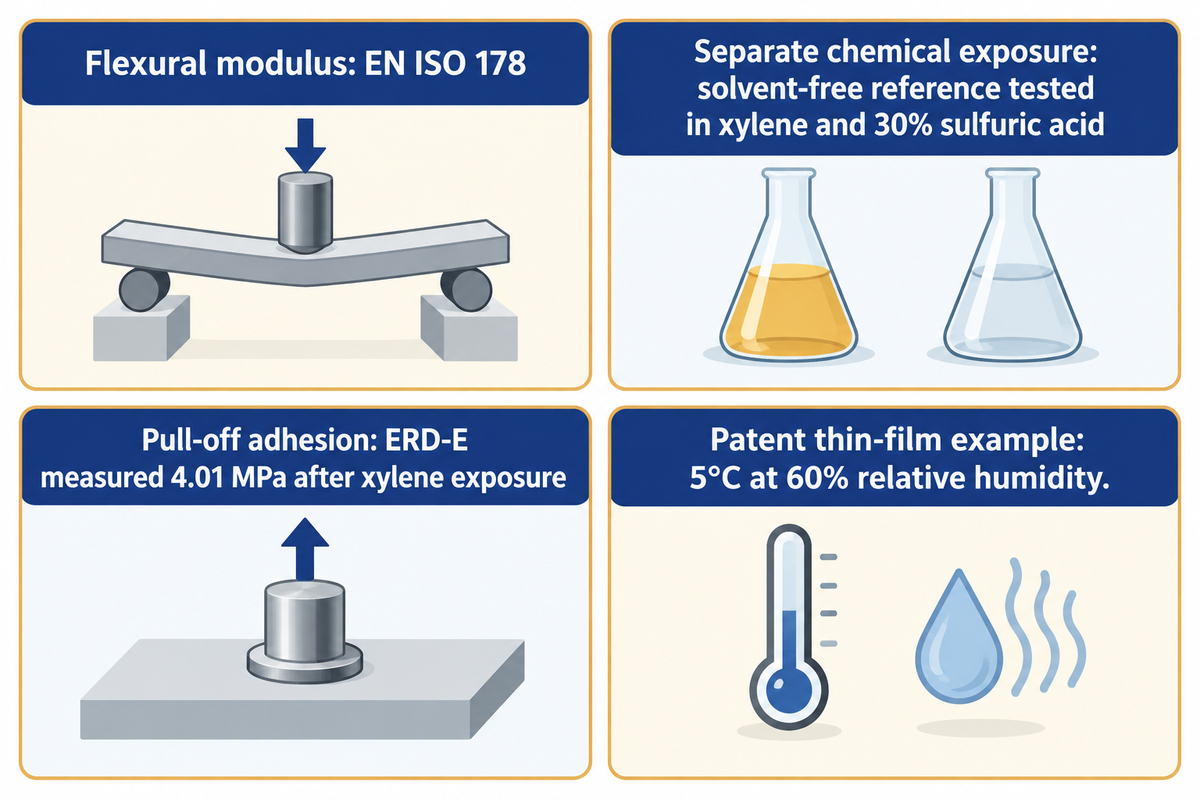
In one study, the solvent-free epoxy reference showed no discoloration, blistering or peeling after exposure to xylene or 30% sulfuric acid (H2SO4). Adhesion depended on the formulation and exposure. For example, ERD-E measured 4.01 MPa on concrete after xylene exposure (Materials, Table 6).
The study compared three-layer solvent-free epoxy, waterborne epoxy and polyurethane coatings. The applied systems averaged 300–400 μm in thickness. The researchers used EN ISO 178 at a 5 mm/min loading rate to measure flexural modulus and tested chemical resistance separately (Materials).
Hardener selection affects working time and cure. Concrete Floor Supply describes Epoxy Flow 100 as a low-VOC formulation with a cycloaliphatic amine hardener. A separate patent application reports thin-film tests of specific phenalkamine formulations at 5°C and 60% relative humidity. At the lower test temperature, the clear coats developed haze, so check the product’s minimum application temperature and finish requirements for the job (Epoxy Flow 100, WO2019185567A1, paragraphs 0051–0054).
When comparing commercial grade epoxy, check whether the supplier reports Taber abrasion results under standard CS-17 wheel procedures. Compare Shore D hardness and wear ratings only when the test method and cure conditions match. Where the resin formulation matters, check the product data and ask for performance test results.
Key Downsides of 100% Solids Epoxy: Pot Life, UV Yellowing, and Slip Risk
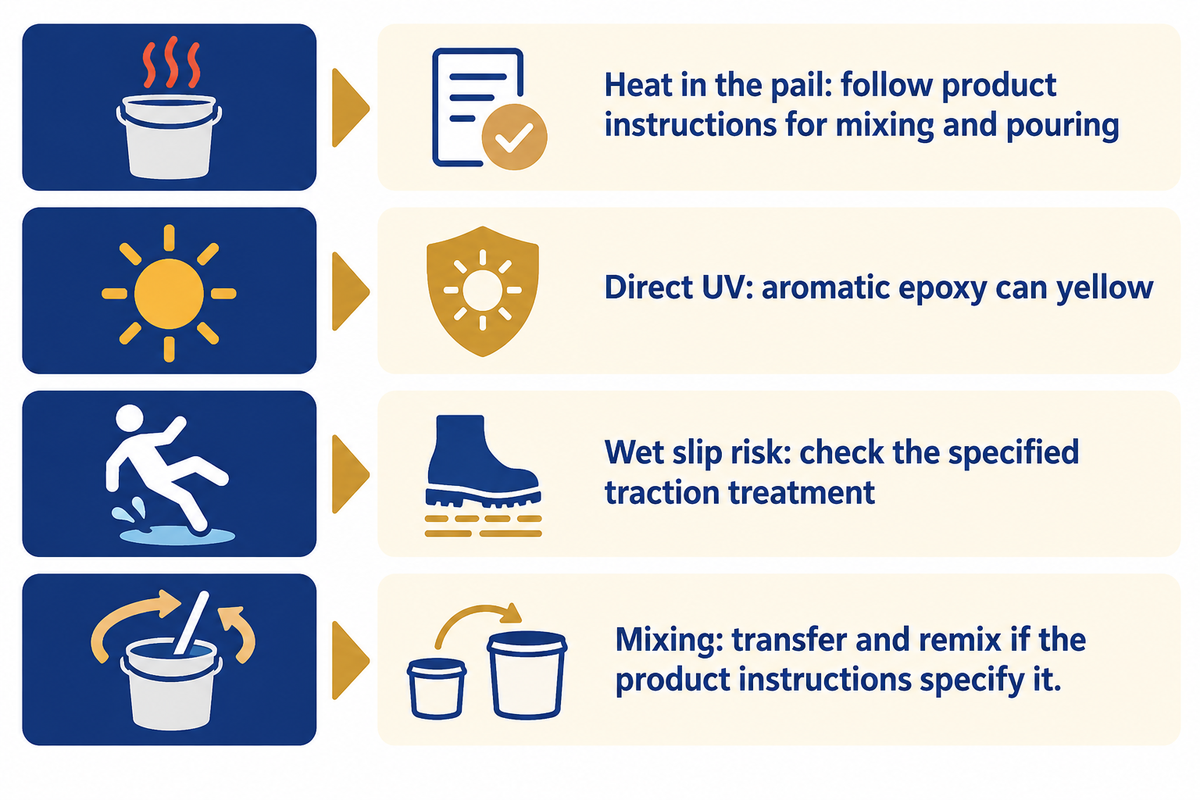
Direct UV exposure can yellow aromatic epoxies. Smooth finishes can also become slippery when wet. Check the specified traction treatment and verify the product’s application time before mixing.
Mixed epoxy releases heat as it cures. Heat can build quickly in a deep pail and shorten the time available to spread the coating. Epoxy Flow 100 lists approximately 20 minutes of working time on the floor and directs crews to pour immediately after mixing. Sherwin-Williams describes a separate 30–40 minute pot-life example for solvent-free epoxy. Check the current product instructions for batch size, temperature and the recoat window (Concrete Floor Supply, Sherwin-Williams).
Aromatic bisphenol-A rings oxidize when exposed to UV light, causing an unsealed epoxy garage floor to amber. A smooth solid color floor can become slippery when wet. Specify a traction treatment for the intended service conditions and confirm the finished surface meets the project requirement. Stellar Surfaces reports service lives of 10–20 years for residential installations and 5–10 years for heavy commercial environments with a protective topcoat.
| Downside / Failure Mode | Root Physical Mechanism | Published Benchmark | Mandatory Jobsite Prevention |
|---|---|---|---|
| Exothermic Bucket Flash Cure | Heat accumulates in a deep mixed batch | Mixed resin left in a deep pail | Pour mixed resin into floor ribbons immediately |
| Ambering & Chalking | Aromatic ring oxidation under sunlight | Direct or window UV exposure | Seal with PolyGloss 85 polyaspartic or urethane |
| Wet-Floor Slip Hazard | Smooth self-leveling resin film | 16–18 mil neat gloss finish | Broadcast flake blends, quartz, or aluminum oxide |
| Uncured Sticky Soft Spots | Unblended resin scraped from pail walls | Off-ratio mixing or unblended walls | Follow the mixing procedure, including transfer and remixing if specified |
Substrate Preparation, Moisture Limits, and Coating Application
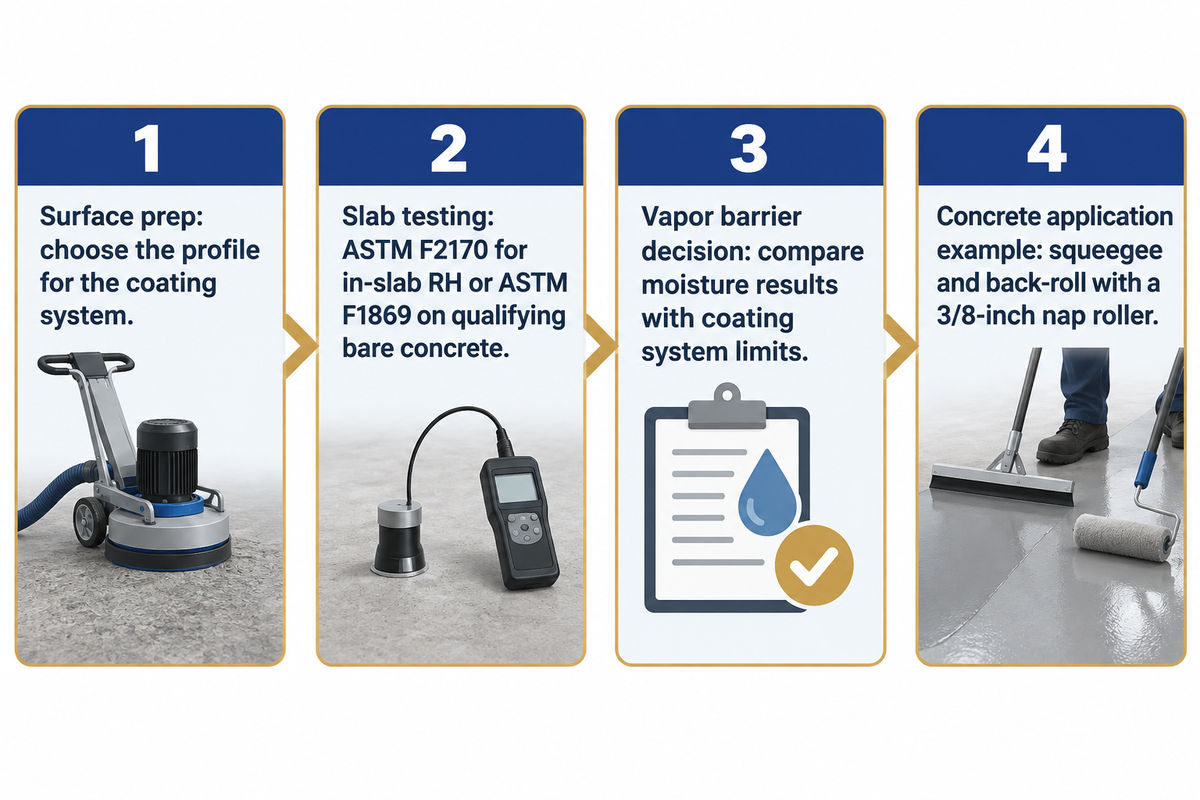
Mechanical preparation uses either planetary diamond grinding or shot blasting to create the concrete surface profile required by the coating system. Xtreme Polishing Systems recommends grinding slabs to ICRI CSP 2 or CSP 3 before priming.
Epoxy can bond to weak laitance and still peel when that concrete layer breaks away. Remove weak material and follow the selected coating system’s instructions for the concrete profile. Xtreme Polishing Systems gives ICRI CSP 2 or CSP 3 as examples and recommends mechanical preparation where acid etching may leave an inconsistent profile (Xtreme Polishing Systems).
“40 mils of something that doesn’t adhere well will peel off near as quickly as 6 mils.”
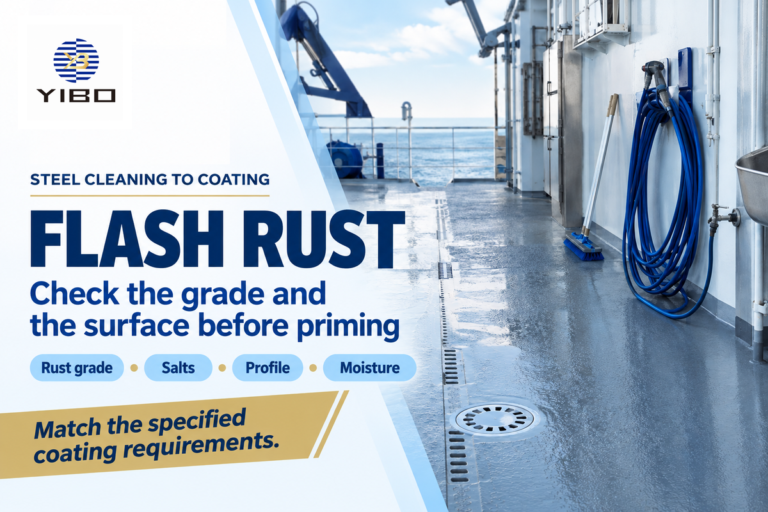
For mission-critical facilities, POWER Magazine discusses dust-shrouded grinding with HEPA extraction and the need to assess moisture before coating. On steel ship decks, follow the specified flash rust control on blasted steel decks. On concrete, some epoxy systems call for spreading the resin with a squeegee and back-rolling with a 3/8-inch nap roller (POWER Magazine, Colored Epoxies).
Do You Need a Moisture Vapor Barrier Primer Under 100% Solids Epoxy?
Compare the ASTM F2170 in-slab relative humidity result or the ASTM F1869 moisture-emission result with the coating system’s limits. Use F1869 only on qualifying bare concrete (Xtreme Polishing Systems).
Moisture beneath a concrete coating can contribute to blistering or loss of adhesion. Compare the test result with the coating system’s published limit before specifying a moisture vapor barrier (Xtreme Polishing Systems).
How Much Does 100% Solids Epoxy Cost per 1,000 sq ft and per Dry Mil?
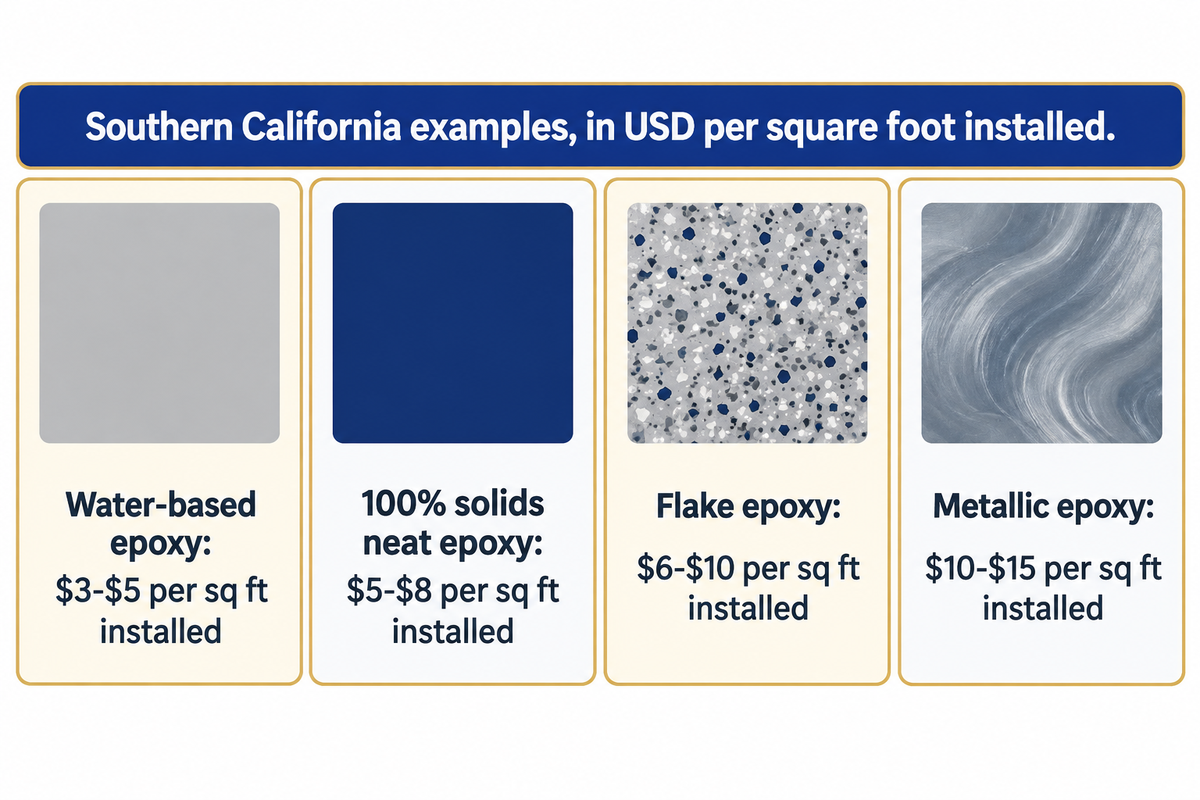
According to Stellar Surfaces, most Southern California jobs in the published example run from $3 to $12 per square foot installed. The upper price can be higher for premium metallic systems. Its examples include standard preparation. Depending on slab condition, the same guide gives $1 to $5 per square foot for surface-preparation work. Check what the quoted rate includes before adding a separate allowance.
Comparing coatings by wet gallon price alone leads buyers to think low-solids products are better, but part of the wet film evaporates during cure. In the Southern California cost examples published by Stellar Surfaces, water-based epoxy (40–50% solids) costs $3 to $5 per square foot installed and lasts 1 to 3 years. Solid epoxy (100% solids) costs $5 to $8 per square foot installed and lasts 10 to 20 years. Flake epoxy costs $6 to $10 per square foot (10 to 15 years), and metallic epoxy costs $10 to $15 per square foot. Retail DIY kits range from $100 to $500 for materials (Stellar Surfaces). For commercial materials, Concrete Floor Supply lists a 3-gallon 100% solids kit at $229.00 ($199.00 for 36+ kits). Meanwhile, One Stop Epoxy lists an 801–1,000 sq ft full-flake kit at $2,099.00.
At the published $5 to $8 per square foot installed rate, an illustrative 1,000-square-foot 100% solids epoxy job totals $5,000 to $8,000 before any separately quoted repairs or moisture work. If the quote specifies 16 dry mils, divide the installed rate by 16 to get about $0.31 to $0.50 per square foot per dry mil. Compare quotes on the same scope, including concrete repairs, moisture control and aggregate.
Installed Cost and Service-Life Examples
Published kit prices, Southern California installed-rate examples and reported service life (Stellar Surfaces; One Stop Epoxy; Concrete Floor Supply).
| System Type | Typical Build | Published Material Kit Benchmark | Installed Rate (per sq ft) | Published Service Life |
|---|---|---|---|---|
| Water-Based Epoxy (40–50% solids) | 1–3 mils | $100 to $500 (DIY material kits) | $3 to $5 per sq ft | 1–3 years |
| Solid Epoxy (100% solids neat coat) | 16–18 mils | $229.00 per 3-gal kit ($199.00 at 36+ kits) | $5 to $8 per sq ft | 10–20 years |
| Full Flake Epoxy + PolyGloss 85 | 25–30 mils | $2,099.00 (801–1,000 sq ft full kit) | $6 to $10 per sq ft | 10–15 years |
| Metallic Epoxy System | Varies with the full system | Varies by metallic pigment kit | $10 to $15 per sq ft | 10–20 years |
Specifying Epoxy Flooring vs. Primary Deck Coverings on Marine Vessels
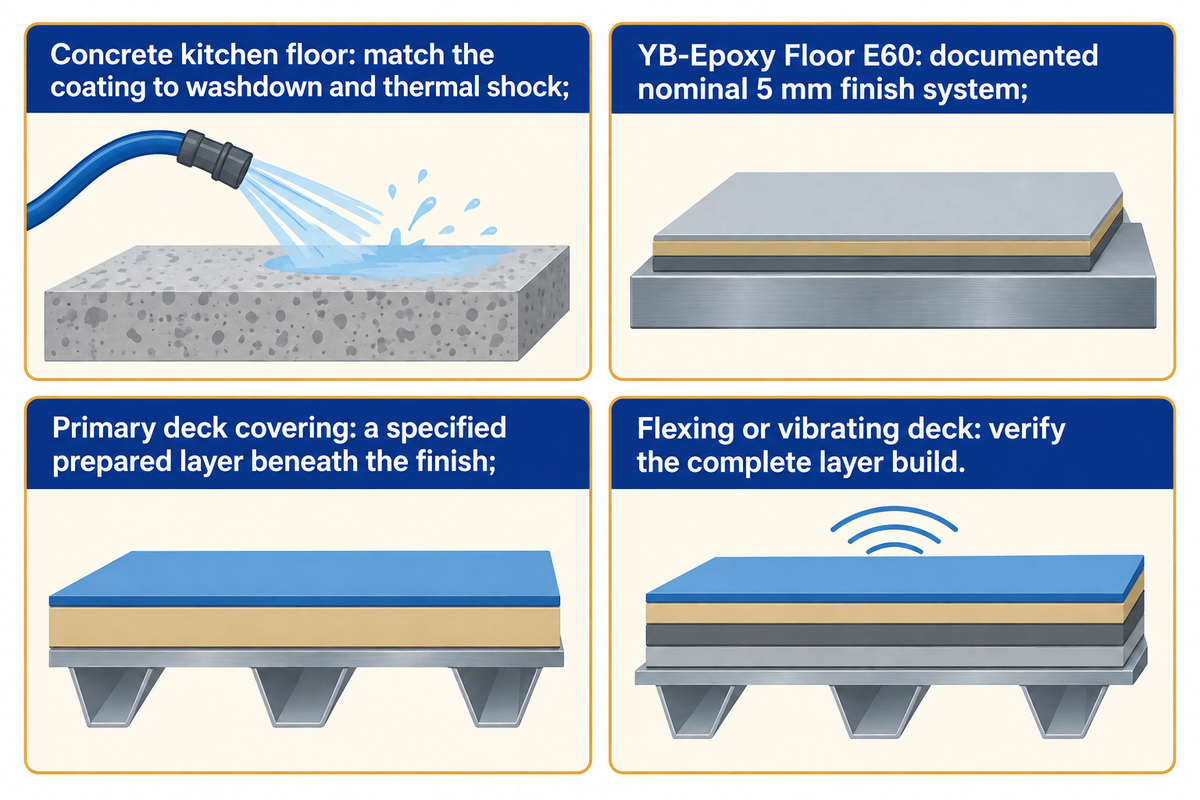
The IMO 2010 FTP Code addresses surface flammability in Part 5 and smoke and toxicity in Part 2. Check which tests apply to the proposed layers, substrate and service space (IMO Resolution MSC.307(88)).
On land, a commercial kitchen may need a thicker urethane cement mortar for thermal shock and washdown. On a vessel, first identify the steel deck and existing layers, then check which floor build matches the service space and deck movement (ArmorGarage, Yibo Marine).
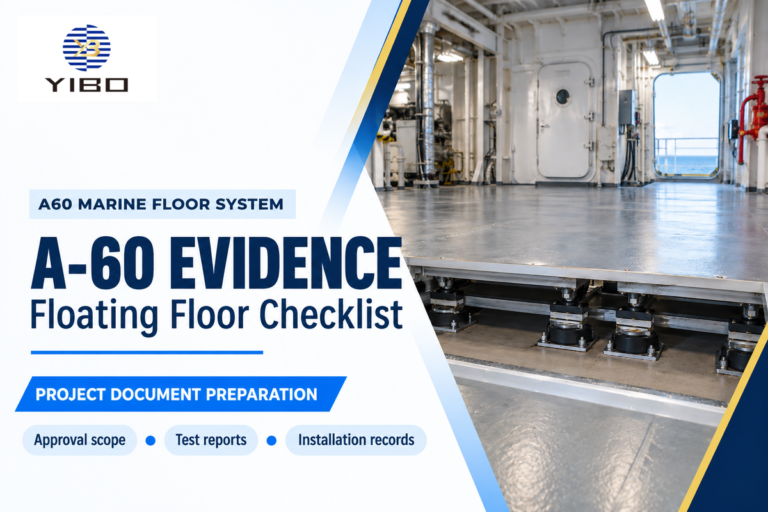
Yibo lists its primary deck coverings separately from its YB-Epoxy Floor E60 system. The E60 product page documents a nominal 5 mm build, with a 4.8 mm resin-and-sand layer and a 0.2 mm polyurethane varnish. For a leveling underlayer or a change to the finish, check that the proposed layers, substrate and adhesive match the current documents for the vessel space. Yibo provides separate documentation for its marine resin floor systems.
| Compartment / Substrate | Primary Structural Stress | Recommended System | Published Specification |
|---|---|---|---|
| Residential Concrete Garage | Hot tires & road salts | 100% Solids Epoxy + Flake | 14–20 mils total build (ArmorGarage) |
| Commercial Warehouse Slab | Pallet jacks & abrasion | High-Build Epoxy + Grit | 25–30 mils build with aggregate (ArmorGarage) |
| Heavy Manufacturing Concrete | Heavy forklift tonnage | Broadcast System + Topcoat | 30–35 mils build (ArmorGarage) |
| Chemical Containment Sump | Acid & xylene exposure | A lining rated for the actual chemicals and exposure | Confirm chemical, concentration, contact time and immersion conditions with the lining supplier. The 30% H2SO4 result is a laboratory example (Materials) |
| High-Humidity Concrete Slab | Sub-slab vapor pressure | 100% Solids MVB + Epoxy | Supplier example above 75% RH or 3 lb per 1,000 sq ft per 24 hours. Confirm system limits (Xtreme) |
| Commercial Kitchen / Food Prep | Thermal shock & washdown | Urethane Cement Mortar | 1/8–1/4 in urethane cement mortar (ArmorGarage) |
| Vessel Interior Workshop & Galley | Oil spills & foot traffic | Marine deck finish matched to the service space | Confirm approval for the space and traction in the expected wet or oily conditions |
| Uneven Steel Accommodation Deck | Deck leveling & fire rules | Primary deck covering matched to the specified finish | Confirm deck material, layer thickness and certificate scope |
| High-Vibration Marine Steel Deck | Hull deflection & vibration | Flexible leveling underlayer matched to the finish | Verify the complete layer build-up with the supplier |
When Should Shipyards Use Primary Deck Covering Instead of a Thin Bonded Epoxy Coat?
Specify a primary deck covering when the vessel design calls for a prepared layer beneath the finish. A thin epoxy coating follows the steel profile, so address plate irregularities and weld seams in the approved build-up before selecting the finish (Yibo primary deck coverings).
For flexing or vibrating decks, give the supplier the deck drawings and service conditions. Ask for the specified primer, leveling layer and finish, together with the documentation for the complete build.
How to Select a 100% Solids Epoxy Supplier and Verify Technical Datasheets
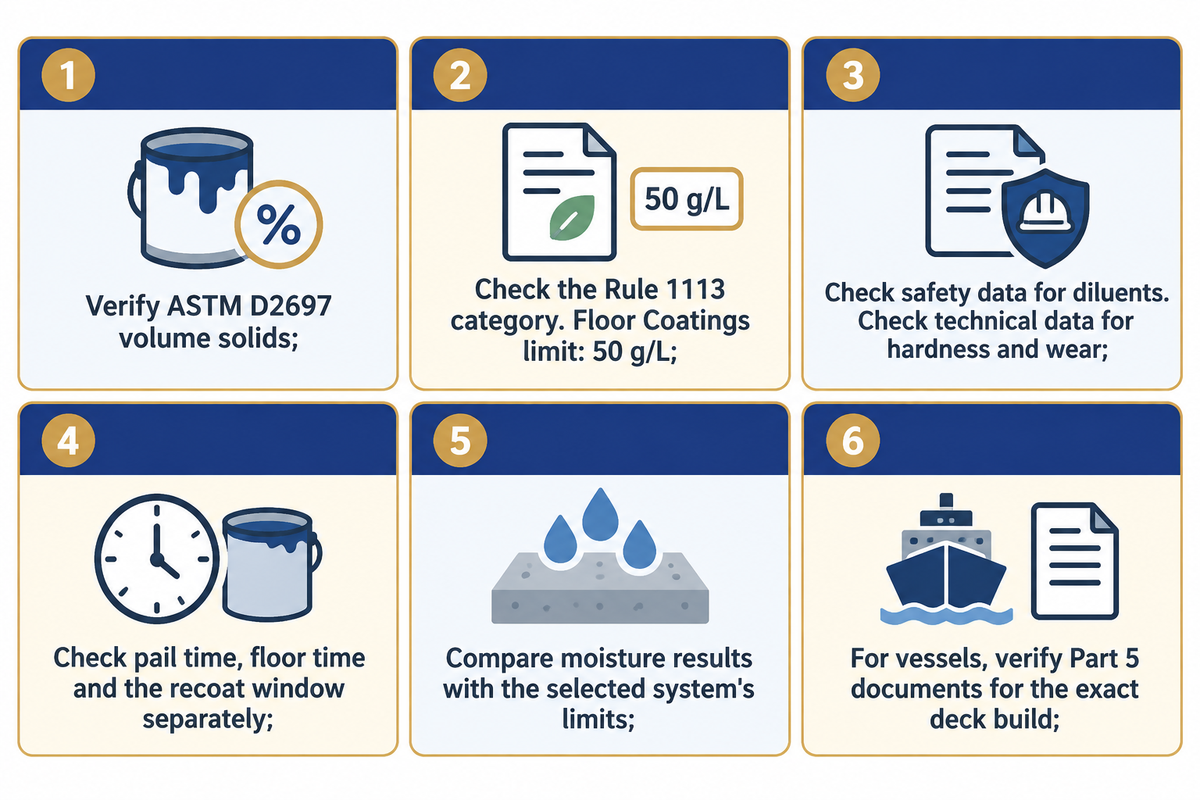
Verify that supplier datasheets report solids by volume measured under ASTM D2697. Compare the reported VOC content with the 50 g/L limit where the South Coast AQMD Floor Coatings category applies (SCAQMD). Also check batch pot life at 70°F and avoid low-solids $100 to $500 DIY kits (Stellar Surfaces).
Stricter air-quality rules and green-building documentation are shaping 2026 resin procurement. The South Coast Air Quality Management District (SCAQMD Rule 1113) sets a 50 g/L VOC limit for Category 14 Floor Coatings and 100 g/L for Industrial Maintenance Coatings. Meanwhile, Stonhard’s 2026 Commercial Flooring Outlook reports growing requests for Environmental Product Declarations (EPDs). For commercial spaces, check the project specification for its disclosure requirements.
No single brand is best for every substrate, so buyers should screen suppliers by application tier and technical datasheet thresholds. In the cited regional guide, basic water-based kits are commonly rated at 40–50% solids. The $100 to $500 DIY epoxy kit range is a separate material cost example (Stellar Surfaces). Compare the stated volume solids and tested film build before ordering coating kits for a commercial slab. Check kit sizes and coverage figures when comparing epoxy kits online. On the product sheet, verify ASTM D2697 volume solids, SCAQMD Rule 1113 VOC limits (50 g/L for Floor Coatings and 100 g/L for Industrial Maintenance Coatings), and product-specific working time at 70°F (approximately 20 minutes on the floor for the cited Epoxy Flow 100 example). For flake epoxy floors, check which primer and topcoat come with the kit. One Stop Epoxy full flake kits with a Poly Gloss 85 topcoat are an example. One Stop Epoxy self leveling systems are a separate product option. For marine vessel decks, request IMO FTPC Part 5 and system submittals from Suzhou Yibo Industry & Trade Co., Ltd.
6-Point 100% Solids Epoxy Datasheet (TDS) & RFQ Verification Checklist
Require suppliers to confirm these six parameters in writing before purchasing epoxy floor kits or approving marine deck submittals:
- Confirm the ASTM D2697 solids-by-volume value rather than solids by weight. A 100% volume-solids material yields approximately equal wet and dry film thickness (One Stop Epoxy).
- Verify VOC content against the 50 g/L Floor Coatings limit under SCAQMD Rule 1113 (SCAQMD). Epoxy Flow 100 is a separate low-VOC product example (Concrete Floor Supply).
- Read the epoxy product safety datasheet for disclosed diluents and the technical sheet for tested hardness and wear.
- Verify the published working time and whether it is measured in the pail or on the floor (Concrete Floor Supply; Sherwin-Williams). Confirm the product’s recoat window separately.
- Compare the applicable ASTM F2170 or ASTM F1869 slab moisture test results with the system’s moisture limits. Xtreme Polishing Systems uses a moisture vapor barrier above 75% RH or 3 lb per 1,000 sq ft per 24 hours as a supplier example.
- For marine steel decks, request the applicable Part 5 surface-flammability documents for the specified deck build. Check the substrate, layer sequence and limits of approval.
Frequently Asked Questions
Below are direct engineering responses to the most frequent questions about epoxy flooring from facility managers, contractors, and marine specifiers.
Q: How should crews prepare concrete before applying 100% solids epoxy?
Mechanical preparation removes weak concrete and creates the profile required by the selected coating. Xtreme Polishing Systems gives ICRI CSP 2 or CSP 3 as an example. Epoxy Flow 100 specifies CSP 3–5 using diamond grinding or shot blasting. Check the product instructions before choosing the method and target profile (Xtreme Polishing Systems, Concrete Floor Supply).
Q: Can 100% solids epoxy be applied over an existing garage or industrial floor coating?
Recoating can work when the old finish is fully cured, sound, clean and compatible with the new epoxy. Follow the manufacturer’s preparation procedure and remove failed or loose areas before recoating. Check the recoat window and ask the supplier whether a test patch is needed (Concrete Floor Supply, Top Epoxy Flooring).
Q: How long does 100% solids epoxy take to cure before foot and forklift traffic?
Epoxy Flow 100 lists 10 to 16 hours for recoating, at least 24 hours before light foot traffic, and 2 to 7 days for full cure and heavy traffic. Check the instructions for the coating used and confirm when the installed floor can return to forklift service (Concrete Floor Supply).
Q: Should 100% solids epoxy flooring be sealed with a polyurethane or polyaspartic topcoat?
Either can work if the manufacturer approves it for the base coat (One Stop Epoxy).
Q: What happens if mixed 100% solids epoxy is left in the bucket?
A mixed batch can heat up and harden faster in a deep pail. Epoxy Flow 100 directs installers to pour immediately after mixing and lists approximately 20 minutes of working time on the floor. Follow the product instructions for mixing and application, including any transfer and remixing steps (Concrete Floor Supply).
Q: How do vinyl flake and metallic epoxy systems change 100% solids coverage rates?
Flake systems use the base coat to receive chips. Metallic systems use a separate build to carry the pigment. Estimate each layer from its wet-film target and the product’s published coverage, such as 100 sq ft/gal at 16 mils (One Stop Epoxy).
Q: Does 100% solids epoxy meet IMO FTPC Part 5 fire standards for marine decks?
Volume solids do not establish compliance. Part 5 covers surface flammability. Where smoke and toxicity testing applies, check Part 2. Ask for the documents for the exact substrate, layer build-up and vessel space you are specifying (IMO 2010 FTP Code, Yibo E60 documented build).
Specify the Right Industrial or Marine Epoxy Floor System
Seeking technical datasheets, IMO FTPC Part 5 certificates, or a custom thickness and coverage schedule for your vessel deck or industrial facility? Explore Yibo’s marine epoxy floor coating systems or contact our engineering team for a project consultation.
References & Sources
- South Coast Air Quality Management District (SCAQMD) – Rule 1113 Table of Standards: Floor Coatings VOC Limit (50 g/L)
- Hodul, J., Mészárosová, L., & Drochytka, R. (2022), Materials 15(9), 3235 — New Chemically Resistant Coating Systems with Progressive Incorporation of Hazardous Waste in Polyurethane and Epoxy Matrices
- International patent application WO2019185567A1 – Phenalkamine epoxy curing agents and epoxy resin compositions containing the same
- Sherwin-Williams High Performance Flooring – Solvent-Based vs. Water-Based vs. 100% Solids Epoxy Technical Comparison
- One Stop Epoxy – How Thick Should an Epoxy Floor Coating Be? Wet-to-Dry Film Math & Coverage
- One Stop Epoxy – Full Flake 100% Solids Epoxy Floor Kits & PolyGloss 85 Slow Go Specifications
- Concrete Floor Supply – Epoxy Flow 100: 100% Solids Cycloaliphatic Amine Floor Epoxy Datasheet
- ArmorGarage – How Thick Is Epoxy Flooring & Why Does It Matter? Mil Build by Traffic Class
- Stellar Surfaces – 2026 Epoxy Flooring Cost Guide: Installed Pricing & Durability by System
- Xtreme Polishing Systems – Epoxy Floor Failure: 4 Mistakes That Ruin Your Coating (ICRI CSP 2–3 & 75% RH MVB)
- POWER Magazine – Special Flooring Considerations for Mission-Critical Facilities
- Stonhard – 2026 Commercial Flooring Trends: EPDs, HPDs, and Low-VOC Resinous Systems
- TBF Environmental – VOC and MIR Regulations by Industrial Coating Application
- GarageJournal Flooring Forum – Practitioner Field Discussion: High-Solids vs. 100% Solids Epoxies (#94588)
- Top Epoxy Flooring — What Is 100% Solids Epoxy Flooring — And Why Does It Matter?
- Colored Epoxies — 100% Solids Colored & Clear Epoxy Resin Kits
- Zeraus Products Inc. (Atta Zaghloul, M.Sc.) — About 100% Solids Epoxy Floor Coating Working Time & Maintenance Tradeoffs
- International Maritime Organization – 2010 FTP Code, Resolution MSC.307(88)
- Suzhou Yibo Industry & Trade Co., Ltd. – Yibo Marine Resin Floor Systems
About This Analysis
The coverage calculation uses 231 cubic inches per U.S. gallon, or approximately 1,604 mil-square-feet. The coating examples use published product data and laboratory results. For marine use, check the intended build against the applicable requirements and certificate scope (IMO 2010 FTP Code).
Commercial marine flooring systems
Plan the deck build-up before the workfront is released.
Yibo manufactures commercial marine flooring systems in Suzhou for vessel projects that need a coordinated deck-covering, resin-floor, or acoustic-floating-floor build-up.
Review marine deck covering systems, marine resin floor systems, and marine acoustic floor systems against the vessel area and planned application sequence.
Project enquiry
Give the engineering team the inputs that shape the system review.
Include the vessel area, substrate or deck condition, intended floor build-up, fire or acoustic target, and project schedule so the enquiry can begin with the relevant deck constraints.
Send Your Deck Schedule