Get in touch with Yibo Company

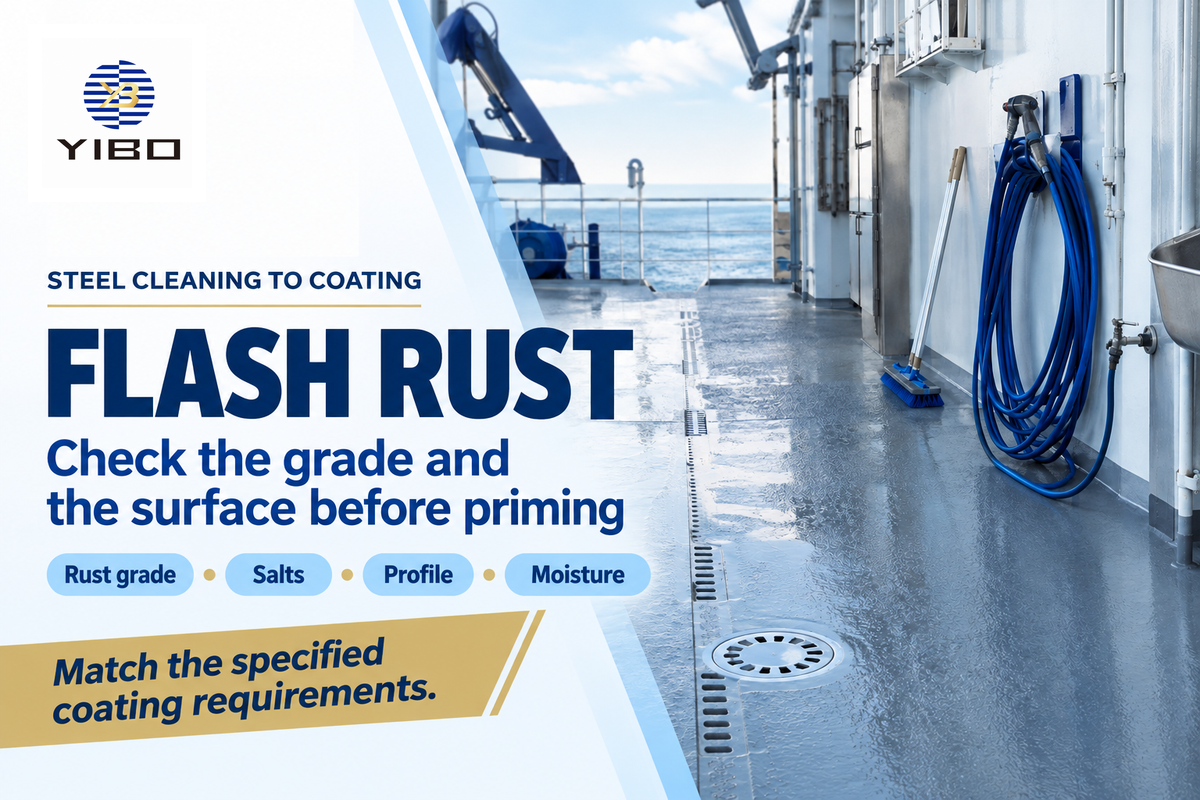
Flash rust is fresh orange-brown corrosion that develops quickly on wet, exposed iron or steel. Before painting, remove loose corrosion and meet the specified primer’s preparation requirements. A light rust film may be acceptable for a particular coating; a clean-looking deck still requires individual checks for salts, surface profile and moisture.
Rust can start before the rinse water has dried. In a demonstration by the Canadian Conservation Institute, a cleaned carbon-steel coupon immersed in tap water showed corrosion within 5 minutes. That makes the handover between cleaning and coating a practical scheduling issue, especially around deck drains, welds and areas waiting for inspection.
Updated November 2026
Quick checks before coating
- Material: exposed carbon steel or iron.
- Rust assessment: light, moderate or heavy, using the specified visual reference.
- Separate measurements: soluble salts, surface profile, steel temperature and dew point.
- Decision: remove loose corrosion and correct unacceptable salts, surface profile or moisture conditions before priming; proceed when the surface meets the specified primer’s preparation requirements.
Flash rust is rapid corrosion on freshly exposed steel. Wet cleaning can leave steel ready to oxidize as it dries. Coat only when the observed rust grade and the other surface conditions meet the selected primer and project requirements.
Key points
- Visible rust doesn’t automatically require full re-blasting.
- Pure water jetting exposes an existing profile; it doesn’t create a new anchor pattern.
- An inhibitor, a rust remover and a paint additive perform different jobs.
- Compare the complete recovery operation, including drying and inspection, before choosing the cheapest chemical.
Flash rust meaning: fresh oxidation on bare steel
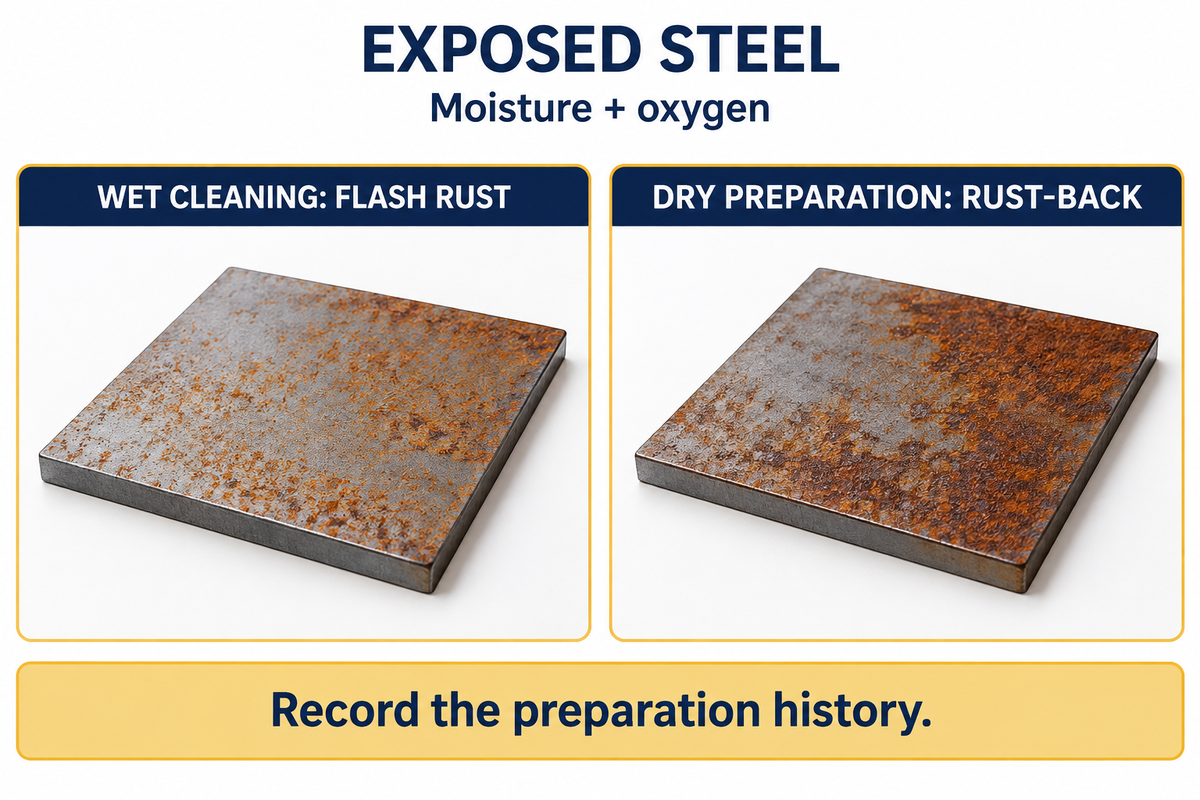
What does flash rust mean?
Flash rust means rapid oxidation of an exposed metal surface, usually noticed as a thin orange bloom after contact with water. For coating work, AMPP’s waterjet and wet abrasive cleaning guidance describes its development as non-stainless-steel surfaces dry. The visible film is a corrosion product. Rust forms on the steel as its newly exposed surface reacts with water and oxygen in the air.
Freshly prepared steel left uncoated is prone to flash rust because cleaning removes the protective barrier. When the bare metal surface is exposed to moisture, oxygen in the air supports the corrosion process. Carbon steel and cast iron are susceptible; fresh corrosion can appear within minutes, while thick, flaky deposits form through further attack.
How does flash rust form after cleaning? Moisture and oxygen react at the freshly cleaned steel surface; the onset of corrosion can precede visible drying. KTA distinguishes wet-process flash rust from rust-back, which occurs when steel is prepared using dry methods and left uncoated. Using dry abrasive blasting followed by damp exposure overnight is, therefore, a different sequence from a bloom on steel prepared by wet blasting. Record which sequence occurred before choosing a remedy for flash rust or rust-back.
Flash rust prevention: water, drying and dew point
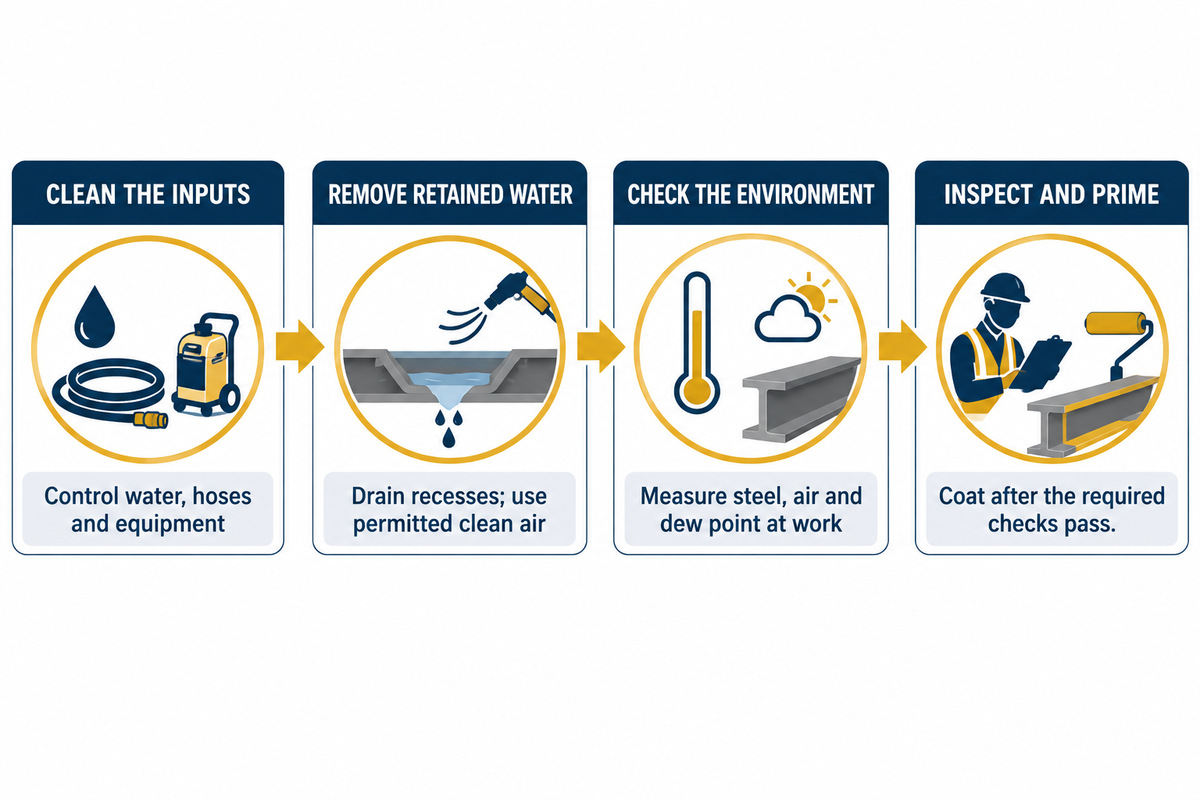
How to avoid flash rusting?
Preventing flash rust requires clean process water, prompt removal of trapped liquid and a preparation area small enough to dry, inspect and coat under the selected product’s conditions. Combat flash rust with moisture control and contamination checks prior to changing chemicals. Additional corrosion inhibitor won’t correct air lines carrying water or a steel surface collecting condensation.
Jotun’s Barrier 80 S application guide requires steel at least 3°C (5°F) above dew point. It also lists relative humidity of 10–85%. Those are conditions for that atmospheric zinc-rich epoxy primer. Measure near the work, including the coldest steel, rather than relying on a weather reading taken elsewhere.
Lower humidity lessens one form of wetting, but salts change things. In Schindelholz, Risteen and Kelly’s 2014 study, mild steel loaded with 9 μg/cm² of sodium chloride was exposed at constant humidity for up to 300 days. Corrosion could initiate at 33% relative humidity. Thus, a salt-contaminated surface, which looks dry, could still be active.
Assume a deck is cleaned late in the shift when the steel is still warm. The air temperature falls overnight, and moisture from the air condenses as the cold plate reaches dew point. The next crew finds a new orange film even though yesterday’s inspection was acceptable. The best thing to do is repeat the surface checks, and alter the work-zone schedule. The exposure is unchanged by using a stronger additive. Place the next work-zone cleaning, drying, inspection and primer application in the same workable window, with protective measures for the weather. Stop increasing the cleaned area when the coating crew is unable to keep up.
- Clean the inputs. Control rinse-water contamination and the cleanliness of hoses and equipment.
- Remove retained water. Drain recesses and use clean, oil-free compressed air where the process permits it.
- Check the environment. Measure steel temperature, air conditions and dew point at the work.
- Inspect and prime. Apply the specified coating after the required surface checks pass.
Rust timing: diagnose the process before changing chemicals
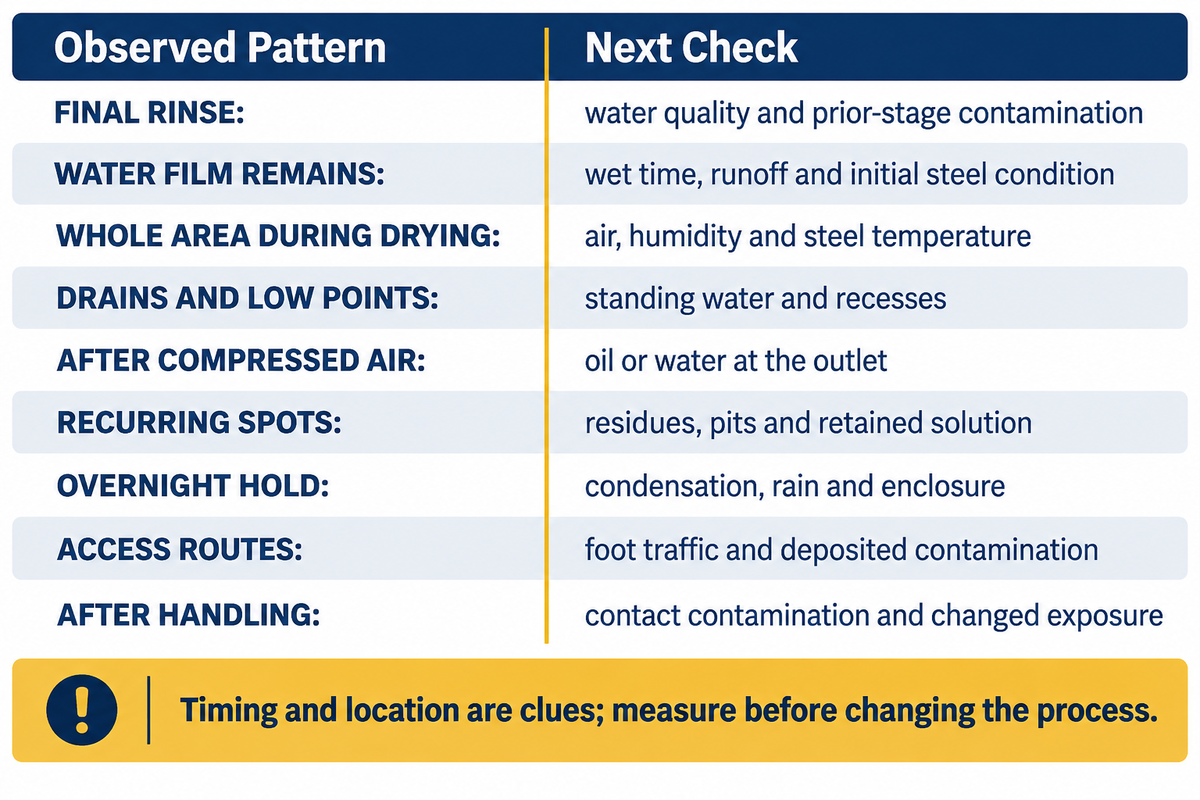
Rust timing narrows the next inspection: during washing, examine the water and cleaning process; during drying, examine retained liquid and air delivery; after storage, examine renewed exposure and handling. View the time and location as clues. Measure the level of contamination and environmental conditions to determine the adjustment that’s justified.
Rust Return Timeline
| Observed pattern | Check next | Practical response |
|---|---|---|
| During the final rinse | Water quality and contamination carried from the previous cleaning stage | Correct the wash/rinse process before treating another area. |
| While a water film remains | Wet time, runoff and the initial steel condition | Shorten the wet interval and drain the area. |
| Across the whole area during drying | Air temperature, humidity and steel temperature | Adjust enclosure or drying conditions before increasing the work zone. |
| At drains and low points | Standing water and inaccessible recesses | Remove trapped water and inspect the recess again, including adjoining vertical surfaces. |
| After blowing with compressed air | Oil or water reaching the outlet | Correct the air supply before using it on prepared steel. |
| At recurring isolated spots | Local residues, pits and retained cleaning solution | Inspect and test the affected spots rather than treating the pattern as proof of one cause. |
| After an overnight hold | Condensation, rain and enclosure performance | Repeat the relevant preparation checks before priming. |
| Along access routes | Foot traffic and deposited contamination | Restrict access and restore contaminated areas. |
| After handling or moving steel | Contact contamination and changed exposure | Clean affected areas and reassess the coating conditions. |
The CCI flash-rusting activity also shows droplets on a cleaned iron blade containing orange corrosion at about 2 hours, while drying took almost 4 hours. These example observations describe the demonstration, not a yard limitation. Water can support rust before the surface looks dry.
A Products Finishing answer by Carl Izzo describes a different series of events: large tanks took about 15 minutes to relocate from acid/rinse baths to phosphating baths. That acid-treatment case points to a transfer delay. A ship deck with no acid-pickle stage needs its own process history, not the tank line’s timing imposed as a limit.
Flash rust grades: appearance is not coating approval
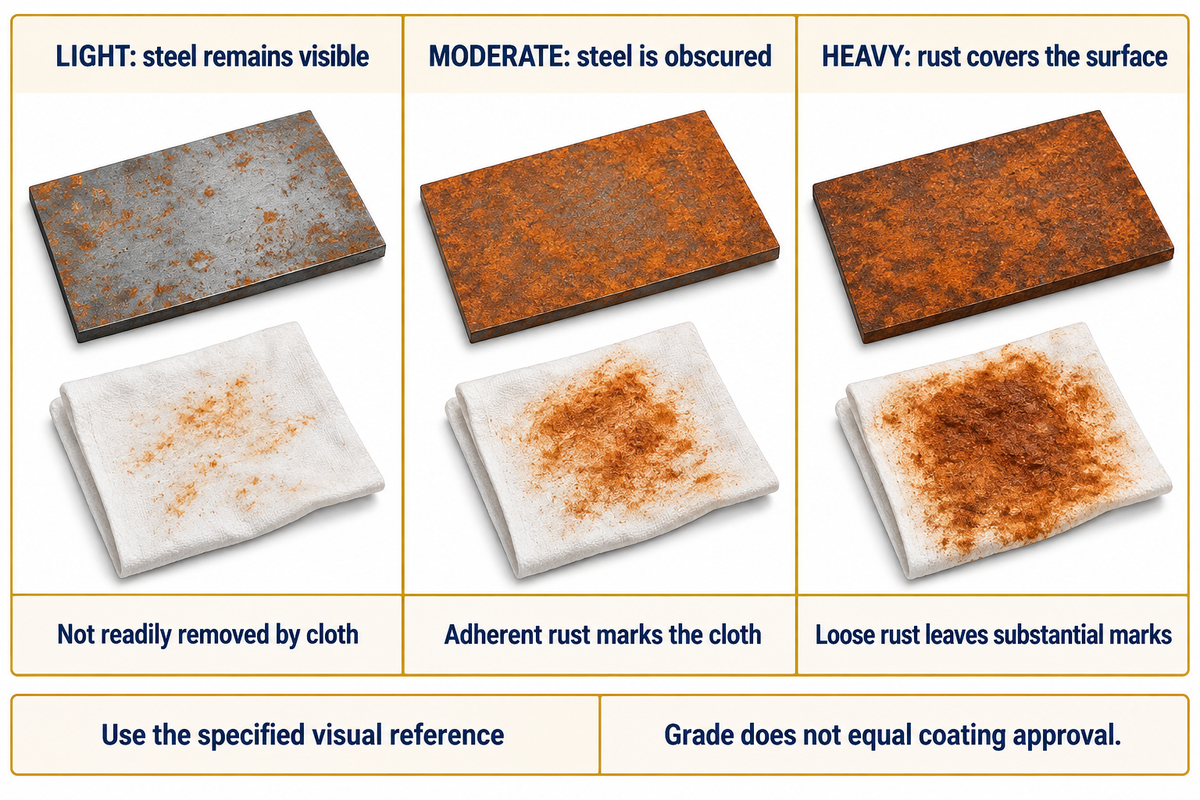
Flash rust grades describe the visible film and how firmly it adheres. Light rust leaves the substrate visible; moderate rust covers the substrate; heavy flash rust forms a loose covering. The coating inspector then compares that condition with the grade permitted for the specified preparation method and coating system. A high-performance coating still needs the substrate condition stated in its application instructions.
| Grade | Appearance | Cloth-wipe behavior |
|---|---|---|
| Light | A thin rust layer with the steel still visible | Not readily removed by a cloth. |
| Moderate | Steel is obscured without magnification | Adherent rust leaves marks on the cloth. |
| Heavy | Rust completely covers the surface | Loose rust leaves substantial marks. |
ISO 8501-4:2020 provides descriptions and reference photographs for steel prepared by water jetting. Waterjetting references such as SSPC-VIS 4/NACE VIS 7 and wet-abrasive references such as SSPC-VIS 5 address their respective methods. Use the reference named in the project specification, with suitable viewing conditions.
The visual grade belongs in the inspection record with the name of the product and permitted grade. Epoxy is too broad a description to settle coating adhesion. Pull-off adhesion testing uses ASTM D4541 for coatings on metal and ASTM D7234 for coatings on concrete. Two primers with that generic chemistry could have different surface preparation instructions and service uses.
Salt residue: a separate check from the rust grade
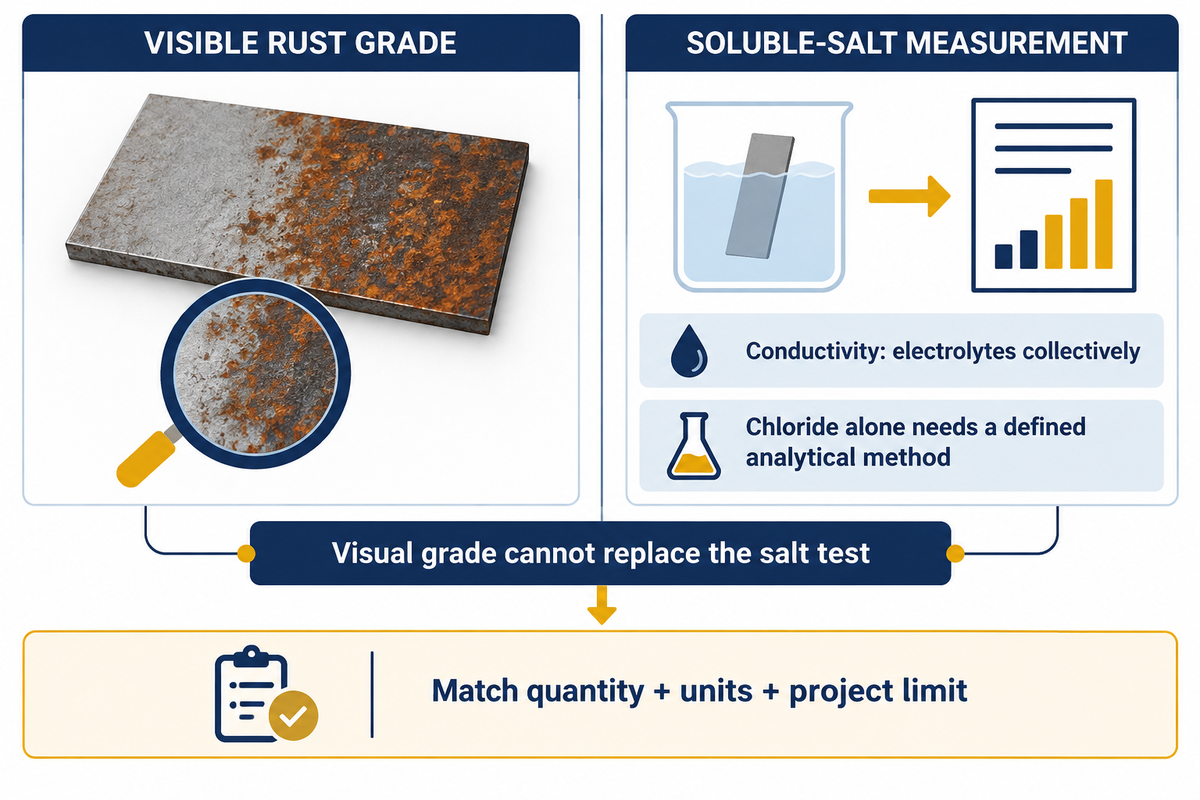
Salt residue needs a measurement separate from the visual rust inspection. Water-soluble contaminants can remain on an apparently clean surface and can affect the coating system. ISO 8501-4 directs testing for these invisible contaminants to the ISO 8502 series, so a favorable visual grade cannot replace the specified salt test.
The Bresle test for soluble salts uses an extraction from a defined surface area. Under ISO 8502-9:2020, conductometric measurement assesses water-soluble electrolytes collectively; it does not separately determine chloride or sulfate loading. Match the reported quantity and units to the project’s limit before accepting the result.
As a product-specific example, Jotun’s Barrier 80 S guide lists maximum soluble salts of 200 mg/m² for C1–C4 exposure and 100 mg/m² for C5, measured using ISO 8502-6 and -9. Carry the named product, exposure class and test method with these figures. The requirement for chloride alone necessitates an analytical method be defined.
After a failed result, restore the surface with the specified cleaning process and repeat the measurement. Keep the extraction location, area, blank correction and units with the reading. A recurring orange patch near a drain is reason to look into that area and not a substitute for the test result.
Painting over flash rust: when re-cleaning is necessary
Can you paint over flash rust?
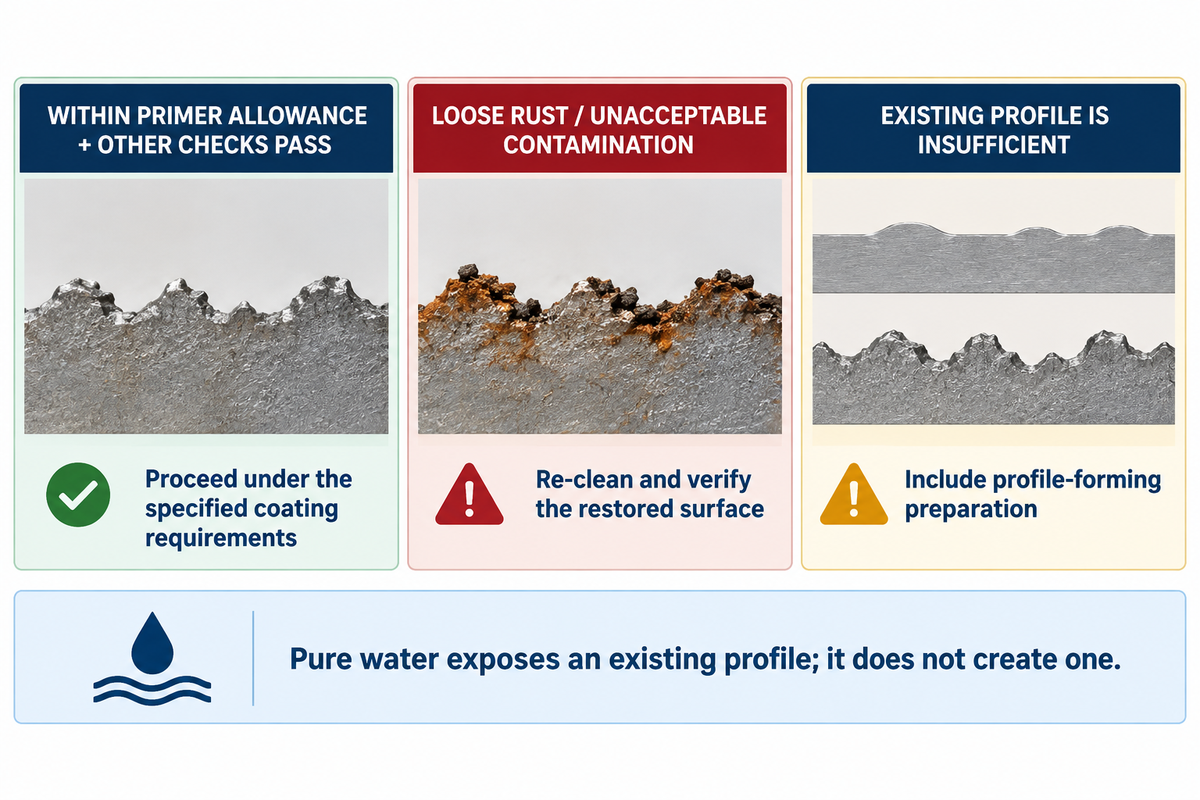
Yes, when the observed condition is within the allowance for the specified primer and the remaining preparation criteria pass. Re-clean steel that exceeds allowance and/or has loose material, unacceptable salts or other contamination. Rust removal requires full abrasive re-blasting when an accepted alternative can’t restore the specified surface condition.
Jotun’s Barrier 80 S guide provides a specific example for previously blast-cleaned steel: Wa 2½ for DC A, DC B and DC C surfaces or Wa 2 for DP Z, with maximum flash-rust grade L.
KTA’s discussion of removing flash rust without re-blasting describes an approved chemical removal followed by the specified rinse. A citric acid product in that process is a rust remover, not permission to improvise using acid on a deck. For the cited Chlor*Rid SP8 Gel/Rinse system, KTA describes about 30 minutes of gel dwell at 70°F, followed by the specified rinse; warmer conditions may require shorter dwell, and the gel must not dry completely. That’s treatment dwell; total job time is determined by other factors, e.g. rinsing, waste removal and drying the steel.
AMPP’s explanation of waterjetting identifies another boundary: pure water exposes the existing anchor profile but does not create a new one. A 30-85 μm profile is recommended after abrasive blasting in the named Jotun guide. Where the existing profile is insufficient, removing the orange film alone won’t complete the preparation.
If the original profile still meets the requirement, an approved removal-and-rinse route may remove the flash rust without repeating the entire abrasive operation. The inspector still verifies the existing cleanliness, salts and drying condition. Where the existing profile is insufficient, the same chemical treatment wouldn’t develop the required anchor profile. The contractor has to include profile forming preparation as part of the recovery work. This distinction changes the equipment, waste stream and labor required, which is why a concentrate price cannot settle the rework decision.
Flash rust inhibitors: compare the product and its restrictions
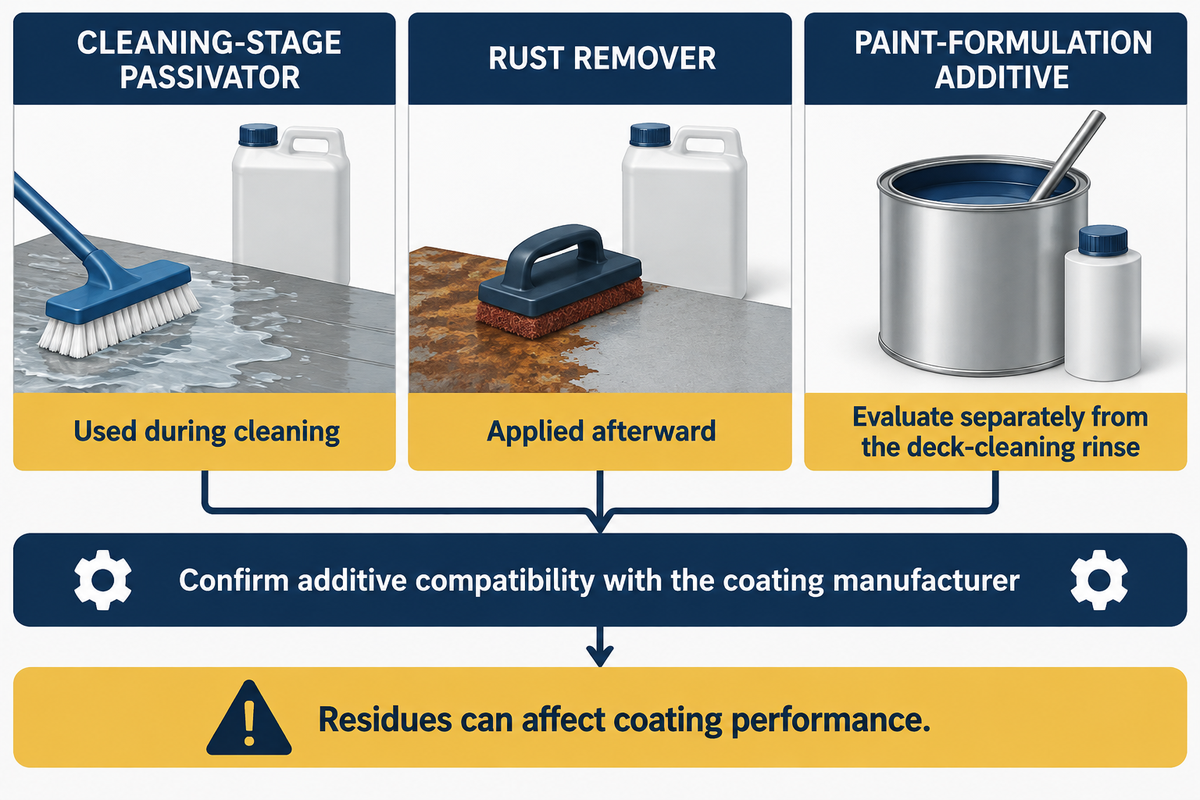
Choose a flash rust inhibitor by where it is used and what happens before coating: in blast water, in a wash stage or inside a paint formulation. Keep these roles of the products separate when comparing suppliers. A surface passivator used during cleaning serves a different purpose from a rust remover applied afterward.
HoldTight Solutions provides HoldTight 102 for power washing, wet abrasive blasting and waterjetting, including ultra-high-pressure equipment. This additive is one option for controlling flash rust on prepared steel. Their May 2025 product data sheet states that the water to concentrate ratio is 50-250:1, with 100:1 being the norm for blasting and wash cycles. The same data sheet states that for high-humidity environments with very contaminated substrates a ratio of 50:1 may be needed.
The same HoldTight 102 product data sheet describes a 48-hour-or-longer rust-free window above 40°F (4°C), without rain or condensation. It also directs prompt priming after drying and before rust appears. Schedule coating around the prepared surface and primer requirements, rather than treating the advertised window as a waiting target.
KTA offers Hold Blast surface passivator at its equipment store. In its technical documents, KTA recommends Hold Blast and HoldTight as wet-prep options when authorized by the coating manufacturer. Consider KTA’s documentation as a commercial technical source when evaluating suppliers. Paint additives should be evaluated separately. PCI’s report on Heubach waterborne flash-rust inhibitors discusses additives for waterborne binder systems. San Nopco’s WO2020129425A1 likewise describes an inhibitor in water-based paint. Neither is a substitute for the chosen deck-cleaning rinse.
ASTM D5367-26 evaluates compatibility between coatings and additives that stop this form of corrosion. An incorrectly used additive can leave a residue that affects performance after the coating application. Diluting a product correctly and obtaining the intended rust protection are both necessary parts of the process.
“The manufacturer of the coatings shall be consulted to ensure compatibility of additives with the coatings.”
Rework cost: compare the whole preparation route
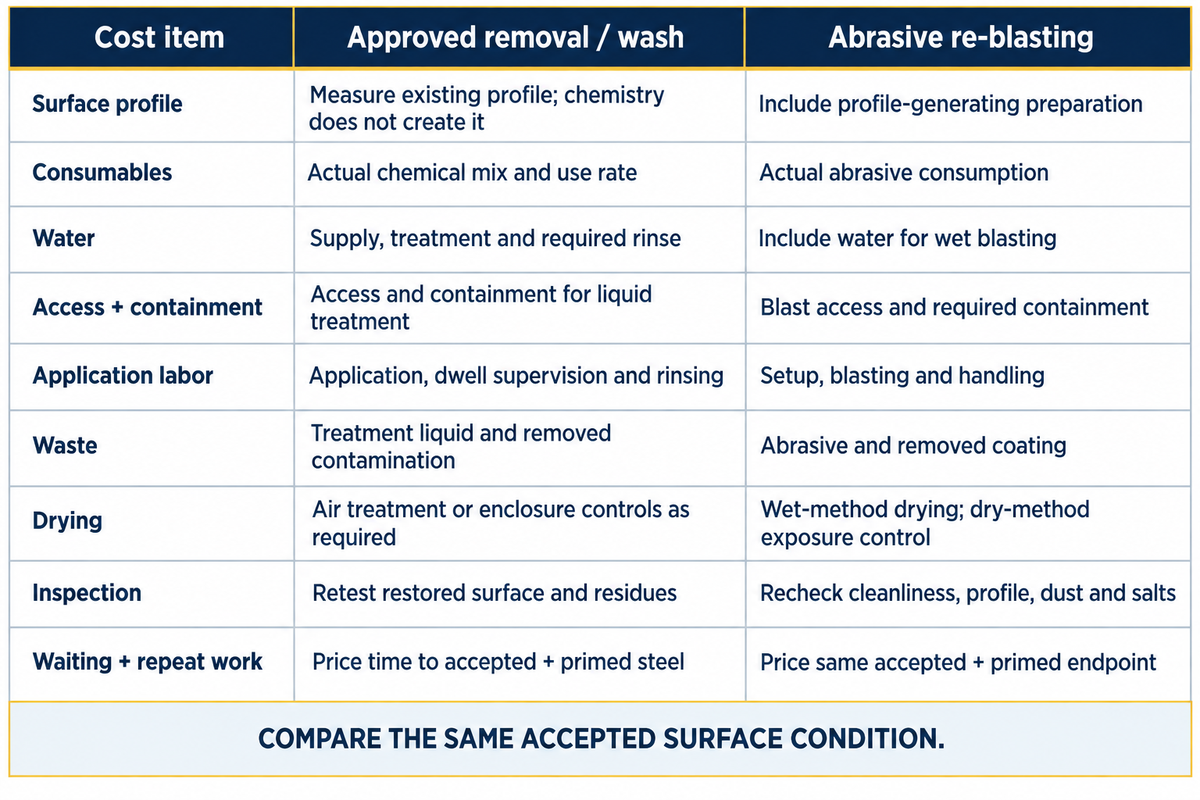
Compare recovery routes at the same endpoint: a surface the coating inspector can accept for the selected system. Include water treatment, drying, residue removal and inspection in a chemical route. Include containment, abrasive, cleanup and profile checks in a blasting route. The bottleneck may be the drying or inspection crew rather than the cleaning equipment.
Example: assume a batch starts with 100 gallons of water. GlassBlast’s HoldTight 102 listing, checked on November 4, 2026, displays $70 per gallon in 5-gallon jugs. At 100:1, concentrate consumption is 100 ÷ 100 = 1 gallon, or $70. At 50:1, it’s 100 ÷ 50 = 2 gallons, or $140.
Buying a whole 5-gallon jug at that displayed rate is $350 before freight and tax. Consumption cost and purchase cost are different things. The calculation prices concentrate only; it gives neither treated deck area nor total installed cost. For an apples-to-apples comparison, determine actual water use and work scope of the contractor. Then compare the chemical line item to a complete blasting quote.
Preparation route cost comparison
Compare each route’s operations against the same accepted surface condition, then add the quoted labor, equipment and consumables for each operation.
| Cost item | Approved removal/wash route | Abrasive re-blasting route |
|---|---|---|
| Surface profile | Measure the existing profile; the chemistry does not create it | Include the specified profile-generating operation. |
| Consumables | Price concentrate or remover at its actual mix and use rate | Price the selected abrasive and its actual consumption. |
| Water | Include supply, treatment and the required rinse | Include water when using wet abrasive blasting. |
| Access and containment | Allow access and containment for liquid treatment | Allow blast access and the required containment. |
| Application labor | Count application, dwell supervision and rinsing | Count setup, blasting and handling. |
| Waste | Collect and dispose of treatment liquid and removed contamination | Collect and dispose of abrasive and removed coating. |
| Drying | Provide air treatment or enclosure controls where required | Include drying for wet methods and exposure control for dry methods. |
| Inspection | Retest the restored surface and residues as specified | Recheck cleanliness, profile, dust and salts as specified. |
| Waiting and repeat work | Price time until the surface can be accepted and primed | Price the same accepted-and-primed endpoint. |
For procurement, request separate quantities and rates for those operations; for the supervisor, size the next work zone to the slowest downstream operation. For finance, compare the total accepted scope rather than treating unused concentrate as labor savings.
Steel-deck handover: connect preparation to the floor system
To provide long-term protection, the specified coating system needs the prepared steel, selected primer and following layers to work together. Primer, screed, adhesive and wearing finish have different jobs. Keeping their names separate prevents an epoxy flooring material or deck covering from being treated as a substitute for the specified corrosion-control primer.
Yibo’s marine deck covering systems include distinct material roles. In the catalogue, E60 is an epoxy flooring material; its place in a marine resin floor system doesn’t make it the preparation primer. Set the compatible build-up before ordering materials for a repair.
For a deck that needs leveling and a new finish, the self-levelling screed underlay guide covers the layer above the prepared substrate. The marine epoxy floor range covers the wearing surface. Complete steel preparation before closing that surface under the next layer.
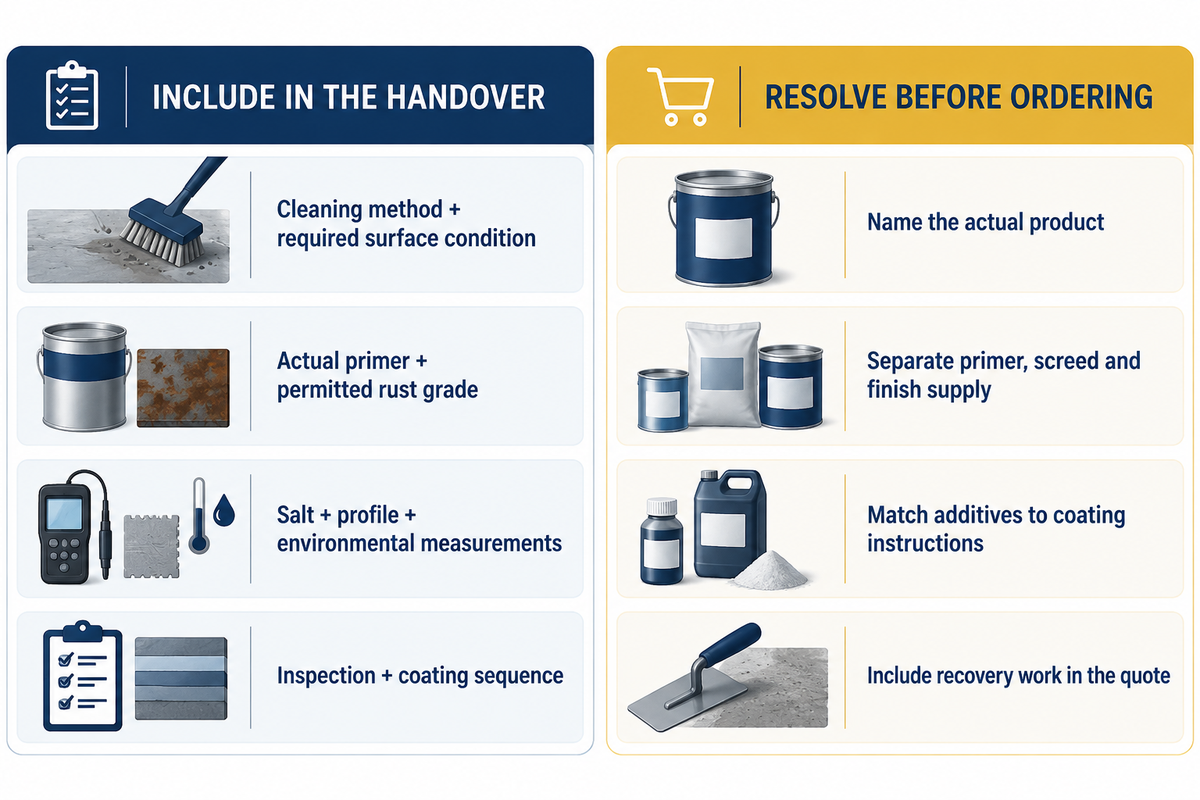
Include in the handover
- Name the cleaning method and required surface condition.
- Identify the primer and permitted rust grade.
- Record salt, profile and environmental measurements.
- Assign the inspection and coating sequence.
Resolve before ordering
- Replace generic “epoxy” with the actual product.
- Separate primer supply from screed and finish supply.
- Match additive use to the coating instructions.
- Include the recovery work in the quotation.
Provide the steel surface condition and cleaning method in the project enquiry. The selected service area and primer system must also be included in the enquiry. The proposed floor layers and inspection requirements must also be included. Include the allowed working window and access restrictions. Those details let the material supplier and contractor address compatibility, application sequence and delivery quantities in the same proposal. The quality and longevity of the finished system are affected by the surface to which its first layer adheres.
Industry outlook: waterjetting standards and coating compatibility
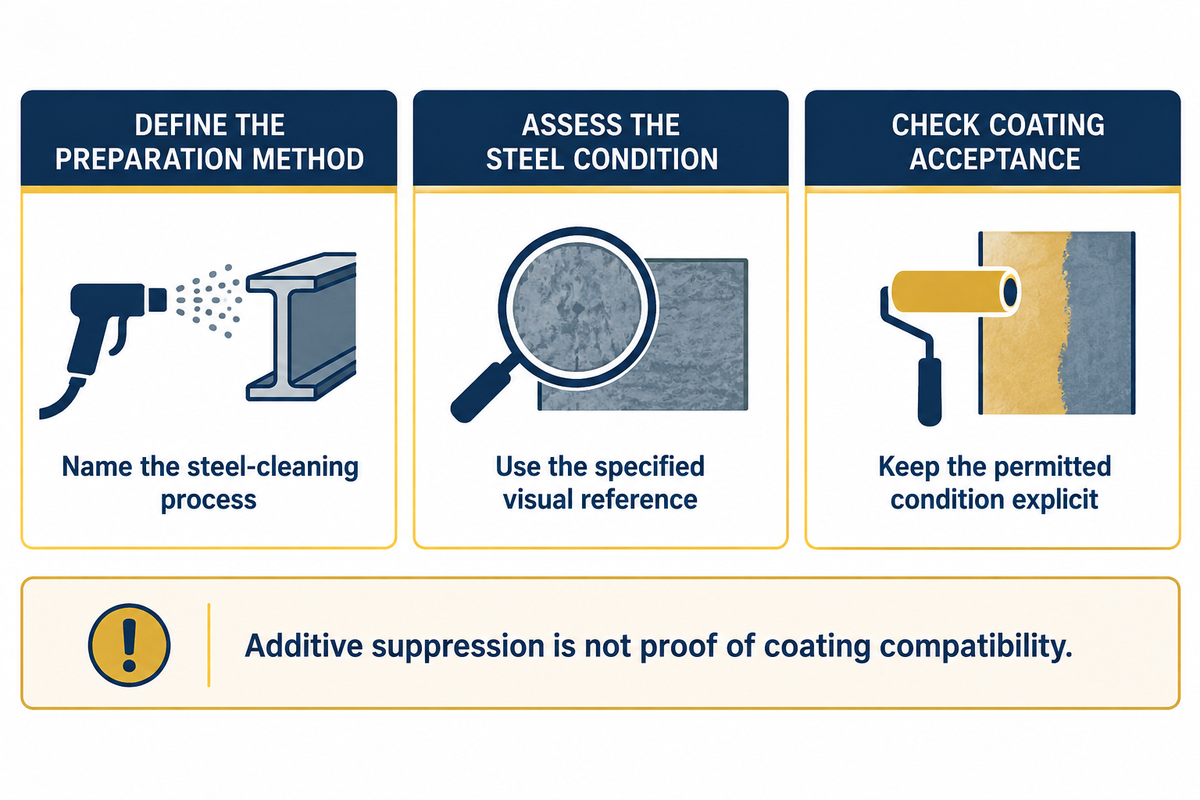
When specifying a waterjetting process, the client must make three independent decisions. The first is to define the type of preparation and the waterjet cleaning method for the steel. The second is to assess the steel condition using the specified visual reference. The third is to determine whether the selected coating accepts that condition. These decisions are often confused. The contemporary references help keep the decisions and the work of the various parties consistent.
ISO 8504-5:2024 describes water jet cleaning methods for removing existing coatings and rust. DIN’s official publications catalogue also lists the German adoption dated November 2026, identified as EN ISO 8504-5:2026 and based on the ISO 2024 text. A European adoption year and an international publication year may legitimately differ.
When reviewing a 2026 quotation, carry the full designation and regional adoption into the contract. Keep the required preparation grade and the coating’s rust allowance explicit instead of assuming the edition number answers either question.
For additive selection, ASTM D5367-26 was listed as active on June 29, 2026. The practice compares coating performance with and without additives under relevant laboratory exposures, including high moisture, marine atmosphere and immersion. This highlights the link between treatment and coating: a product that suppressed visible rust may, in fact, alter the surface left underneath the paint.
Historical field work also explains why blanket rules are unhelpful. The NSRP field study of ship coatings over flash rust indicated a recommendation to allow moderate rust for the Navy coating systems assessed. Use this as context for product-specific acceptance, while the current project’s coating instructions dictate the work being bought.
For the next repair, ensure that the method, visual reference, limit of measured contamination and primer instructions are in the same work package. Assign the person who releases each cleaned area to the coating crew. If an inspection fails, price the operation to restore that particular condition. Don’t automatically repeat every step in a preparation.
Flash rust questions
Does flash rust go away?
No. Drying stops the surface being visibly wet, but it doesn’t remove corrosion that has already formed. If the rust exceeds the selected primer’s allowance, restore the required surface condition before coating. Remove loose material, complete the specified contamination checks and inspect the steel again after corrective work, before handing it to the painter.
What removes flash rust quickly?
An approved remover-and-rinse process can avoid another abrasive blast when the existing profile is adequate. KTA’s Chlor*Rid SP8 example uses about 30 minutes of gel dwell at 70°F before rinsing; that’s a product-specific step, not a guaranteed completion time or a comparison proving the fastest method. The finished surface still needs the specified cleanliness and salt condition. Recurring patches call for investigation of retained water or contamination, followed by the appropriate correction.
Will WD-40 prevent flash rust?
For metal that will be painted, choose a coating-approved preparation treatment rather than WD-40. An oily protective film adds a cleaning requirement before painting, even when it keeps stored metal looking bright. If a water-displacing product has already been applied, remove the contamination using the coating system’s specified cleaning process before completing the remaining surface checks. ASTM warns that soluble contaminants or highly concentrated or unreacted additives left beneath a coating may cause premature failure.
Can aluminum flash rust?
No. Aluminum doesn’t form the iron rust discussed here, although it can corrode and carry iron contamination. An orange deposit on aluminum needs a different investigation. Use the preparation procedure for that metal and its coating system, rather than transferring a carbon-steel treatment.
How fast can flash rust happen?
Flash rust can appear within 5 minutes, as observed in a Canadian Conservation Institute demonstration on a prepared carbon-steel coupon immersed in tap water. Other observations in the same activity took hours as droplets dried. Record the actual cleaning and drying sequence, and inspect the prepared area again when exposure or conditions change before the painter begins.
Can you prime over flash rust?
Yes, if the specified primer accepts the observed grade and the other preparation requirements pass. Use its named preparation method, permissible rust condition, contamination limits and application conditions together when releasing the surface for priming.
Does flash rust affect coating performance?
Yes. Rust condition and the surrounding preparation can affect the bond and durability of the coating. Loose corrosion, soluble contamination or incompatible treatment residues require correction before the next layer. Some specified systems accept a defined amount of adherent rust, which is why color alone isn’t a rejection rule. Apply the product’s full preparation requirements, including the existing surface profile, and keep environmental conditions suitable through the handover from cleaning to painting.
Plan the deck layers before ordering

Send Yibo the steel condition, selected primer, service area and intended floor build-up. We can help identify the deck-covering materials and supporting product information for that proposal. Start with our marine deck covering systems, or contact Yibo about your deck project with the preparation and inspection requirements.
Technical examples distinguish standards and published research from named product instructions.
References & Sources
- Canadian Conservation Institute, Understanding flash rusting
- AMPP, Waterjet and wet abrasive blast cleaning methods
- Schindelholz, Risteen and Kelly, Effect of relative humidity on corrosion of steel under sea salt aerosol proxies I. NaCl (2014)
- Products Finishing, Flash Rusting, Carl Izzo
- International Organization for Standardization, ISO 8501-4:2020
- International Organization for Standardization, ISO 8502-9:2020
- PCI, Waterborne Flash Rust Inhibitors from Heubach
- ASTM International, ASTM D5367-26
- International Organization for Standardization, ISO 8504-5:2024
- DIN, Coatings and coating materials standards committee publications
- National Shipbuilding Research Program, Field Study of Ship Coating Performance over Flash Rust