Get in touch with Yibo Company



A Bresle test measures contamination recovered from a small area of surface. On a steel ship deck, a leaking patch or contaminated blank can make the reported salt value unusable, even when the number looks comfortably below the project limit. Check the extraction before deciding whether to clean the steel again.
Updated October 2026
A Bresle test extracts soluble contaminants from a defined surface area for analysis. A sound seal, controlled blank and correct area-to-volume inputs make the result interpretable. Repeat a leaking extraction before judging the steel against its specified salt limit.
Quick Specs: read the result correctly
- A low reading from a leaking patch is an invalid extraction, not a clean-surface result.
- ISO 8502-6 covers extraction; ISO 8502-9 addresses conductometric assessment.
- 1 µg/cm² equals 10 mg/m². Neither unit is interchangeable with µS/cm.
- The patch model controls the effective area and liquid-volume setting.
- A valid result belongs to its recorded test position; the project sampling plan controls area coverage.
Why the Bresle test belongs in steel-deck preparation

Contamination on the steel may affect the coating. A Bresle extraction brings water-soluble material into a liquid sample so the inspector can measure it. The resulting record addresses salt contamination alongside the separate checks for visible cleanliness, surface profile and the specified primer.
What is the purpose of a salt test before painting?
Soluble contamination can lead to premature coating failure, and prior to painting a check for soluble contamination can identify a risk of blistering or corrosion. For ship-deck work, use the result to decide whether the tested steel meets the salt criterion before the next specified preparation or coating operation.
Zimmermann and colleagues’ 2020 epoxy-coating study looked at allowable contamination in a coating system subjected to accelerated exposure conditions. Their results suggest that the tolerable levels of allowable contamination in a given installation are tied to the exposure conditions and the characteristics of the coating, and not to a single safe value. As a result, a shipyard needs to know the limit for their chosen coating system, in the same reporting frame as the test.
For a marine deck covering system, the steel preparation record is included with the layer schedule. A salt result doesn’t measure primer bond strength, resin finish cure, or the acoustic performance of a floating floor. These have their own acceptance criteria.
Keep the acceptance basis intact. A report in mg/m² describes surface mass per area; a report in µS/cm describes conductivity. Converting 1 µg/cm² to 10 mg/m² preserves the mass per area quantity. Going from conductivity to a salt estimate requires the specified measurement method as well as the extraction inputs.
Bresle test procedure: define the extraction before reading the meter
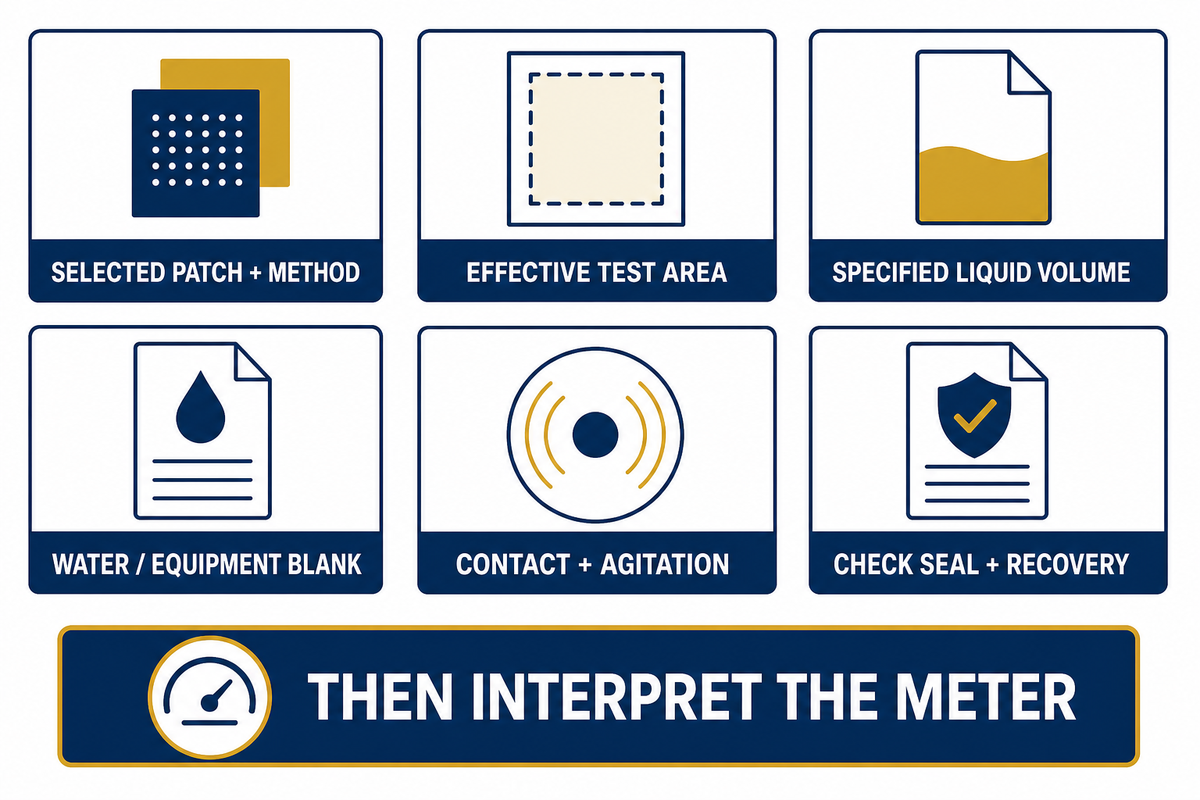
The Bresle method takes a defined extraction area and a controlled liquid sample. Record the patch identity, water volume and governing procedure before taking a reading. Mixing a patch from one system with the default settings of another can change the calculation, even if the two systems are similar.
What is the procedure for the ISO 8502-6 salt test?
The ISO 8502-6 salt test uses an attached cell to extract water-soluble contaminants from the surface. Establish the blank, attach the selected cell, introduce the specified liquid, complete the prescribed contact and agitation sequence, then recover the extract for analysis. Record leakage or incomplete recovery as a test-quality problem before interpreting the salt result.
The ISO 8502-6:2020 extraction method can be used on differently oriented surfaces. On overhead or curved steel, the attachment still has to retain the liquid over the intended test area. Gravity, awkward syringe access and a rough seal line deserve attention when choosing the test position.
“The method described is suitable for use in the field”
Engineering note: Elcometer lists a 1,250 mm² test area, equivalent to 12.5 cm², and a 2.6 mL ± 0.6 mL sample volume for its 135C Bresle test patch. Its 50 × 50 mm outside dimensions aren’t the extraction area. Entering the entire 2,500 mm² outer square would double the intended area in the calculation.
- Identify the method. Match the controlled standard edition to the instrument and patch instructions.
- Establish the background. Record the water/equipment blank and the required patch-cleanliness evidence.
- Control the extraction. Use the specified area, volume, contact time and agitation; observe the seal throughout.
- Evaluate the result. Check validity, units and reporting basis before comparing with the project limit.
A 3 mL syringe states a limit of syringe capacity, not an instruction to inject 3 mL. The 2020 experiment states it used 2.5 mL and a 1,250 ± 13 mm² patch; that’s a study setup. Contact times in governing procedures should be followed, not a short timing sequence borrowed from a different manual.
Water blanks and patch cleanliness are different checks
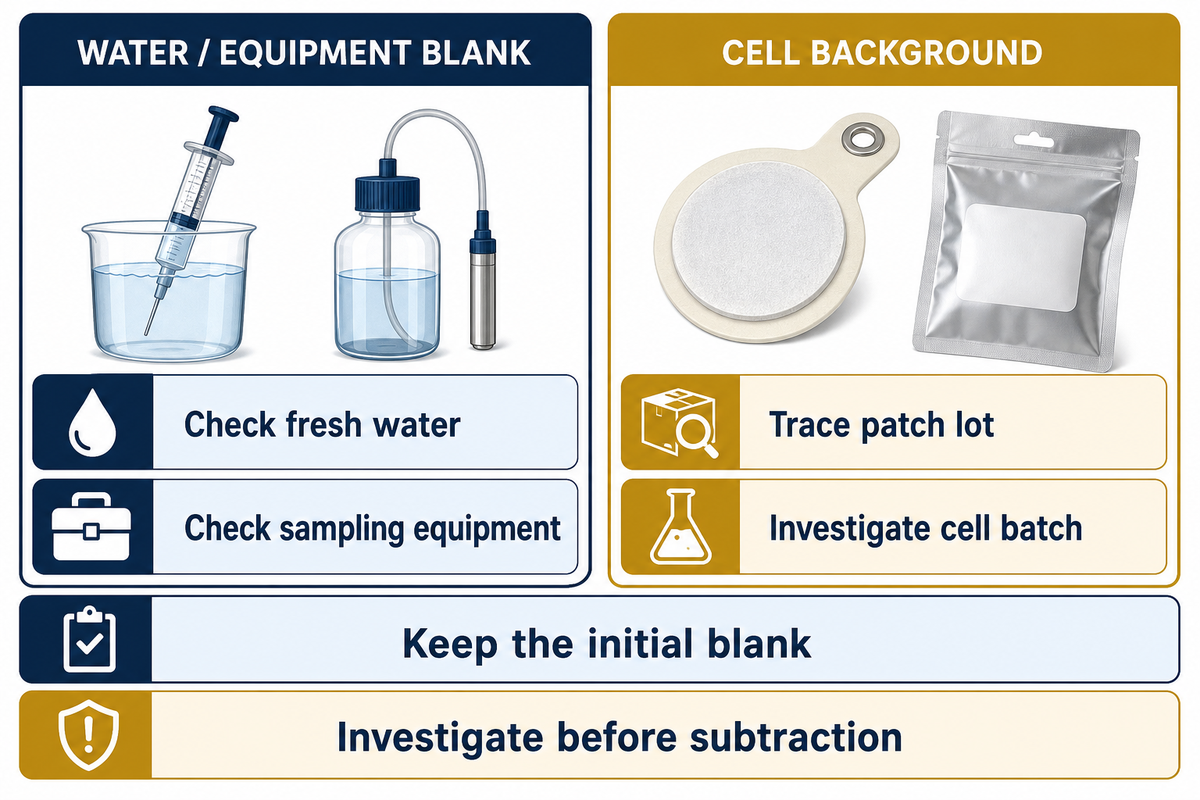
A water blank measures the background brought into the test by the liquid and measurement equipment. Patch cleanliness concerns material contributed by the extraction cell. Keep the two checks separate: clean water cannot remove contamination already present in a patch, and a patch certificate cannot diagnose a dirty syringe or measuring cell.
Section 6.2 of the public ISO 8502-6 preview addresses cell-background testing on clean glass. Significant background calls for investigation and elimination. Its parallel-blank treatment is used when significant and reproducible interference cannot be eliminated; it is not telling us to subtract any large blank and accept the rest.
Example: a blank changes during a shift. The same conductivity meter sampled a water blank before a deck panel. Before the next deck panel, the inspector finds the new water and sampling equipment blank is higher. If he immediately subtracts the new background, he might miss the reason for it. The inspector keeps the record, checks a fresh portion of water and cleans the sampling equipment according to its instructions. If the water/equipment blank returns to its normal controlled range but a cell blank remains high, attention moves to the patch batch. A replacement patch from that same batch is not automatically a clean control. This separates sampling system problems from conclusions about the steel.
Do
- Keep the initial blank with the final reading.
- Trace the patch lot to its cleanliness record.
- Investigate a changed background before accepting a subtraction.
Don’t
- Treat water purity as a patch certificate.
- Erase an inconvenient blank value.
- Use an unexplained correction to approve a surface.
Before subtracting blank and final values, ensure both are referenced to the same measurement basis. Even if a difference is mathematically correct, it remains tied to the liquid and effective area used. For the Elcometer 135C example, the area is 12.5 cm²; the batch record and meter setup should identify that same area.
Patch leakage and high blanks: when to reject the reading
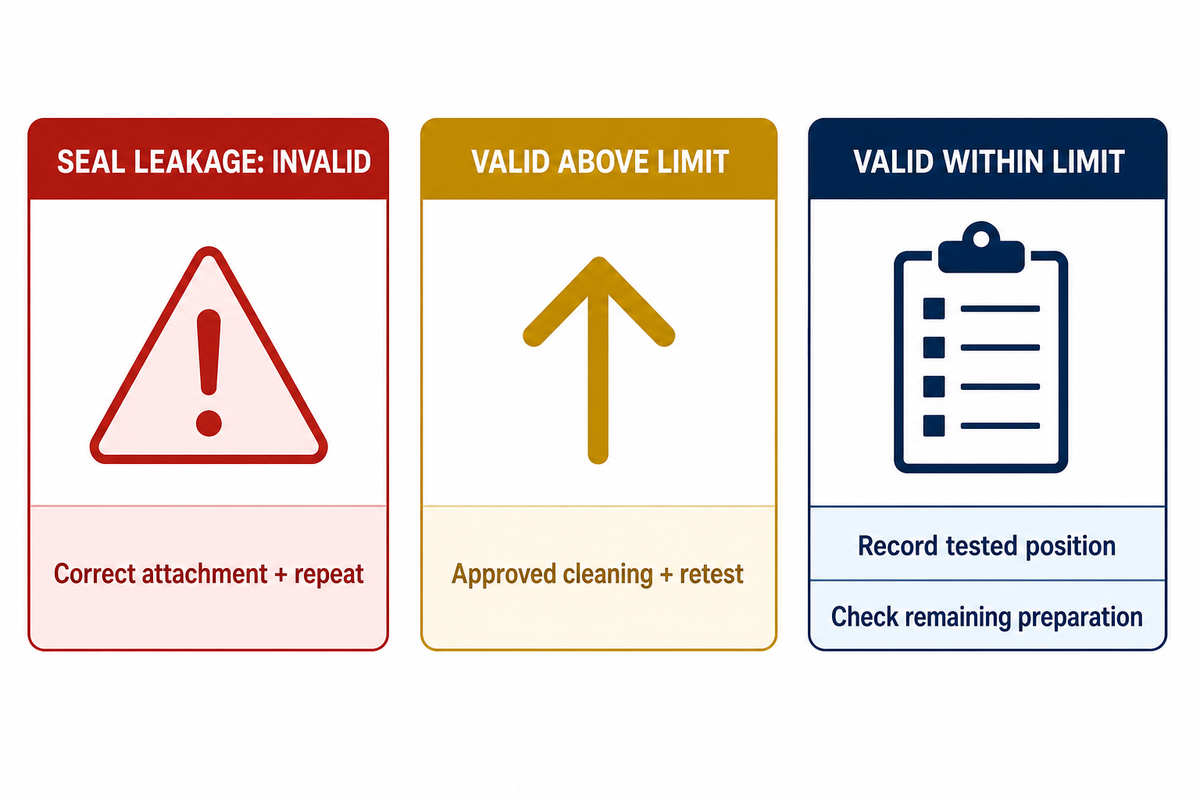
Don’t accept an extraction if there’s leakage or if there’s uncontrolled background that prevents a defensible result. A valid reading above the specified limit calls for surface action; an invalid reading calls for correction of the test. Keeping these outcomes separate prevents unnecessary recleaning and stops a low number from concealing a failed extraction.
3-State Salt Result Triage
3-State Salt Result Triage determines the next action assigned by the inspector for an invalid extraction, a valid reading above the limit, and a valid reading within the limit, respectively.
| Observation | Result state | Next action |
|---|---|---|
| Liquid escapes at the seal | Invalid extraction | Correct attachment and repeat under the controlled method. |
| Liquid wets beyond the intended cell area | Invalid area control | Retain the failed record; repeat with the specified effective area. |
| Recovered liquid is insufficient for the measurement | Incomplete sample | Resolve the loss; do not invent a replacement-volume correction. |
| Water/equipment blank rises unexpectedly | Background unresolved | Check water and equipment before judging the steel. |
| Cell background is significant | Cell interference unresolved | Investigate the cell batch and apply the prescribed blank procedure. |
| Meter area differs from patch certificate | Calculation input mismatch | Correct the documented input and follow the method for reassessment. |
| Valid result exceeds the project limit | Above-limit contamination | Use the approved cleaning and retest sequence. |
| Valid result meets the project limit | Within-limit salt result | Record the tested position; complete the remaining preparation checks before deciding that the surface is clean enough for the specified covering. |
| Local result is offered for an untested area | Coverage unresolved | Apply the project sampling plan before releasing the wider area. |
Example: a low reading after a visible leak. The sample gives a low salt value. Is it justified to retain this value because replacement patches are limited? The useful response is to identify the lost control: liquid volume and wetted area are no longer assured. There is no justified multiplier that restores the missing measurement. Retain the failed entry, correct the attachment and repeat at a position permitted by the procedure. Re-extracting the same washed spot measures an altered surface, so it should not silently replace the original result.
Seal loss lacks a defined error direction. Liquid can leave the cell, or water can spread under an edge and contact extra steel. NCHRP Research Report 912, Appendix C talks about extraction problems and variation between positions. The bridge examples supplied give a distinction between local test validity and area coverage; they supply no ship-deck sampling density.
A 12.5 cm² extraction samples that bounded position. A second valid 12.5 cm² extraction elsewhere adds another observation, not permission to ignore intervening areas. Keep position identifiers with the readings so the technical reviewer can relate them to the specified sampling plan and the steel preparation history.
Bresle conductivity vs chloride-specific testing
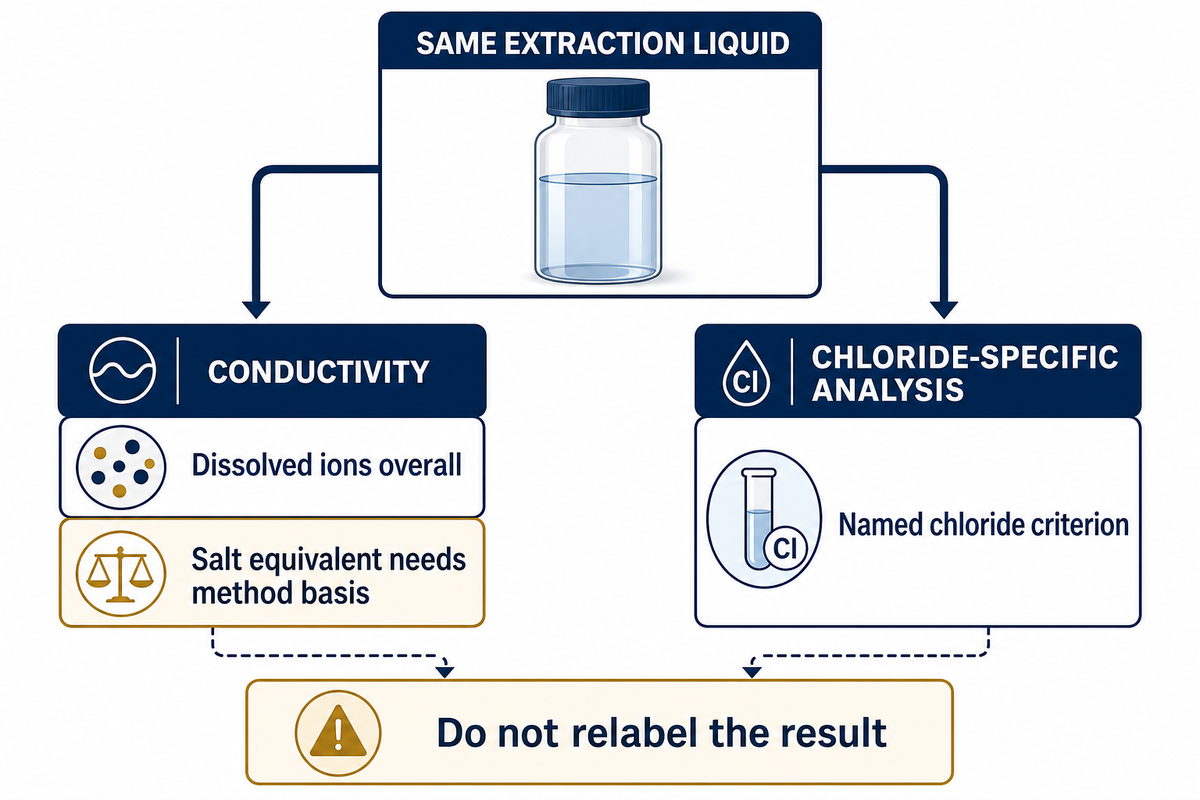
Conductivity reacts to dissolved ions overall, while a chloride-specific analysis measures chloride. The Bresle test method is an extraction technique; the analysis applied to its liquid determines what the reported number means. Select the analysis that matches the contaminant that’s named in the project specification to compare the concentration of soluble salts.
ISO 8502-9:2020 specifies conductometric assessment of water-soluble salts. Conductivity alone cannot resolve the individual surface densities of chloride, sulphate or sodium. A result expressed as NaCl equivalent is a conversion standard and not a chemical identification of all the ions in the sample.
| Specification or report | What it describes | Decision |
|---|---|---|
| Conductivity in µS/cm | Electrical response of the liquid | Use the prescribed conversion before comparison with surface mass. |
| Salt equivalent in mg/m² | Method-derived surface loading | Match the equivalent basis and project limit. |
| Chloride in µg/cm² | Chloride surface loading | Require chloride-specific analysis and extraction records. |
If the contract names chloride but the report supplies only total-salt equivalent, return the method mismatch for technical resolution. Relabeling a column doesn’t change the analytical problem. The same applies to salt contamination hidden under films or in crevices: extraction accessibility matters before the liquid reaches the instrument.
Converting 2 µg/cm² to 20 mg/m² changes units by a factor of ten. It doesn’t convert total salts to chloride. The analyte and reporting basis must remain attached to the value through spreadsheets, inspection forms and the final handover package.
Read soluble salt results in the specified units
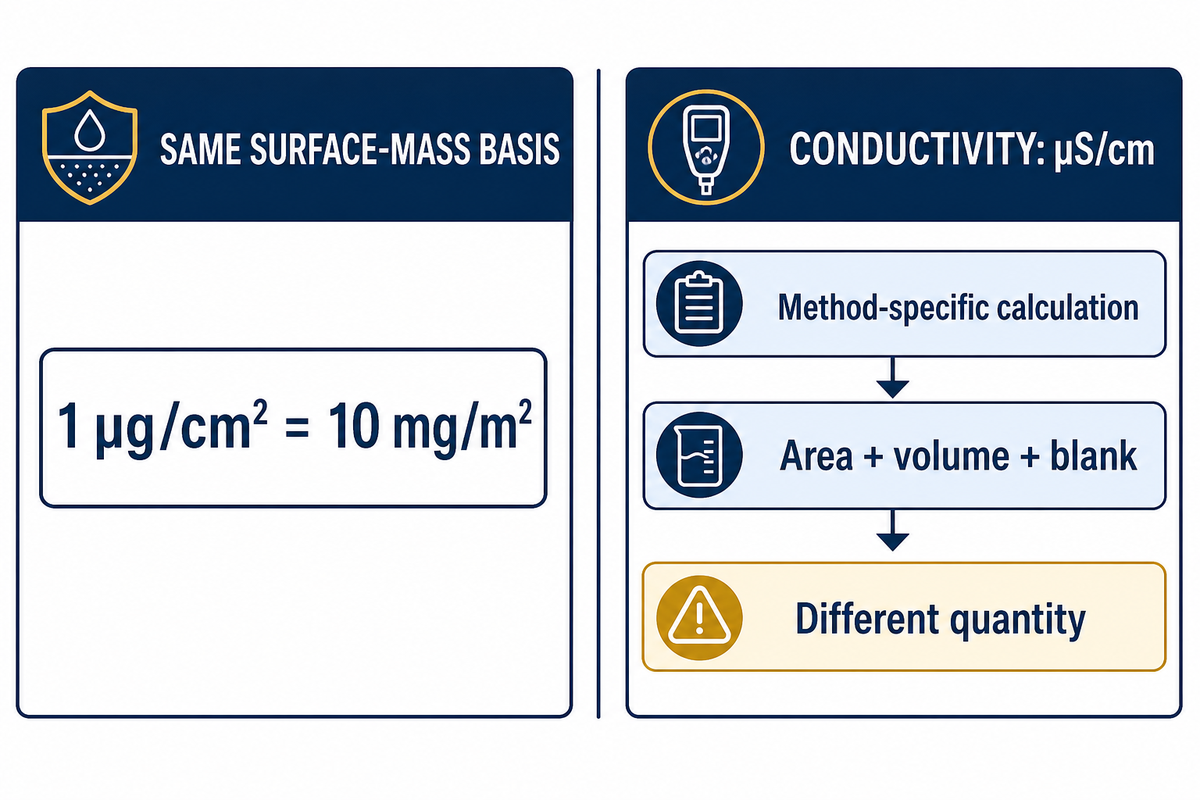
Results from a soluble salt test can be compared to their respective limits only after the quantity and units are the same. Surface-density units like mg/m² and µg/cm² are directly convertible. In conductivity, a method-specific calculation is required with the extraction area, the volume of the liquid and the blank. A bare meter display can’t provide the missing inputs.
The NIST prefix definitions state 1 µg = 0.001 mg and 1 cm² = 0.0001 m². Therefore 0.001 mg divided by 0.0001 m² = 10 mg/m².
Example: reconcile two report units. A technical reviewer receives a valid surface-salt result of 2.4 µg/cm². The project form records the same salt basis in mg/m², so the reviewer calculates 2.4 × 10 = 24 mg/m² and retains both the original and converted values. If that project’s stated maximum is 30 mg/m², this result is 6 mg/m² below it. The arithmetic is complete, but the entry still needs its test position and valid extraction record. Had the original display been 2.4 µS/cm, multiplying by ten would be wrong: conductivity is a different quantity. In this case, the reviewer would take the analysis calculation and recorded inputs, and apply them according to the principle and basis defined.
Repeatable reporting also requires a consistent temperature basis. Record whether conductivity is measured at the sample temperature or normalized by the instrument. DeFelsko’s PosiTector SST performs automatic conductivity temperature normalization to 25°C and records sample temperature. Keep the normalization basis and actual sample temperatures with the result.
Key takeaway
Use 1 µg/cm² = 10 mg/m² for surface-density units. Keep conductivity, the salt-equivalent basis and the specified acceptance criterion distinct.
Connect the test record to the actual marine deck build-up
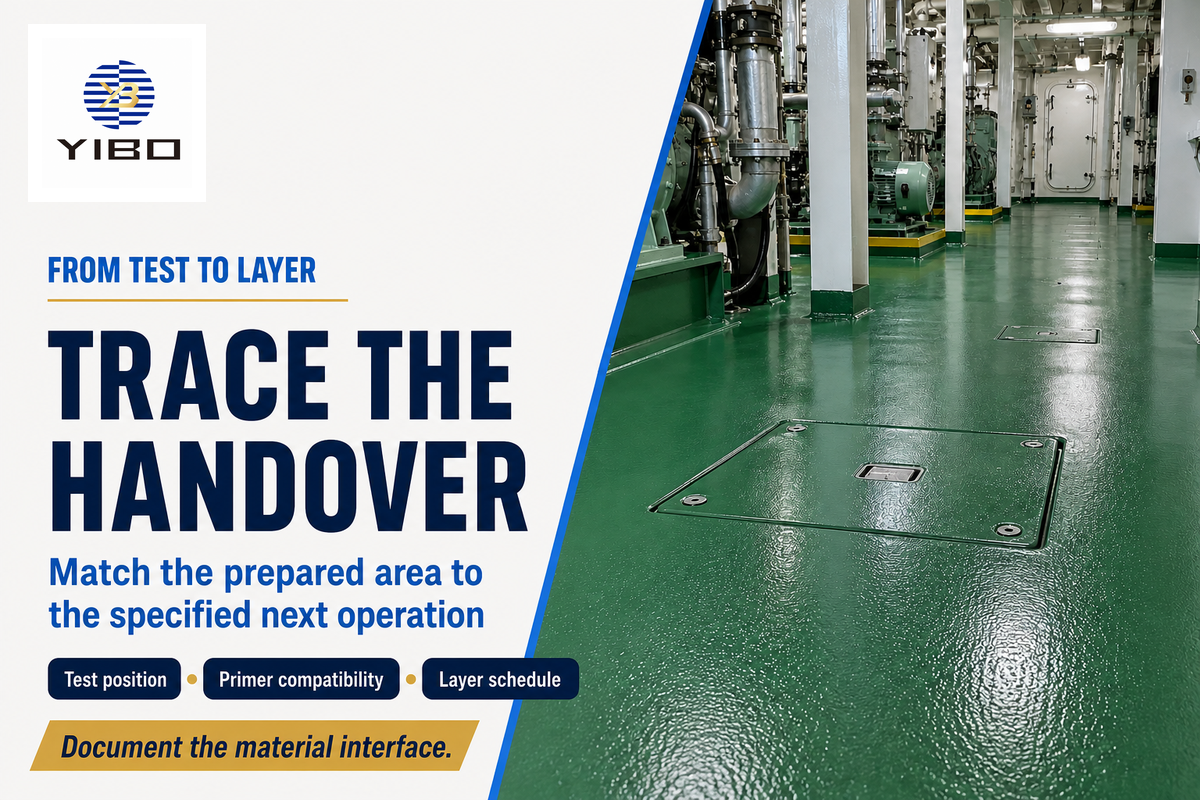
The salt result is attached to the steel preparation and primer records for the selected deck build-up. The wearing finish, primary covering and any damping or floating layers perform different functions. Identifying the next material interface tells the inspector which application documents and acceptance conditions belong to the test.
Yibo Marine’s resin floor layer schedule distinguishes E60 wearing-floor material from S20 primary covering. An acceptable steel salt reading answers a preparation question before the specified primer or covering operation. It does not select a resin chemistry or demonstrate a fire-resistance or sound-insulation rating.
For primary deck covering, keep the substrate designation and primer compatibility in the same document set as the inspection record. Should work already be done over coating or intermediate layers, use the inspection method pertaining to that surface, rather than consider a steel-substrate procedure as universal.
The answer to the question posed by the handover should be clear. Which prepared area, with which next layer, was accepted? If an area is required to be restored to an acceptable state at the test position, this information should be recorded rather than handing over a number, which has little practical value.
Bresle test kit procurement and a traceable test record

Purchase a compatible measurement system and related records. Replacement patches require a traceable model and effective area; water, syringes and the meter need their specified handling and calibration arrangements. A data export feature can capture instrument settings, but accuracy still depends on a complete measurement process. A lower cost consumable doesn’t mitigate an inability to connect the resulting report to the approved method.
Extraction Record Cross-Check
The Extraction Record Cross-Check links purchased items to field-records that explain their results.
These responsibilities are suggested handovers, not assignments by the test standard. Complete the relevant fields in the kit order and inspection form. Ask for the exact model documentation and batch records only at the time of procurement and carry those identifiers throughout the work.
| Order category | Record field | Cross-check | Owner |
|---|---|---|---|
| Patch model | Exact model designation | Model matches the selected method instructions. | Procurement |
| Patch batch | Lot and cleanliness certificate | Delivered lot matches the certificate. | Inspector |
| Effective test area | Area entered in the calculation | 135C example: 1,250 mm² = 12.5 cm², not outer size. | Technical reviewer |
| Liquid delivery | Extraction volume | 135C published example: 2.6 mL ± 0.6 mL. | Inspector |
| Water supply | Water/equipment blank | Blank belongs to the measurement sequence. | Inspector |
| Conductivity meter | Serial number and calibration reference | Identity and calibration arrangements match the procedure. | Quality lead |
| Temperature handling | Sample temperature and conductivity normalization basis | SST: conductivity normalized to 25°C; actual sample temperature retained. | Technical reviewer |
| Timing arrangement | Contact and agitation record | Governing method time is recorded, not copied from another kit. | Inspector |
| Reporting software | Analyte, units and conversion settings | mg/m² and µS/cm remain separate quantities. | Technical reviewer |
| Surface restoration materials | Test position and restoration entry | Prepared test spot is handed back under the approved procedure. | Applicator |
Calibration and reporting are part of measurement practice, as described in the United States Geological Survey’s Specific Conductance guidance. Its natural-water context is broader than a Bresle kit; the instrument’s own instructions supply the model-specific operating details.
As checked in October 2026, ISO 8502-6:2020 remains the published edition while its revision project is under development. Record the edition required by the contract. Work described as being in accordance with ISO 8502-6 must follow that edition and the approved equipment procedure. A draft replacement is not a newly effective instruction to change extraction timing mid-project.
The inspection form must be kept with the system document pack. Before ordering covering, define the preparation and supply scope, including who’s responsible for cleaning, testing and test-spot restoration. That allocation helps prevent a consumable issue from becoming a delay between steel preparation and coating.
Bresle test FAQ
Can you provide a PDF document explaining the Bresle patch test procedure?
Use the manual for the selected patch and meter.
Yes. Use the equipment manufacturer’s procedure together with the controlled standard required by the project. The public ISO preview helps identify the document; the complete operating sequence needs the applicable edition and model instructions. A downloaded procedure for another patch can carry a different volume, area or timing sequence. Record its document identifier on the inspection form.
Can the PosiPatch be used on rough, blasted, or pitted surfaces?
A continuous seal controls suitability.
Yes, where the patch maintains its seal. DeFelsko describes use on blasted steel and makes reuse conditional on avoiding membrane or substrate-seal leakage. Pitting can interrupt contact or trap contamination. A surface that prevents sealing needs a different approved extraction arrangement; pressing harder does not correct an uncontrolled test area.
Can the PosiPatch be used on curved surfaces?
Select the ring for the surface curvature.
Yes. DeFelsko offers a standard or flexible magnetic ring for different geometries. Its standard ring guidance covers diameters greater than 1 m; the flexible version covers outer diameters greater than 10 cm and inner diameters greater than 12 cm. Use the manufacturer’s PosiPatch guidance and assess the seal on the particular surface. Geometry alone doesn’t establish a leak-tight extraction.
How many times can the PosiPatch be reused?
Retire it when the membrane or seal leaks.
There’s no fixed reuse count for every surface. DeFelsko permits rinsing with deionized water between uses and repeated use while the membrane and seal remain sound.
Are there other methods?
Alternative extraction and analysis methods answer different questions.
Yes. Swabbing and other extraction arrangements are used for soluble salts on metal surfaces, while ion-specific analysis can target a named contaminant. Choose an alternative through the project’s approved method rather than exchanging devices solely for speed. Collection efficiency, accessible surface geometry and the analytical quantity can differ.
A dry, quick indicator may help a particular production task, but it must answer the acceptance question assigned to it. If the criterion names chloride, a conductivity-only result can’t determine chloride concentration without an appropriate analytical basis. For a reusable cell, cleaning between samples also affects carryover. For adhesive test patches, retain the instructions for removal and adhesive residue. Restore the inspected position before the next coating operation so the test itself doesn’t leave an uncontrolled preparation condition.
Prepare the deck-system handover
Send Yibo Marine the deck location, specified preparation standard, primer and layer schedule with the salt-test record. A result that names the method, units and extraction conditions gives the technical review a clear starting point for the selected covering.
References & Sources
- Zimmermann et al., Influence of soluble salts content on the performance of an epoxy coating system via accelerated corrosion tests, Matéria, 2020.
- International Organization for Standardization, ISO 8502-6:2020.
- ISO 8502-6:2020 public preview, standards preview hosted by iTeh.
- National Academies, NCHRP Research Report 912, Appendix C chapter skim, 2019.
- International Organization for Standardization, ISO 8502-9:2020.
- National Institute of Standards and Technology, Special Publication 330, Appendix 1.
- United States Geological Survey, Chapter A6.3 Specific Conductance, 2019.
- International Organization for Standardization, ISO/AWI 8502-6 revision project, status checked October 2026.