
Get in touch with Yibo Company



Updated September 2026
Marine deck leveling compound is used to form a controlled layer in a marine floor build-up, but quotations can’t be compared when bidders receive only a deck region and one nominal thickness. The bidder is then forced to make conjectures regarding the layer role, the finished-floor reference, local highs and lows, substrate condition, the limits of the work, the finish interfaces, the approval path, the schedule basis, and who retains the unresolved decisions.
An adequate response would be a controlled input package. It places each bidder in the same vessel and space context, providing the drawing revision, measured zone data, interface schedule, evidence request, and clarification log. The bidder would then be able to identify a named system, state the calculation basis, and indicate what’s pending the project review. This guide shows how to prepare that pack without turning a pre-quotation article into an installation procedure or a remote engineering approval.
For a comparable quotation, send every bidder the same vessel applicability, drawing revision, survey reference, zone-by-zone thickness distribution, substrate and interface record, schedule definitions, approval authority, evidence request, and open-item register.
Scope boundary
This is a commercial-vessel enquiry guide. It does not prescribe a universal survey grid, select a product, calculate bags from generic factors, define a cure time, approve a construction, or replace the owner, naval architect, flag Administration, class, yard, applicator, or finish supplier.
Start With the Quotation Decision, Not a Product Name

Start with the decision the supplier is expected to support. Name the vessel or project, newbuild or refit status, flag or national Administration, any delegated or recognized review body, the governing vessel or project route, the functional space, deck zones, project phase, the intended layer role, the final finish, and the requested output. “Quote self-leveling compound for 500 square metres” hides nearly every one of those controls.
Layer role matters because a leveling underlay, primary deck covering, acoustic build-up, local correction layer, and exposed finish do not answer the same design or evidence question. The focus keyword can describe several commercial systems, but the enquiry should not collapse them into one undefined material category. Whether the bidder calls the layer cement, epoxy or similar doesn’t answer the issue of layer role. Ask the bidder to name the proposed role, state the supplied mix or installation format, and show how each document maps to it.
Delineate the commercial scope as carefully as the technical scope. State whether the request covers supply only, a preliminary model shortlist, quantity take-off, document review, technical attendance, installation, temporary protection, or a specific combination. Identify who owns the level survey, preparation, removal of retained layers, drain and penetration details, finish compatibility, approval submission, installation inspection, and handover record.
| Input category | What it controls | Typical owner |
|---|---|---|
| Vessel, flag, code route | Applicability and accepting authority | Owner or design authority |
| Space and layer role | What the proposed material must do | Naval architect or system designer |
| Drawing and zone revision | The geometry snapshot being priced | Design office |
| Modification-review route | Who decides whether vessel approval or records are affected | Owner, yard, or Administration interface |
| Substrate and retained layers | Preparation, compatibility, removal, and evidence assumptions | Yard, applicator, and system designer |
| Finish and physical interfaces | Drains, thresholds, penetrations, clearances, and adjacent trades | Design office and interface owners |
| Schedule and release conditions | Delivery, workfront access, inspection, next-layer readiness, and service release | Project manager and yard production |
| Deliverables and responsibility split | What is included in the price and what remains open | Procurement and project manager |
The U.S. Coast Guard explains that shipyards and others use approved-material information when specifying and selecting materials for ship construction. That institutional context supports a disciplined evidence request. It doesn’t select a product, nor determine if a proposed build-up is appropriate for a specific ship.
Fix the Finished-Floor Reference Before Interpreting Fill Thickness
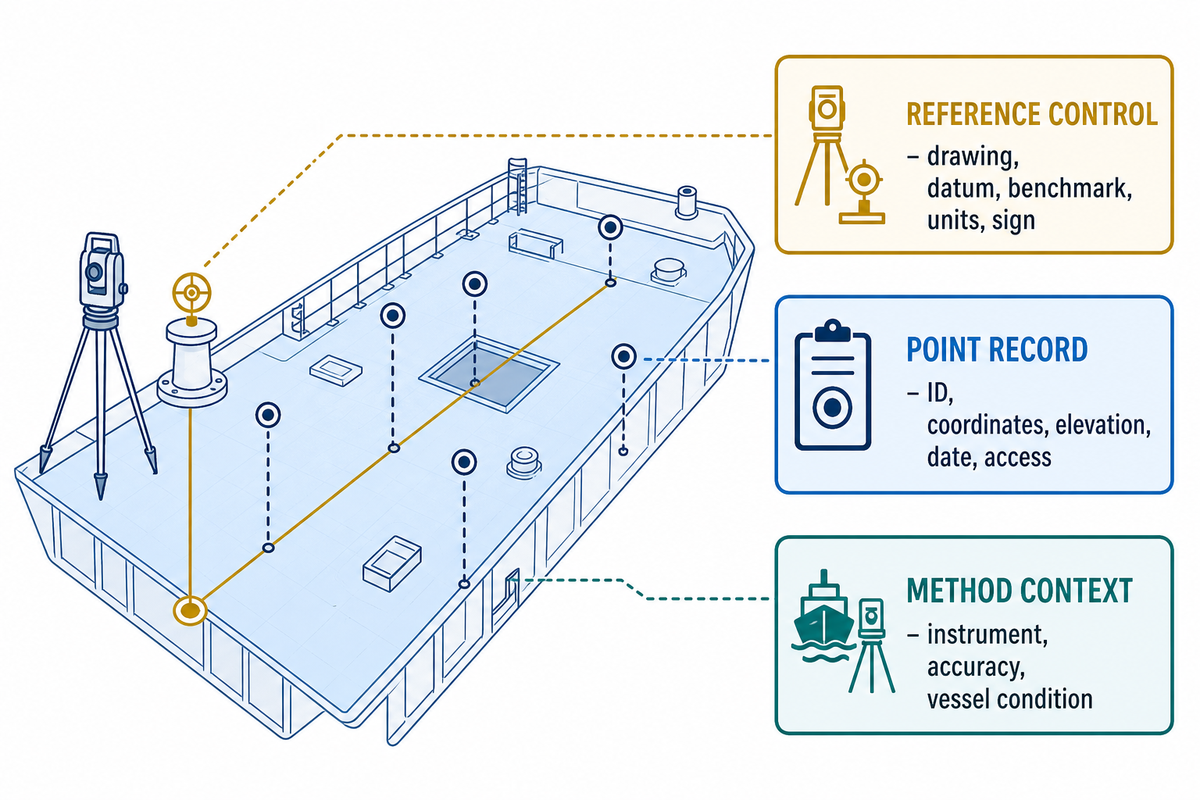
Point elevations only become valuable reference data when a different party is able to understand them. Cite the project datum or reference, reference a specified benchmark, and detail the procedure used to transfer the reference to the area of interest. Also, connect the reference to a drawing revision. Include units, sign convention, point IDs or coordinates, survey date, vessel condition, instrument or method, stated accuracy, and the treatment of inaccessible points.
This is not an absolute assertion that no valuable floor information exists prior to defining a fixed floor target. ASTM E1155/E1155M-23 describes a sampled surface-profile method for assessing flatness and levelness. Therefore, a profile can represent a surface. The quotation concern is more specific: the design fill thickness and product quantity cannot be interpreted consistently unless the project states the reference and defines the planned final state.
ISO 7078:2020 supplies general measurement terminology for levels, reference datums, and benchmarks. It does not give shipyards one mandatory point spacing. Survey density, tolerances, acceptance, uncertainty, and any permitted layer thickness remain project-defined and must be checked against the controlling specification, approved material documents, and proposed construction.
Reference control
Drawing, revision, datum, benchmark, transfer method, units, sign convention.
Point record
Point ID, coordinates or zone, measured elevation, date, inaccessible locations.
Method context
Instrument or method, stated accuracy, vessel condition, exceptions, intended slope or camber.
A reference makes a measurement traceable; it does not make a material compliant. Keep the survey record separate from the supplier’s proposed layer strategy, and keep both separate from the authority that accepts the vessel-specific submission.
Report the Thickness Distribution, Not One Average
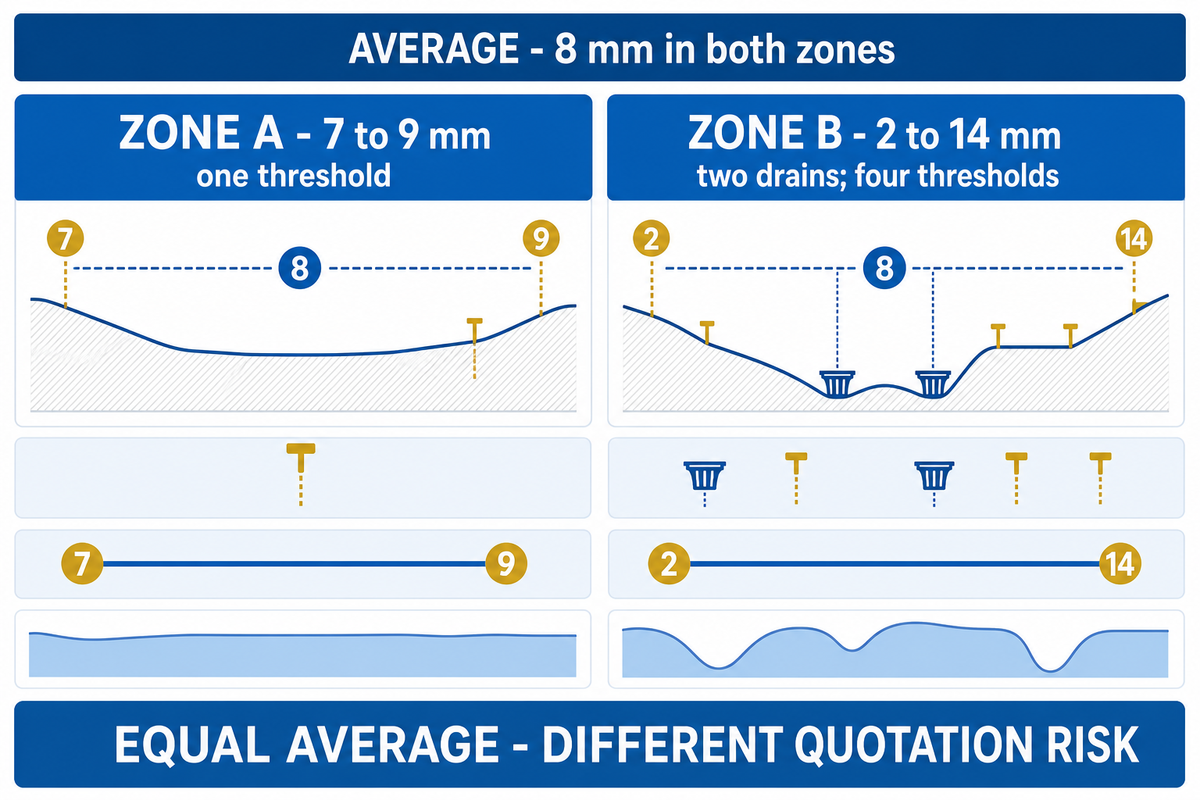
One average thickness can mask the local geometry that can change a proposal. For each controlled zone, provide net area, point count, mapped minimum, typical or design, and maximum thickness. In cases where the dataset allows, include bins or percentiles, tagged high and low points, deep-fill areas, edge conditions, slopes, transitions, exclusions, and links back to the point file.
The ASTM E1155/E1155M-23 surface-profile method is a useful reminder that measured floor data retains its sampling and reporting context. It does not turn one average into a product limit or an order quantity.
Imagine two zones that both average 8 mm. The first ranges from 7 to 9 mm. The second ranges from 2 to 14 mm and has several low points beside thresholds and drains. The average is identical, but the interface questions, layer strategy, local detailing, survey risk, and product-specific quantity basis aren’t. These example numbers explain the reporting method only; they aren’t product limits or project recommendations.
| Field | Zone A | Zone B | Quotation effect |
|---|---|---|---|
| Average | 8 mm | 8 mm | Does not distinguish local geometry |
| Minimum, maximum | 7–9 mm | 2–14 mm | Exposes thin, deep, and transition areas |
| Tagged interfaces | One threshold | Two drains and four thresholds | Changes coordination and work limits |
| Commercial status | Geometry defined | Layer strategy and details open | Prevents an invisible supplier assumption |
Geometric volume isn’t an order quantity. Conversion to installed mass, bags, or packs still requires the current named product’s density or yield basis, permitted thickness and layer strategy, package size, treatment of local extremes, and an agreed waste or allowance method. Reviewed marine product documents use different bases and conditions, which is precisely why a generic bag calculator would create false precision.
When a named-product estimate is available, record the estimated permanent mass by zone and elevation. Assign the owner or naval architect to decide whether lightship, deadweight, or stability records need review. Do not invent a universal threshold; the article’s job is to expose the decision and its owner.
Build the Datum × Zone Quote Envelope
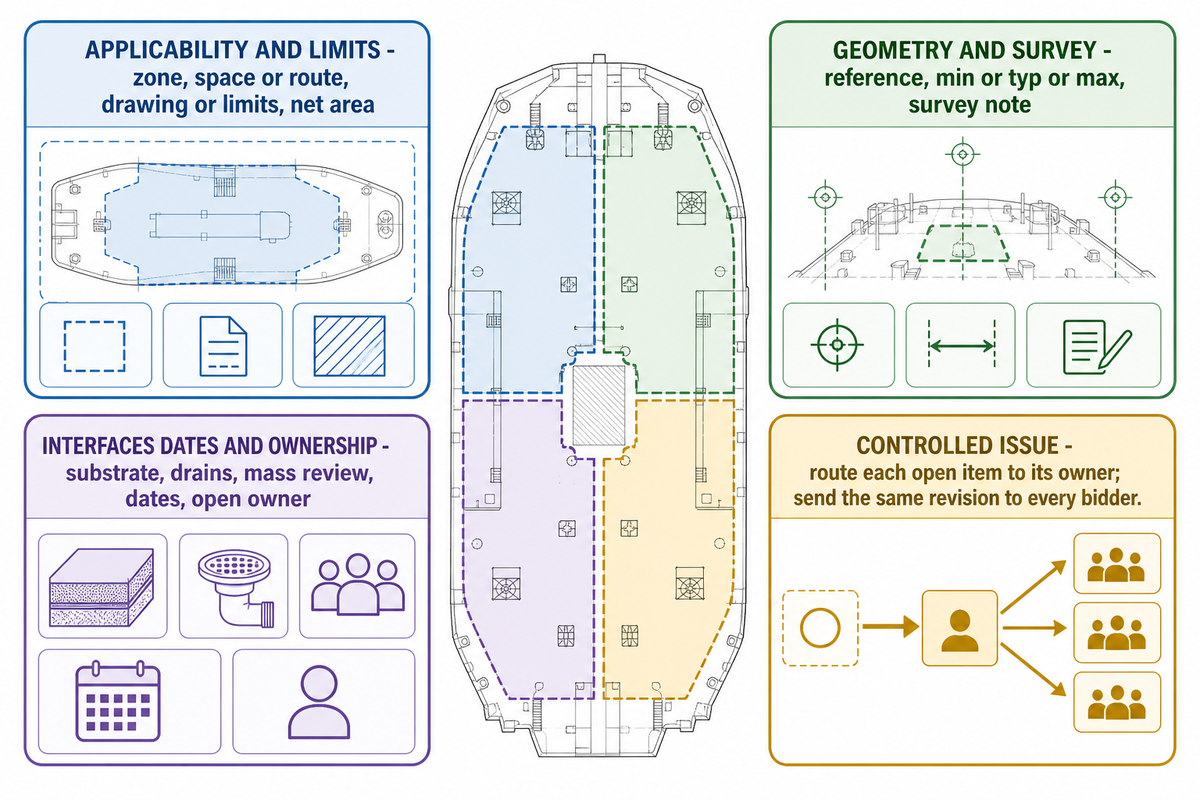
The 12-Field Datum × Zone Framework, presented as the Datum × Zone Quote Envelope, places quotation inputs on one controlled surface. It’s an editorial framework and not an International Maritime Organization form, a classification rule, or a shipyard standard. Create one row for every pricing zone and issue the same revision to every bidder.
The framework uses the reference and benchmark distinction described by ISO 7078:2020. Its 12 fields remain an editorial quotation-control structure, not an ISO form or a prescribed survey grid.
The envelope joins measurement, physical scope, applicability, interfaces, schedule, and ownership. Its central rule is simple: if a row lacks its regulatory and space route, reference, thickness distribution, work boundary, retained-layer decision, survey-quality note, or responsible owner, keep it open. Never replace a blank field with an unrecorded bidder assumption.
| Zone | Space / route | Drawing / limits | Net area | Reference | Min / typ / max | Survey note | Substrate / retained layers | Drains / interfaces | Mass review | Dates | Open owner |
|---|---|---|---|---|---|---|---|---|---|---|---|
| D4-Pantry-02 | Service space; route TBC | GA-217 Rev C; marked boundary | TBC | FFL-D4-01 | Survey schedule | Two inaccessible points | Steel; coating status TBC | Drain D-17; two thresholds | Owner/naval architect | Delivery, workfront, release | Yard design; due before final offer |
Fictional illustrative row only: the identifiers demonstrate record structure and do not describe a live vessel, product requirement, or Yibo project case.
Ready for comparable review
- Applicability and authority are named.
- Drawing and survey revisions agree.
- Work limits and retained layers have a status.
- Every open item has an owner and due date.
Not comparable yet
- A supplier must infer the layer role.
- Gross area hides exclusions or equipment footprints.
- Drain, threshold, or coating-removal limits are missing.
- One completion date hides several release conditions.
Close Substrate and Interface Unknowns by Zone

Area and level data do not describe the surface receiving the proposed material. Record whether the deck is smooth or uneven, then record the structural substrate, plate and weld condition, corrosion or contamination observations, existing coatings, primer status, moisture or cleaning evidence where relevant, and every retained underlayment or base coat. In a refit, define the limits of removal and the evidence required to retain an old layer. “Existing floor” and a photograph aren’t statements of compatibility.
The U.S. Coast Guard approved-material guidance helps define what an approval record can support. It does not establish the condition or compatibility of an existing project substrate, which must remain a separate zone-level decision.
Draw the physical work boundary around penetrations, drains, collars, movement details, thresholds, door clearances, adjacent finishes, upstands, equipment bases, removable fittings, and furniture footprints. A low point beside a drain is not only a thickness entry; it may also involve the finished water route, drain operability, a transition detail, another trade’s release, and the accepting authority’s comments.
Use an interface-owner schedule with four fields: condition, evidence, owner, and due date. If another trade controls a drain, threshold, coating removal, hot-work release, final finish level, or temporary protection, keep it open in the register until a traceable decision is issued.
Can Marine Leveling Compounds Be Used Over Existing Flooring?
Don’t make decisions based on the word “self-leveling.” The refit pack should identify every retained layer, its condition, adhesion or survey evidence, contamination and moisture findings, prior repairs, removal boundary, and new finish interface. Ask the supplier to map its answer to the named product and actual substrate, then state the required preparation, primer, test area, or removal decision. Project engineering and the applicable approval route still control acceptance.
Separate Delivery, Workfront, and Floor-Release Dates
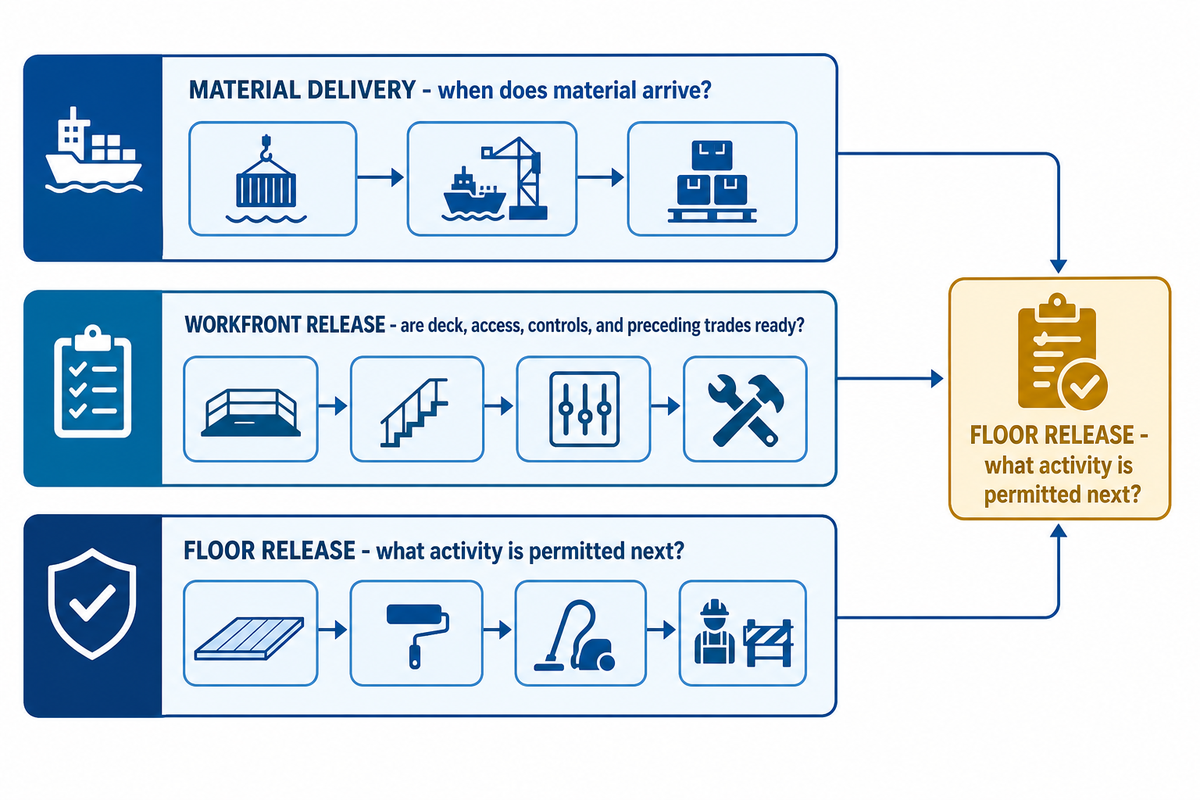
One completion date masks many timelines. Material delivery answers a logistics question. Workfront release answers whether the deck, access, ventilation, power, lighting, environmental controls, and preceding trades are ready. Application window describes when the work may proceed. Next-layer readiness, limited traffic, inspection, equipment movement, wet cleaning, and final service release are different conditions again.
Each milestone should be listed separately. Include the delivery point, access route, shift window, known temperature and humidity basis, ventilation constraints, protection duty, sequence dependencies, and needed inspection or witness. Ask the bidder to interpret and explain each of the readiness statements and how they relate to the named product, build-up, thickness range, substrate, conditions, and test or acceptance method.
Where an approval scope applies, the United States primary-deck-covering process keeps approval evidence separate from product-specific readiness and project scheduling. The quotation should preserve that separation.
How Long Does Marine Deck Leveling Compound Take to Dry?
There is no responsible project-wide answer for an unnamed product and build-up. “Dry” may mean workable, walkable, ready for the next compatible layer, ready for equipment, or fully released to service. Product documents make these conditions dependent on the product, layer, temperature, humidity, and ventilation. Record proposal-specific values as assumptions to be confirmed, not generic promises.
Define the Authority and Evidence Request Before Comparing Offers
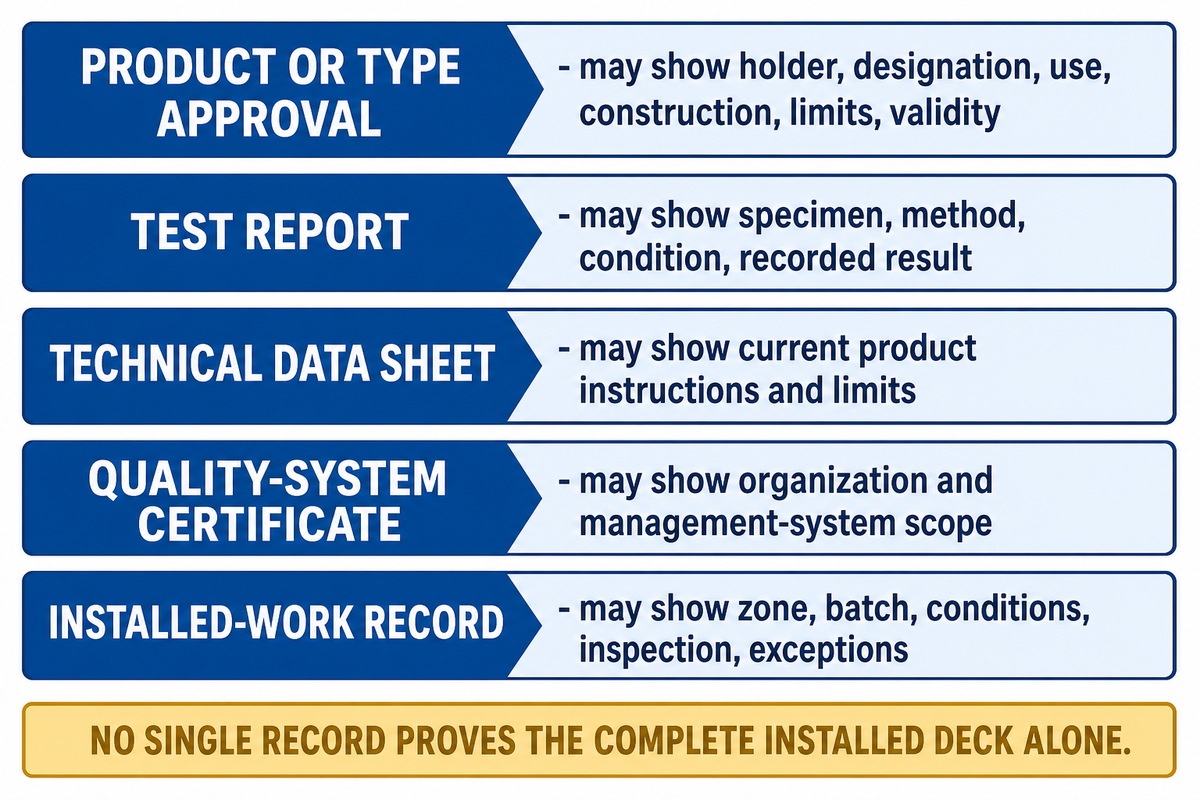
An evidence matrix necessarily consists of two sides: a document and the authority that accepts it. According to the International Maritime Organization, it doesn’t test or approve products for marine use. Approval is generally issued by the relevant national maritime Administration, based on recognized laboratory testing, and the flag Administration controls the interpretation and authority for onboard use. Therefore, don’t write “IMO approved”. State the actual issuer or accepting route.
Documents answer different questions. Product or type-approval certificates may identify the holder, product, intended use, construction, limits, and validity. Fire-test reports record a specimen, method, and result. Technical data sheets supply product instructions. Quality-management certificates concern an organization and stated scope. Project approvals, batch records, delivery identities, installation records, inspection results, and closed comments belong to other steps. The project’s internal evidence matrix should therefore ask whether each document is suitable for the named interior or exterior zone without implying that a certificate settles the contractor’s execution duties.
The current United States primary-deck-covering approval process demonstrates why an approval package identifies product designations, intended uses, test reports, and production inspection information. The International Maritime Organization’s ship-design and type-approval guidelines clarify who issues approvals and who doesn’t. Neither page can make a remote decision for an unnamed vessel build-up.
| Record | May show | Does not show alone | Required response |
|---|---|---|---|
| Product/type approval | Holder, designation, use, construction, limits, validity | Acceptance of every project variation | Issuer, document ID, scope match, exception |
| Test report | Specimen, method, condition, recorded result | Equivalence to a changed build-up | Tested versus proposed construction |
| Technical data sheet | Current product instructions and limits | Vessel approval or site execution | Edition, named product, deviations |
| Quality-system certificate | Organization and management-system scope | Product or installed-floor performance | Holder, issuer, scope, validity |
| Installed-work record | Zone, batch, conditions, inspection, exceptions | A wider approval than the governing document grants | Zone linkage and acceptance reference |
Also record whether the flooring scope enters a vessel-modification approval path and who owns that decision. Ask, rather than assume, whether estimated installed mass by deck and elevation requires a lightship, deadweight, or stability-record review. These are controlled project questions, not supplier-document shortcuts.
Issue a Clarification Register Before Commercial Comparison
Log each assumption, exclusion, requested decision, affected zone, owner, due date, and closure reference. Issue the same controlled revision to every bidder. Keep an offer at “not comparable yet” when bidders use different applicability routes, work limits, retained layers, product-specific calculation factors, evidence deliverables, delivery terms, or site-support assumptions. A lower price isn’t a like-for-like result when its scope is smaller.
Normalize the response without rewriting the supplier’s proposal. Give each bidder a separate comparison column for the named product and build-up, quoted zones, quantity basis, package rounding, delivery basis, attendance, surface-preparation assumptions, excluded details, evidence deliverables, and validity period. For each clarification answer, refer to the offer revision it changes. This preserves the commercial record while making scope differences visible to engineering and procurement.
Do not close a technical exception merely because its cost has been entered. If one offer assumes retained coating, another assumes complete removal, and a third leaves the substrate route open, record three different bases. Assign the unresolved interface to the responsible project party and request a revised offer after the decision. Although this is a lengthy process, it serves to avoid treating an omitted task, conditional product route, or unpriced approval response as a saving.
Send a Bounded Pack to the Commercial System Owner
In one version-controlled package, include the scope statement, authority and applicability matrix, drawings, survey record, Datum × Zone Quote Envelope, substrate and interface schedule, schedule definitions, mass-review owner, evidence request, and clarification register. Add a cover sheet indicating revisions and responsible parties. This offers the marine flooring industry a uniform comparison basis without attempting to treat every system as interchangeable. A missing value may remain “to be confirmed,” but it should never become an invisible bidder assumption.
Keep the formal approval record with the handoff. The United States primary-deck-covering route is one example of why product designation, intended use, test evidence, and inspection information must remain identifiable when a commercial system owner reviews the pack.
Once this neutral package is complete, the project team can review the self-levelling deck-covering system against the completed input pack. That solution page remains the place for Yibo’s product range, supplier-specific technical data, current document review, and quotation. This article remains on the input-preparation side of the intent boundary.
Send Your Controlled Deck Input Pack
Share the zone schedule, survey reference, interfaces, dates, approval route, and open decisions for a supplier-specific review. For company background, visit the Yibo company homepage.
Frequently Asked Questions
What types of marine deck leveling compounds are available?
A useful classification starts with the proposed role in the approved floor build-up, not a generic chemistry label. Ask the supplier to identify the named product, substrate, primer or bonding route, permitted thickness or layer strategy, finish interface and the document covering the proposed use. Product-family and model selection belongs to the current supplier review, so the enquiry should state service conditions and evidence needs before requesting a recommendation.
Can marine leveling compounds be used over existing flooring?
The term “self-leveling” doesn’t imply compatibility. A refit pack should identify every retained layer, its condition, adhesion evidence, contamination or moisture findings, removal limits, surface treatment already completed and the new finish interface. The supplier then needs to state whether the proposed system permits that substrate and which preparation, primer, test area or removal decision applies. A photo or the previous material name by itself doesn’t justify the overcoating.
How long does marine deck leveling compound take to dry?
There’s no safe project-wide answer for an unnamed product and build-up. A quotation should distinguish usable working time, readiness for the next compatible layer, limited foot traffic if relevant, and final service release. Ask the supplier to tie each interval to the exact product and build-up, thickness range, substrate, ambient conditions, ventilation and test or acceptance method.
Treat the published data sheet as the starting condition set, then record any project-specific deviation or confirmation. This helps avoid a loose “dry time” from turning into an unreliable project promise.
Is one average thickness enough for a quotation?
Not generally. Please include the mapped minimum, typical and maximum thicknesses with zone areas showing deep-fill locations and transition details. An average may support a check, but it cannot show the local extremes that affect build-up, interfaces or a product-specific quantity calculation.
What project information should a shipyard send before requesting a quote?
Send one version-controlled package, not an email list. Identify the vessel and project stage, each deck zone and its use, requested layer role, drawing revisions, net areas, finished-floor datum, survey point map, thickness distribution, substrate and retained coatings, penetrations and level interfaces, finish build-up, required evidence route, delivery location, and workfront dates.
Add open assumptions, responsibility owners, and required supplier deliverables. If quantity is requested, require the exact product-specific density or yield source, permitted layer strategy, waste basis and package calculation. If approval documents are requested, ask the supplier to map each document to the named material or tested construction and explain what remains project-specific. The same controlled package is sent to each bidder before price comparison.
Conclusion
A quote-ready marine deck leveling enquiry controls more than area and average thickness. It ties vessel and space applicability to an accepting authority, a traceable survey reference, zone-level geometry, exact work limits, retained layers, interfaces, schedule clocks, installed-mass review ownership, evidence scope, and open decisions. When every bidder receives the same controlled package, commercial differences are easier to trace to the proposed system instead of hidden assumptions.
References & Sources
- Finish & Furnishing materials United States Coast Guard
- 46 CFR Part 164 Subpart 164.106 Electronic Code of Federal Regulations
- History of Fire Protection Requirements International Maritime Organization
- Ship Design and Stability: Type-Approval Guidance International Maritime Organization
- ISO 7078:2020 Procedures for Setting Out, Measurement and Surveying International Organization for Standardization
- ASTM E1155/E1155M-23 Floor Flatness and Levelness ASTM International; cited as a measurement-method counterexample, not a shipyard rule



![Marine PU Floor: Selection & Installation [Guide]](https://yibomarine.com/wp-content/uploads/2026/09/marine-pu-floor-blog-featured-150x150.png)