Get in touch with Yibo Company

Commercial Marine Flooring — Deck Coverings, Floating Floors and Resin Systems by Vessel Area
Commercial marine flooring on a SOLAS vessel is an approval decision before it is a material decision. We manufacture the primary deck coverings, A-60 class floating floors, damping coatings and resin floors that sit under and over them. Every certificate number and expiry date on this page is printed in full so you can check it yourself.
- Wheelmark certificates published with numbers and expiry dates
- CCS works approval SH25PWA00041 and type approval SH25PTB00152
- Floating floors from 27.45 kg/m² to 67.63 kg/m²
- Sound insulation index 46 dB to 56 dB
Send a compartment schedule or a general arrangement drawing and an engineer works through it with you rather than routing it to a price list.
Quality system
DNV Module D certificate MEDD00000CX, notified body 0098, valid to 2027-01-19
Classification approvals
CCS works approval SH25PWA00041 and type approval SH25PTB00152
Wheelmark scope
MED/3.1, MED/3.11a and MED/3.18c across thirteen Module B certificates
Lightest floating floor
27.45 kg/m² at a sound insulation index of 46 dB
Highest sound insulation
56 dB at 63.88 kg/m² for the specified construction
Self-levelling strength
Compressive strength at least 30 MPa, fluidity at or above 130 mm
Marine Flooring by Vessel Area
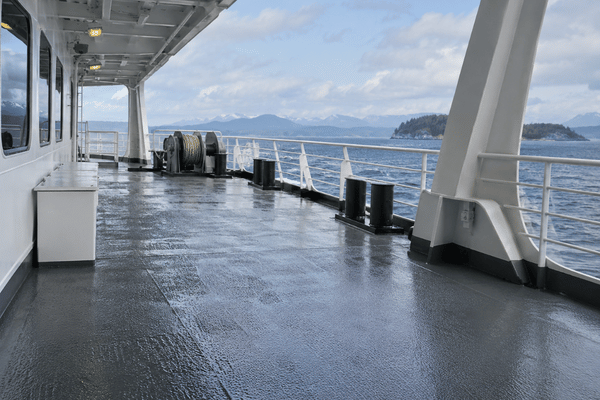
Four vessel areas drive almost all of the deck covering enquiries we receive, and each one weighs those three variables differently. Accommodation work is decided by sound insulation against deck weight, whereas working and process areas turn on mechanical and chemical exposure. That exposure dictates the choice of solution rather than the vessel type.
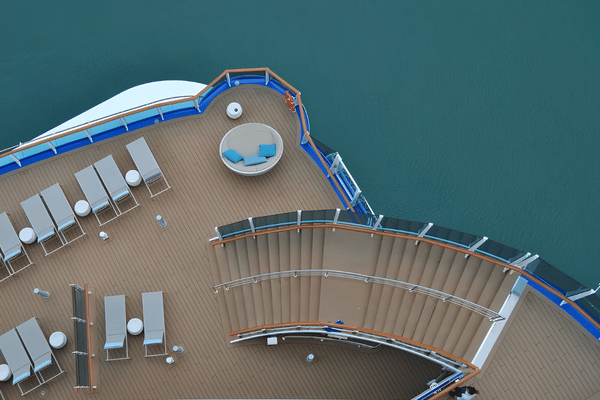
Cruise and Passenger Vessels
SPACES
cabins, corridors, public rooms, galleys, wet units
BUILD-UPS
YB-A60FIII-1 floating floor, AC-JII self-levelling covering, YB-S22 PU levelling covering
DECISIVE FIGURES
56 dB sound insulation at 63.88 kg/m²
Cabin work is where the weight argument is sharpest, because a small saving per square metre multiplies across an enormous deck area.
View Details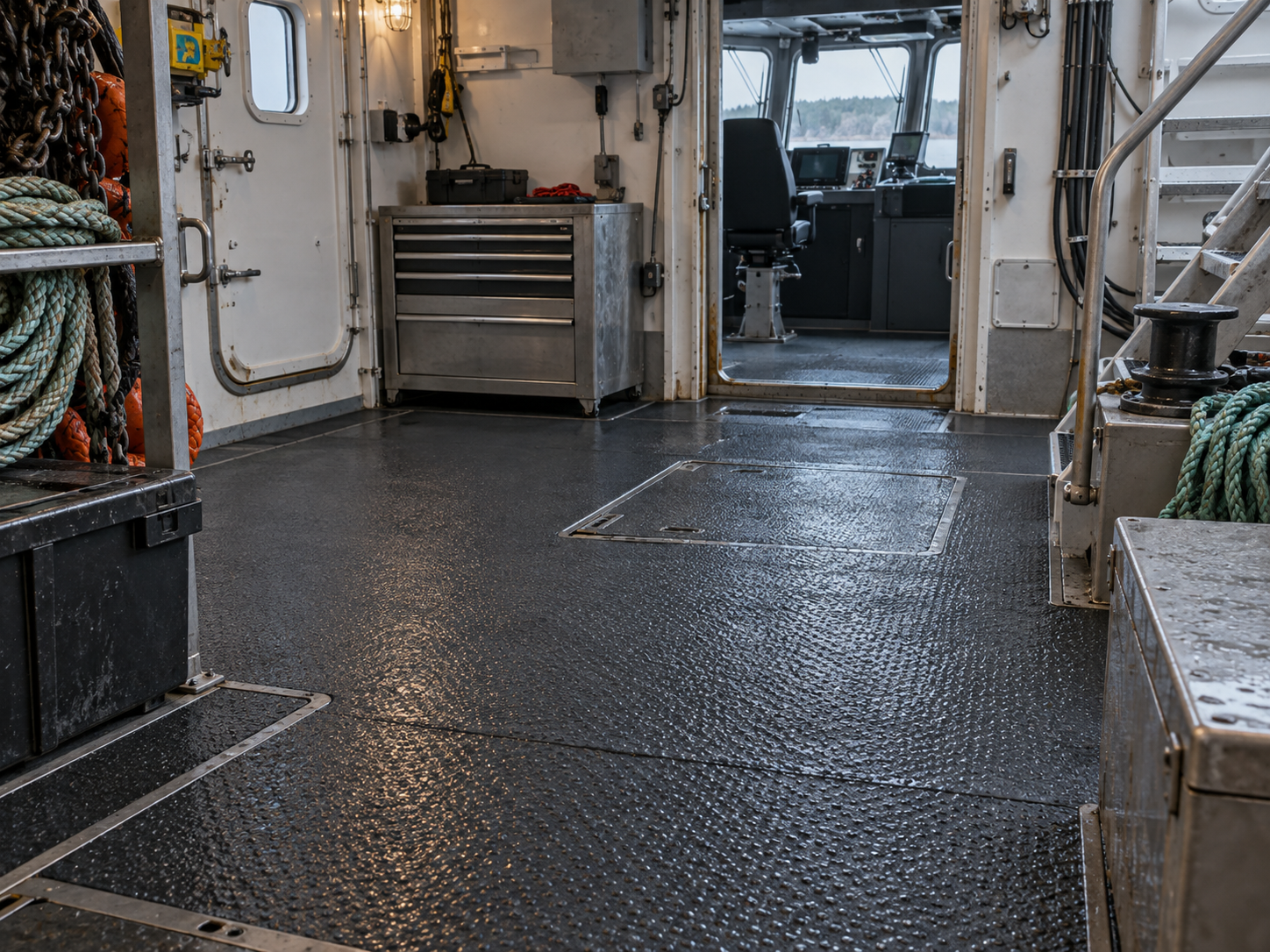
Ferries and Workboats
SPACES
vehicle decks, crew accommodation, service passages
BUILD-UPS
AC-JI self-levelling covering, YB-5 levelling covering, DP-SDI damping coating
DECISIVE FIGURES
compressive strength at least 30 MPa, breaking strength at least 8 MPa
Ro-Pax and workboat decks are subject to wheel loads and cleaning chemicals, so selection is dominated by mechanical properties and cure behaviour.
View Details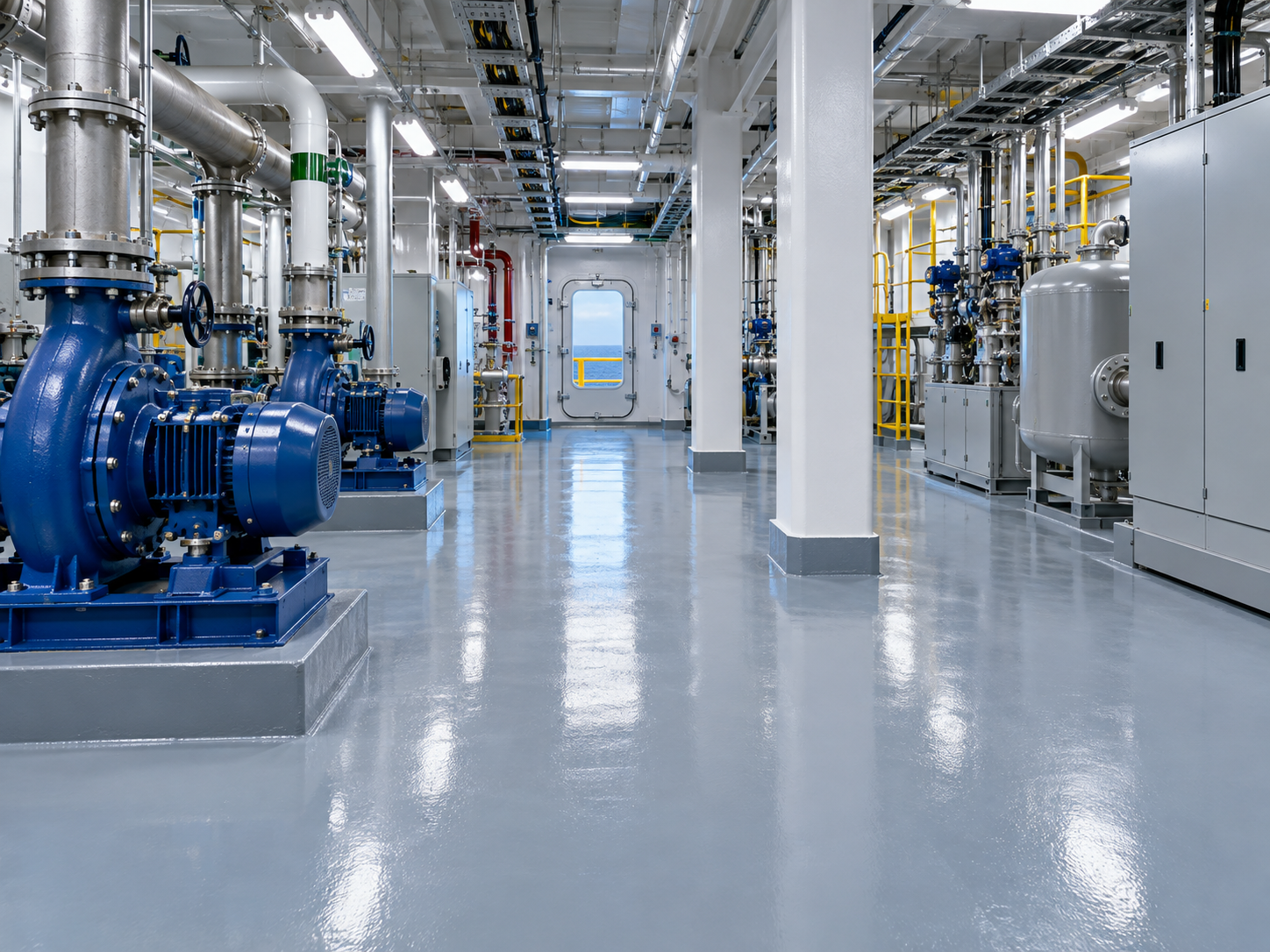
Offshore Platforms and Modules
UNITS
floating production units, fixed platforms, process and living quarters modules
BUILD-UPS
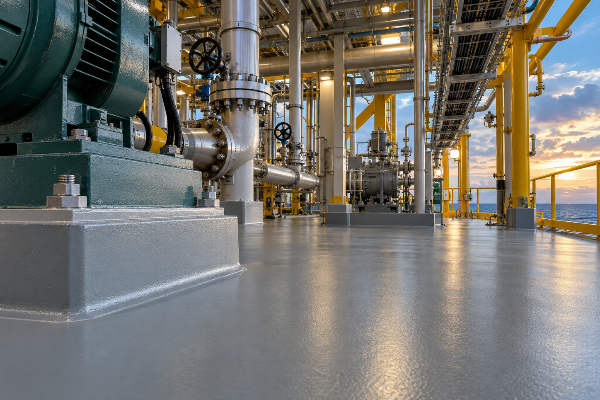
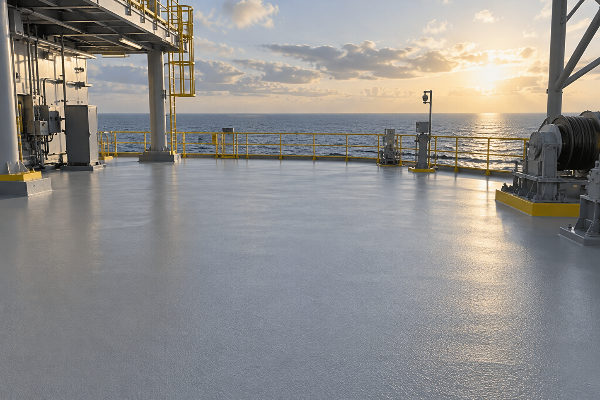
YB-Epoxy Floor E60, YB-S22 PU levelling covering, YB-S20 polyester covering
DECISIVE FIGURES
compressive strength at least 50 MPa, skid resistance of at least 0.5
Our A-class certificates are rated on the standard cellulosic fire curve. Hydrocarbon fire exposure is a separate rating class that we do not hold a certificate for, so those areas are specified against the project fire plan rather than against an A-60 mark.
View Details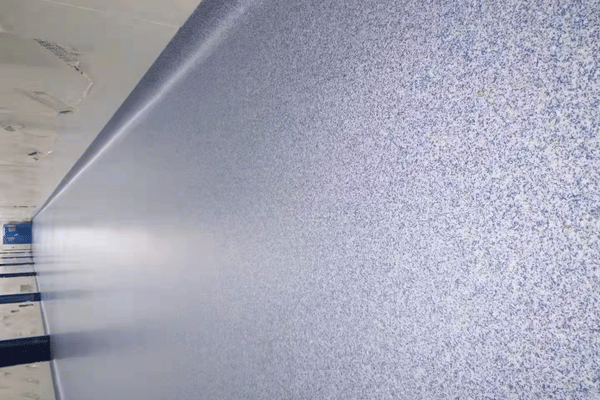
Naval Vessels
SPACES
A-class divisions, machinery space overheads, accommodation
BUILD-UPS
YB-A60-7 fireproof deck, YB-HdB-5 floating floor, YB-LdB-1 floating floor
DECISIVE FIGURES
45.8 kg/m² for the A-60 deck, down to 27.45 kg/m² for the lightest floating floor
Naval work usually arrives with the fire integrity fixed by the drawing, which turns the conversation into weight and build height.
View DetailsSpaces These Systems Cover
- Cabins, corridors and stairwell landings
- Public rooms, restaurants, theatres and shops
- Galleys, pantries, laundries and provision stores
- Wet units, sanitary spaces and shower areas
- Vehicle decks, Ro-Ro decks and vehicle ramps
- Machinery spaces, workshops and switchboard rooms
- Bridge decks, wheelhouse floors and radio rooms
- Process modules, living quarters modules and helideck access routes
- Open decks, walkways and escape routes
Seven Deck Covering and Floor Families, Model by Model
Each family below carries its own approval item number, and the item number decides where the product may be specified. A product approved as a primary deck covering is not automatically the same thing as a floor covering, and the two are tested on different substrates.
Self-Levelling Primary Deck Coverings
ModelsAC-JI, AC-JII, AC-J1200
Approval itemMED/3.1 primary deck coverings
CertificatesMEDB00005WR, MEDB00005WM, MEDB00008VR
Key figuresDensity 800 kg/m³ to 1700 kg/m³, fluidity at or above 130 mm, compressive strength at least 30 MPa on AC-JI and AC-J1200
Pack13 kg, 18 kg and 25 kg bags
Lightweight and Fireproof Deck Coverings
ModelsYB-1, YB-3, YB-4
Approval itemMED/3.1 for YB-1 and YB-4, MED/3.11a for YB-3
CertificatesMEDB0000124, MEDB000014B, MEDB0000125
Key figuresDensity from 800 kg/m³ up to 1300 kg/m³, breaking strength at least 3 MPa, organic content no more than 10 per cent
Pack19 kg, 38 kg and 39 kg sets
Levelling and Cement Coverings
ModelsYB-5, YB-7
Approval itemMED/3.1 for YB-5; YB-7 carries CCS approval only
CertificatesMEDB0000126 for YB-5
Key figuresYB-5 fluidity 250 mm to 300 mm, compressive strength at least 10 MPa; YB-7 compressive strength at least 15 MPa
Pack25 kg bags and 50 kg sets
A-60 Class Floating Floors and Fireproof Decks
ModelsYB-A60-7, YB-A60FIII-1
Approval itemMED/3.11a A-class divisions, fire integrity
CertificatesMEDB0000BBX to 2031-08-05, MEDB000070D to 2030-11-02
Key figuresRock wool at 140 kg/m³ plus or minus 5; 45.8 kg/m² and 63.88 kg/m² for the specified constructions
Build-upDamping layer, rock wool, deck covering and a galvanized steel top plate at 1250 × 1250 mm
Acoustic Floating Floors
ModelsYB-HdB-5, YB-LdB-1
Fire scopeSurface flammability to IMO 2010 FTP Code Part 5; the assembly is not an A-class division
Key figures50 dB at 67.63 kg/m², and 46 dB at 27.45 kg/m²
Where it fitsAccommodation and service spaces where the drawing sets an acoustic target rather than a fire integrity class
Damping Coating
ModelDP-SDI
Approval itemMED/3.1 primary deck coverings
CertificateMEDB00005WN to 2029-11-24
Key figuresTensile strength at least 2.0 MPa, adhesive force at least 1.8 MPa, Shore A hardness 60 plus or minus 5
RoleConstrained-layer damping under a deck covering, which acts as the constraining layer over it
Polyester and PU Deck Coverings
ModelsYB-S20 polyester primary covering, YB-S22 PU levelling covering
Approval itemMED/3.1 for YB-S20, MED/3.18c for YB-S22
CertificatesMEDB00007R8 to 2027-03-17, MEDB00007R9 to 2027-03-15
Key figuresWater absorption no more than 10 per cent, oil absorption no more than 5 per cent, asbestos content no more than 0.1 per cent
ThermalYB-S20 heat conductivity coefficient no more than 1.2 W/(m·K)
Marine Epoxy Floor
ModelYB-Epoxy Floor E60
Approval itemMED/3.18c floor coverings with low flame-spread characteristics
CertificateMEDB00001WK to 2027-09-25
Key figuresCompressive strength at least 50 MPa, flexural strength at least 35 MPa, adhesive strength at least 2.0 MPa, skid resistance of at least 0.5
WearWear resistance no more than 0.03 g at 750 g and 500 revolutions
Another Specification
The range also covers imitation teak and wood-effect deck finishes alongside the families above. Send the build-up called for on your drawing with the compartment schedule and we confirm in the quotation whether an existing certificate covers it.
- Tell us the space, the fire requirement and the weight allowance
- We provide the appropriate model, its item number and the certificate that carries it
- Where nothing in the range fits we say so, rather than offer a substitute
Three Wheelmark Item Numbers, Three Different Approval Scopes
Our thirteen Module B certificates do not all sit under one heading. They span three separate item numbers in the marine equipment schedule, and the three are not interchangeable. Specifying against the wrong one is the most common reason a deck covering submission fails at review, because the item number decides which test the product had to pass.
Item number
What it covers
Our models
Certificates
MED/3.1
Primary deck coverings — the first layer applied directly on the deck plating, including the primer, anti-corrosive compound or adhesive needed for protection or adhesion
AC-JI, AC-JII, AC-J1200, DP-SDI, YB-S20, YB-1, YB-4, YB-5
MED/3.11a
A-class divisions, fire integrity — the complete construction is rated, not a single layer
YB-A60-7, YB-A60FIII-1, YB-3
MED/3.18c
Surface materials and floor coverings with low flame-spread characteristics — everything installed above the primary deck covering
YB-Epoxy Floor E60, YB-S22
Why the Split Exists
The IMO 2010 FTP Code draws the line at the deck plating. Everything above the primary deck covering is counted as floor covering, and that is an entirely separate approval with a separate test. Yibo Marine holds certificates on both sides of that line, which is why the table above is split by item number rather than by product family.
- Primary deck coverings intended only for installation beneath a floor covering are fire-tested on a steel substrate.
- Floor coverings are tested on the standard calcium silicate board referenced in IMO Resolution A.653(16).
- The non-combustibility requirements of Annex 1 Part 1 do not apply to primary deck coverings; what applies is flame spread under Part 6 and smoke density and toxicity under Part 2.
- The relationship is one-directional, which is not necessarily what a specification assumes: an approved primary deck covering may be used as a floor covering without additional testing, because a covering tested to Part 6 is considered to also comply with Part 5. The reverse does not hold.
What the Wheelmark Does and Does Not Settle
Question
Answer
When does conformity attach?
At the moment of marking. Equipment carrying the mark, the notified body number and the year of marking may be placed on the market, installed on board and used across the EU without further national approval.
Is one certificate enough?
No. A valid approval is always a module combination, and the notified body issues a separate certificate for each module. Our Module B type-examination certificates sit with DNV Module D certificate MEDD00000CX.
Does it cover every flag?
No. The wheelmark applies to EU-flag vessels. Other flag administrations run their own acceptance routes, and we hold CCS and NK approvals alongside the wheelmark for that reason.
Does IMO approve the product?
No. IMO sets the test procedures. Approval is issued by the relevant national administration or its recognised organisation on the basis of testing by an accepted laboratory.
Does A-60 cover hydrocarbon fire?
No. A-class ratings run on the standard cellulosic fire curve. Hydrocarbon exposure is a separate rating class and we do not hold a certificate for it.
Do national rules add anything?
Yes. The FTP Code is the international test instrument; individual flag administrations publish their own approval categories and can apply additional national conditions on top of it. Name the flag at enquiry and we quote against that route rather than against a generic one.
Weight, Sound Insulation and Strength Across the Range
Contrary to a common assumption in this market, no rule sets a decibel figure for the insulation material itself. The regulatory obligation on the material is non-combustibility. The noise limits that do exist are set for the space and assessed on the finished construction under the Code on Noise Levels On Board Ships, which is mandatory under SOLAS.
What This Table Is and Is Not
This sheet helps the end user choose materials and is not a certificate of compliance. All values are system-dependent and based on the deck build listed in the table and will change should the layering structure, thicknesses or construction technique change.
Deck Weight Ladder
Lightest floating floor, weight per unit area
27.45 kg/m² (5.62 lb/ft²) — YB-LdB-1
A-60 fireproof deck, weight per unit area
45.8 kg/m² (9.38 lb/ft²) — YB-A60-7
A-60 floating floor, weight per unit area
63.88 kg/m² (13.08 lb/ft²) — YB-A60FIII-1
Heaviest floating floor, weight per unit area
67.63 kg/m² (13.85 lb/ft²) — YB-HdB-5
Sound insulation index range
46 dB to 56 dB across the four floating-floor constructions
Rock wool density in A-class assemblies
140 kg/m³ plus or minus 5 (8.74 lb/ft³)
Galvanized steel top plate
1250 × 1250 × 1.5–6.0 mm (49.2 × 49.2 × 0.06–0.24 in)
Self-levelling compressive strength
At least 30 MPa (4351 psi) on AC-JI and AC-J1200
Lightest self-levelling density
800 kg/m³ (49.9 lb/ft³) — AC-JII
Epoxy floor compressive strength
At least 50 MPa (7252 psi) — YB-Epoxy Floor E60
Epoxy floor wear resistance
No more than 0.03 g at 750 g and 500 revolutions
Damping coating adhesive force
At least 1.8 MPa (261 psi) — DP-SDI
Deck covering fluidity
At or above 130 mm (5.1 in) on the self-levelling range
Organic content in deck coverings
No more than 10 per cent
The Five Things a Buyer Should Ask For
Trade guidance for cruise lightweighting tells buyers to demand five proof points from a flooring supplier, and to treat weight alone as insufficient evidence. Here is where each one sits on this page.
Weight per square metre
Four constructions from 27.45 kg/m² to 67.63 kg/m², in the table above
Sound reduction
Sound insulation index 46 dB to 56 dB, tied to the named construction
Flame rating
Item number and certificate number for every model, in the approvals table
Installation or cure time
Confirmed against the yard programme at drawing review, not published as a fixed figure
Impact resistance
Compressive and breaking strength per model on the datasheets we issue with the quotation
Pricing, Quotation and Delivery Scheduling
Price follows the build-up, the compartment area, the approval route your vessel needs and the delivery schedule the yard is working to. There is no price list for classed deck covering work; the figure comes back in a written quotation against your compartment schedule.
What Moves Your Price
Driver
Effect on cost
How to reduce it
Build-up depth
An A-class floating floor carries damping, rock wool, covering and a steel top plate; a single self-levelling layer does not
Confirm whether the space needs fire integrity or only an acoustic target before fixing the build-up
Number of distinct build-ups
Each additional specification adds its own material batch, submission and site sequence
Group compartments with the same requirement onto one build-up wherever the drawing allows
Approval route
Different flag and class combinations call for different certificate packs
Tell us the flag and class at enquiry rather than after the order
Delivery phasing
Splitting a scope across many small consignments raises handling and packing
Align consignments to the yard block or module erection sequence
How Your Quotation Is Produced
Send us a general compartment schedule / fire plan / arrangement layout and one of our engineers will calculate and prepare your quotation. This shows you the recommended build, the relevant item number and the corresponding certificate.
How Delivery Is Scheduled
- Delivery is planned against the yard build programme and block erection sequence, not against a standing stock date
- The consignment plan is agreed with the quotation so the material lands when the compartment is ready to receive it
- Substrate readiness, ambient temperature and humidity determine when the covering may actually be applied
- Where a certificate renewal is due during your build window, we say so at quotation rather than at delivery

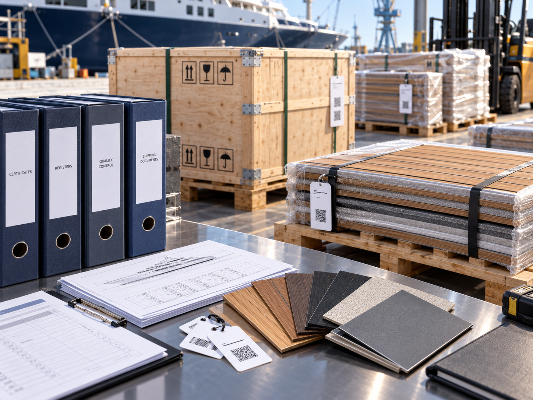
Buyers do not ask us whether we are certified. They ask which item number the certificate sits under and when it runs out, because that is what their surveyor will ask them. So we print the number and the date and let them check it in the public database.
Certificates, Registers and What Ships With the Goods
A certificate is only useful to you if you can check it. Yibo Marine has manufactured marine deck coverings in the same Suzhou factory since 2001, and every number below is printed so you can look it up independently rather than take our copy on trust.
How Every Batch Is Checked
- Incoming raw material batches are sampled and checked against the approved formulation before they are combined
- Each production batch is sampled and tested in-house against the technical index on the product datasheet
- Only after that is the manufacturer quality certificate issued for the batch
- Batch identification moves with the consignment so you can trace a compartment back to its batch
- The certification status of each model is re-checked against the register before the consignment is released
Certificate Expiry Register
Checked on 2026-09-03. Four Module B certificates have a 2026-09-05 expiry date and are shown with that date rather than described as open-ended.
Certificate
Type
Scope
Issued
Expires
MEDB00005WM
MED Module B
MED/3.1 — AC-JII
2024-11-25
2029-11-24
How We Work: From General Arrangement Drawing to Laid Deck
A deck covering order breaks more often at the document stage than at the material stage. These six stages exist to take that risk away before anything ships, and Yibo Marine carries the document work rather than giving it back to the yard.
Send the drawing
General arrangement, fire plan or compartment schedule, with flag and class stated.
Engineering review
Build-up per compartment, applicable item number and the certificate that covers it.
Written quotation
Scope, consignment plan and the document pack that will ship with the goods.
Production and batch release
Manufactured in-house against the approved formulation and released only after batch testing.
Consignment and documents
We are responsible for the material conforming to the certificate it ships under.
Site support
Substrate, ambient condition and sequence questions answered while the deck is being laid.
Specification Notes That Save Time at Review
Design point
What to specify
Why it helps
Fire requirement per space
State the required class from the fire plan, not just a product name
Decides whether the space needs MED/3.11a or only MED/3.1 and MED/3.18c
Acoustic target
Give the index the specification requires and the space it applies to
SOLAS sets none, so the target has to come from your document
Weight allowance
State the kilograms per square metre the naval architect has allowed
Rules out build-ups early instead of at the weight review
Installation sequence
Say whether cabins are built on the floor or moved in prefabricated
A floating floor is normally laid before the cabin walls go up, so the sequence changes the build-up
Substrate condition
Confirm blasting grade and residual coating on the deck plating
Bond performance depends on it more than on the covering itself
Delivered Scopes and Where They Sit
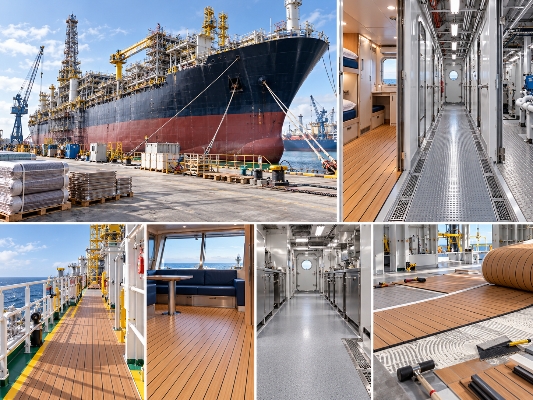
These photographs are from our own project records. They show the vessel, the laid floor and the work in progress rather than a rendering.
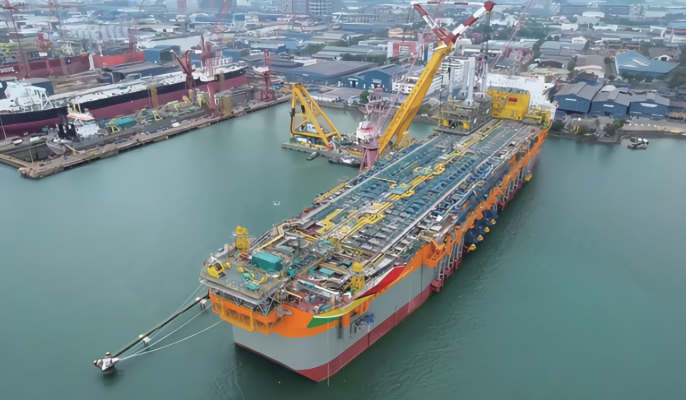
An FPSO hull at the fitting-out quay, built at Shanghai Waigaoqiao Shipbuilding.
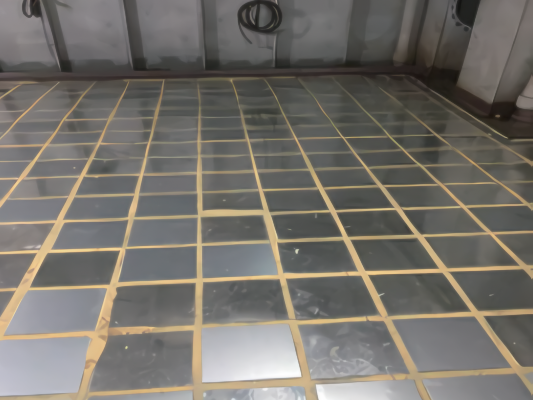
Floating floor as laid: galvanized steel top plates over the damping and rock wool layers.
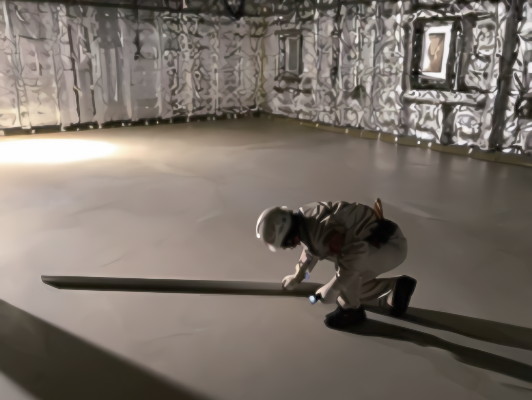
Self-levelling primary deck covering screeded flat across an insulated compartment.
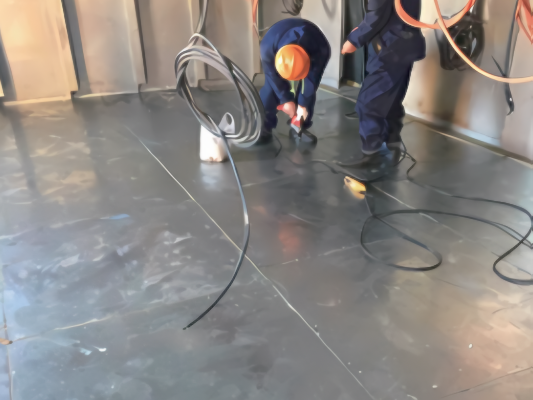
Deck covering going down over prepared steel, worked wet and levelled before it sets.
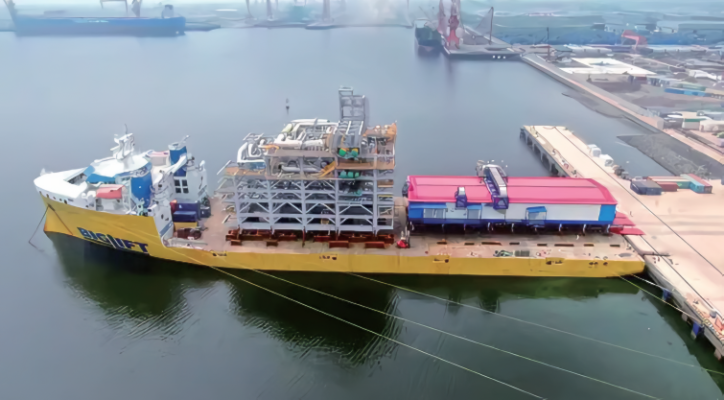
LNG process and living quarters modules loaded out for sailaway.
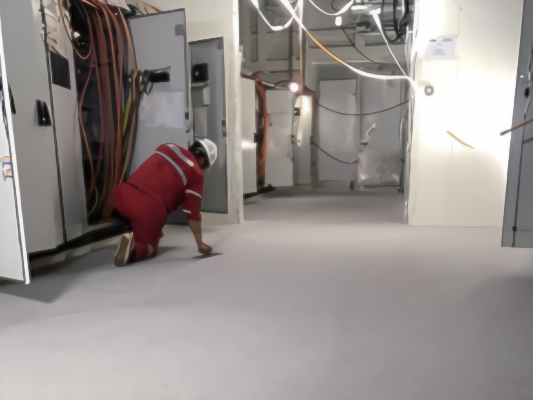
Finished floor in a completed module corridor, laid before electrical fit-out closed out.
Floating Production Hull
A floating production storage and offloading hull built at Shanghai Waigaoqiao Shipbuilding. Accommodation and service spaces were supplied with the YB-A60FIII-1 A-60 floating floor, DP-SDI damping coating and AC-JI self-levelling deck covering.
- 56 dB sound insulation for the specified construction
- 63.88 kg/m² added deck load
LNG Process and Living Quarters Modules
LNG process and living quarters modules for an Arctic module programme. Floors were supplied as YB-Epoxy Floor E60 in the working areas and YB-S22 PU levelling covering in the accommodation spaces.
- 50 MPa compressive strength on the epoxy floor
- MED/3.18c low flame-spread approval on both models
Industries We Supply
Cruise and Passenger
Cabins, corridors and public rooms where the acoustic target is set by the specification.
Ferry and Ro-Pax
Vehicle decks and crew spaces where mechanical strength and cleaning regime lead.
Offshore and Modules
Process and living quarters modules assembled ashore and sailed out complete.
Naval and Government
A-class divisions where the fire integrity is fixed on the drawing.
Cases Where a Poured Deck Covering Is the Wrong Answer
Poured and trowelled deck systems are not always the right choice. Four situations come up often enough to be worth stating before you specify, because each one turns on a trade-off buyers routinely get wrong.
Situation
Why it works against you
What to do instead
Cabins are installed prefabricated rather than built in place
The thickness of a floating floor eats the vertical clearance needed to move the cabin in, and the weight of the cabin plus its handling gear can damage the floor
Decouple at the cabin base instead, and keep the floating floor to spaces built in place
Hydrocarbon fire exposure is credible in the space
A-class ratings are set on the standard cellulosic fire curve, which is not the exposure a hydrocarbon fire produces
Specify against the project fire plan for that rating class; our A-class certificates do not cover it
A thin levelling layer is assumed to need no approval
US federal rules allow unapproved levelling and finishing material up to 9.5 mm, but SOLAS carries no such exemption
Treat every layer on a SOLAS vessel as requiring approval, and check the item number before ordering
Weight is being cut without documenting the rest
A lighter floor that fails earlier costs you more in repairs, downtime and shorter replacement intervals than the tonnage it buys you
Record old and new weight, deck level, centre-of-gravity effect and certification for every package you substitute
Vessel & Ship-Area Applications Tools
Engineering calculators, verification registers, and technical estimators to support specification decisions and yard schedules.
Deck Weight Budget Calculator
Calculate total added deck load based on compartment area and chosen build-up specification.
Open Calculator
Sound Insulation and Weight Selector
Filter floating floor constructions by acoustic target index and acceptable weight threshold.
Open Selector
Certificate Validity Checker
Verify real-time status and expiry dates for all MED Wheelmark and classification society approvals.
Open Checker
Deck Covering Quantity Estimator
Estimate required material batches per compartment based on application thickness and wastage logic.
Open Estimator
Frequently Asked Questions
What is the difference between MED/3.1, MED/3.11a and MED/3.18c?
MED/3.1 covers primary deck coverings, meaning the first layer applied directly on the deck plating together with any primer, anti-corrosive compound or adhesive it needs to bond. MED/3.11a covers A-class divisions, where the rating belongs to the complete construction rather than to any single layer in it, which is why an A-60 result cannot be transferred to a different build-up. MED/3.18c covers surface materials and floor coverings with low flame-spread characteristics, which is everything installed above the primary deck covering and is tested on a calcium silicate board rather than on steel.
What do buyers mean by marine deck flooring, ship deck flooring or a marine floating floor?
Marine deck flooring and ship deck flooring are both used loosely for the whole build-up on a steel deck. A marine floating floor is a specific construction that is resiliently separated from the deck, and the IMO marine flooring test regime treats it as a different approval object from a marine epoxy floor laid directly on the plating.
How much does each floating floor build-up weigh per square metre?
From 27.45 kg/m² on YB-LdB-1 up to 67.63 kg/m² on YB-HdB-5, with the A-class constructions at 45.8 kg/m² and 63.88 kg/m². Each figure applies to the construction described on that model datasheet.
Which build-up gives the highest sound insulation for the lowest weight?
YB-A60FIII-1 reaches 56 dB at 63.88 kg/m², which is both the highest index and lighter than YB-HdB-5 at 50 dB. The sound insulation and weight selector runs the comparison against your own target.
Is a type-approval certificate the same as approval for my vessel?
No. Conformity attaches when the equipment is marked, and marked equipment may be placed on the market and installed across the EU. Acceptance for a specific vessel still runs through that vessel’s flag administration and the responsible review route.
Is a Wheelmark certificate accepted on a UK-flag vessel?
Not automatically. UK vessels run their own marking route.
What documents ship with the goods?
The manufacturer quality certificate, a copy of the society approval certificate, the EU Declaration of Conformity, application instructions with the limitations stated explicitly, and batch traceability data.
What surface preparation does the deck plating need before laying?
The performance of a bond is governed more by the condition of the substrate than by the type of finish applied. The blasting grade and type of residual finish will need to be ascertained during the enquiry process to price against the actual substrate condition.
What is the difference between a primary deck covering and a floor covering?
The primary deck covering is the first layer on the deck plating, including any primer or adhesive needed for protection or adhesion. Everything above it counts as floor covering. The two are tested on different substrates: steel for the first, and for the second a representative substrate or the standard calcium silicate board.
Do you supply material only, or do you also lay it?
We manufacture and supply the material with its document pack. Application scope is agreed in the quotation.
Which products suit a wet unit, a galley, an engine room and a cabin?
Wet units and galleys usually take a resin floor such as YB-Epoxy Floor E60 or YB-S22. Machinery spaces take a cement or levelling covering such as YB-7 or YB-5. Cabins take a floating floor where the specification sets an acoustic target.
What happens if a certificate expires during my build programme?
Conformity attaches at the moment of marking under the Marine Equipment Directive, so material marked while the certificate was in force is not invalidated by a later expiry. Acceptance for your particular vessel still runs through its flag administration. Where a renewal falls inside your window we say so at quotation, and the certificate validity checker shows which dates are affected.
Can these products be used in a refit rather than a newbuild?
Yes, and cruise ship flooring replacement is the most common refit case we quote against. The constraint is usually the existing substrate and the build height available rather than the product itself, so send the existing build-up and the target with the enquiry.
What documentation does an owner need for a class survey after installation?
The EU Declaration of Conformity carried on board, the society approval certificate copy, the manufacturer quality certificate for that batch, and the record of what build-up went into what compartment.
What finish options are available on top of the deck covering?
Resin floors are supplied in a colour-sand or plain finish, and wood-effect and imitation teak finishes are available where the interior specification calls for them. Choose the finish at drawing review, because it changes the build height and the maintenance regime.
How durable is a poured deck covering over the life of the vessel?
Service life depends far implementation more on substrate preparation and on the traffic the space actually takes than on which covering family you pick. A durable result comes from matching compressive strength to real deck loading rather than from choosing the hardest product in the range.
![Marine PU Floor: Selection & Installation [Guide]](https://yibomarine.com/wp-content/uploads/2026/09/marine-pu-floor-blog-featured-150x150.png)