Get in touch with Yibo Company


Epoxy Floor Cracking: Reading the Crack Before Choosing a Repair


Updated October 2026
Epoxy floor cracking describes a visible break in a resin floor surface that may originate in the coating, its bond or the substrate beneath it. A durable surface requires the identification of which layer has failed and the movement of the crack. Filling the visible line alone does not establish that the cause has been corrected.
Repair decision
Epoxy floor cracking needs a failure-layer check before a repair choice. Record the substrate, movement and bond condition. Choose the repair against that evidence and the installed floor system.
Quick inspection record
- Mark crack location and measured width in mm, with the date and service conditions.
- Separate crack length in m, damaged area in m² and proposed finish-restoration area in m².
- Identify concrete, screed or steel deck before choosing test methods.
- Keep product thickness and strength beside the model name; neither states crack-movement capacity.
Concrete garage floor advice answers a different question from repair of a layered shipboard covering. This guide addresses maintenance personnel and staff from related professions. Yibo supplies the flooring materials, and a yard or an appointed applicator performs the work. The marine section bridges the diagnosis to the resin floor system build-up without treating a domestic floor repair kit as an approved ship deck solution.
Inspect the Epoxy Crack Before Ordering a Repair
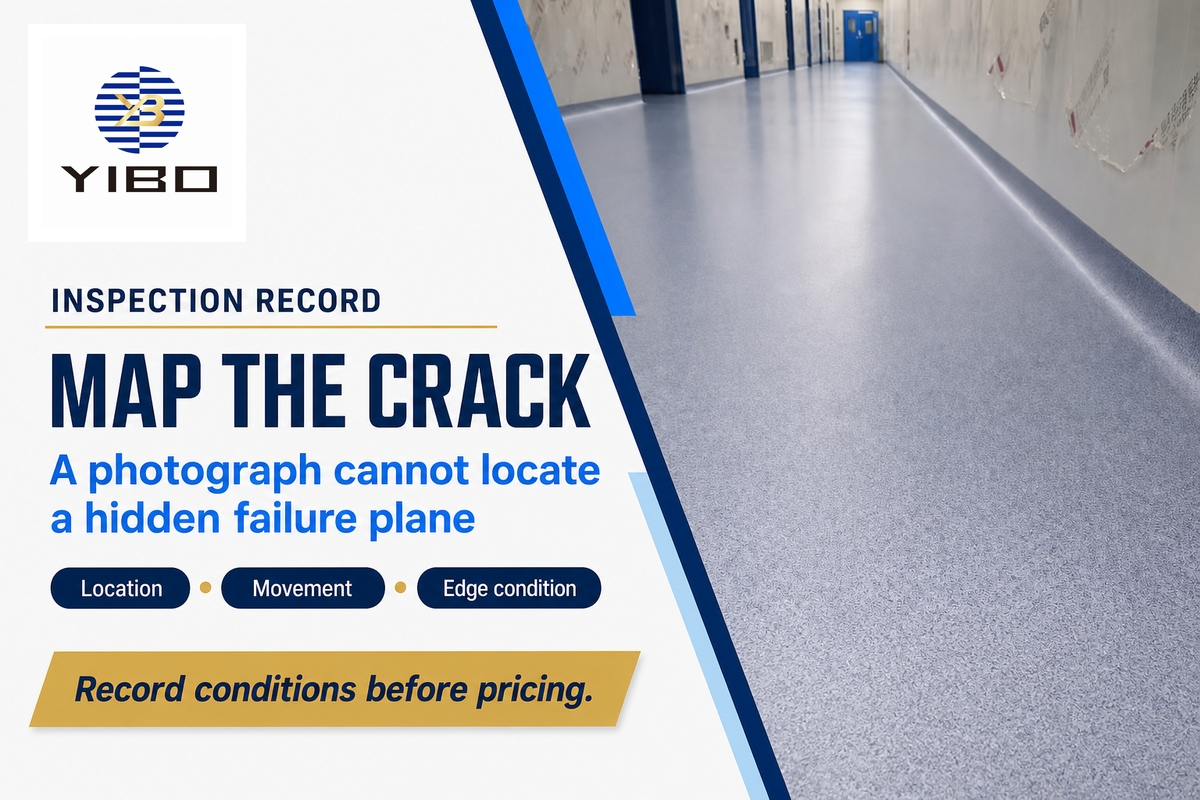
An inspection of a crack should locate what has failed, in what position, and if there’s any movement. Photographs help record the condition, but they do not identify a hidden failure plane. Give the repair contractor a mapped defect record and the operating context before accepting a material recommendation or an area-only quotation.
Mark the line on a floor plan and note its relationship to a slab edge, drain, column, construction joint and repair. Record whether the edges are worn, whether adjoining material has lifted, and any damage over time under comparable conditions. However, narrow hairline cracks do not necessarily mean that the underlying concrete is sound.
The Concrete Society’s floor-repair guidance takes account of crack edge defects and traffic and width. Filling may make a crack more visually apparent, and some live cracks can reopen. A width entry belongs in the record; it is not a universal instruction to buy filler.
Imagine a maintenance manager with a coated aisle with a thin line next to a drain. A supplier offers a small kit, and a contractor asks to remove a larger patch. Both proposals remain provisional until inspection distinguishes a damaged finish from loose concrete or failed underlay; the manager can map the defect, photograph the edge and provide the previous repair record. QA will agree what level of inspection and testing is required. Procurement requires each bidder to state what finding would alter the scope. No one needs to promise that the entire floor must be replaced merely because the line is visible, or that local filling will solve it because the line is small.
Before release: record crack width in mm and the surveyed repair area in m², then identify who will resolve an uncertain base condition. A bid without this constraint exposes the owner to an extra-work dispute after the floor covering has been opened. Appearance of a defect alone can’t be relied on to determine the quantity in dispute.
Find the Cause in the Coating, Bond or Substrate
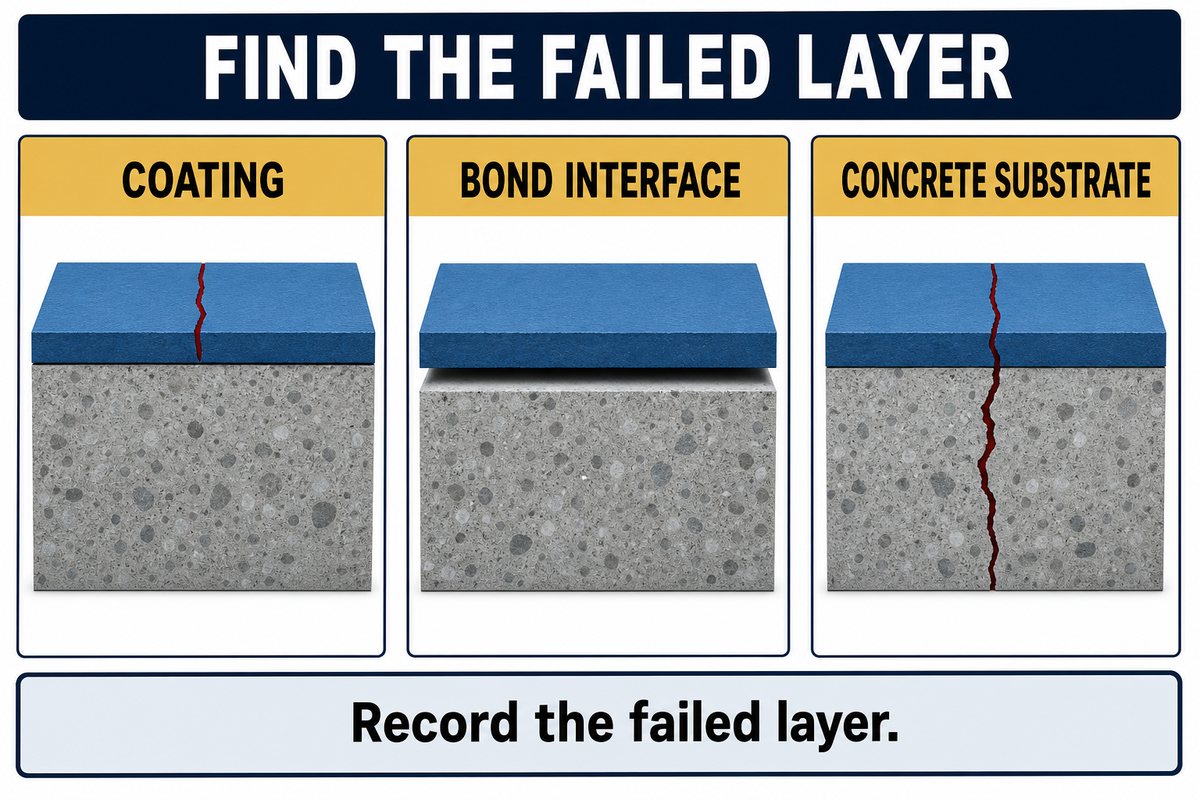
On a concrete floor, epoxy floor delamination, surface cracks and fractured concrete require different types of investigations. A visible symptom suggests a hypothesis. To reach a diagnosis, the damage must be traced through the sequence of building layers and the condition of the exposed interface be examined where access and the approved method of investigation permit.
Why is my epoxy cracking?
Epoxy can crack when movement or damage in the supporting floor reaches the finish, or when a problem exists within the installed coating system. Poor adhesion and substrate weakness can be associated with the damage. Confirm the failed layer before blaming the resin, surface preparation or moisture, because similar looking defects can be caused by different factors.
The Whole Building Design Guide’s coating guidance identifies material selection, preparation, application, curing and substrate conditions among the factors behind premature failures. A peel at the epoxy coating interface is different from a crack that continues into a concrete slab. Removing a loose chip can provide evidence, but a technician shouldn’t assume what’s occurring in an inaccessible area from a fragment that’s accessible.
A 2017 CoatingsPro investigation by Emily R. Hopps and Peter E. Nelson reports on a dealership floor in which the concrete was tied to a delaminated topping. Six pull-off tests averaged 260 psi (1.8 MPa) and five of them failed in the upper concrete. Petrographic evidence pointed to pre-existing near-surface damage. Although the project had recorded approximately 6 lb/1,000 ft² in 24 hours and 88% internal relative humidity, the investigation did not identify moisture as the delamination cause. Trial repairs helped select the subsequent preparation. These results are specific to that project, as opposed to a Yibo case or a general acceptance limit.
ASTM D7234-22 describes and illustrates pull-off testing on concrete and interpreting the failure surface. The weakest plane can include the fixture or test adhesive as well as the concrete and coating. Record the failure mode with the number; a test result alone does not establish the complete root cause.
Repair implication: the published dealership case’s 260 psi (1.8 MPa) average didn’t remove the need to examine the concrete failure plane. A buyer should request the investigator’s interpretation alongside the reading, rather than use a strength number to accept a repair whose damaged layer remains unidentified.
Treat Cracks and Movement Joints as Different Problems
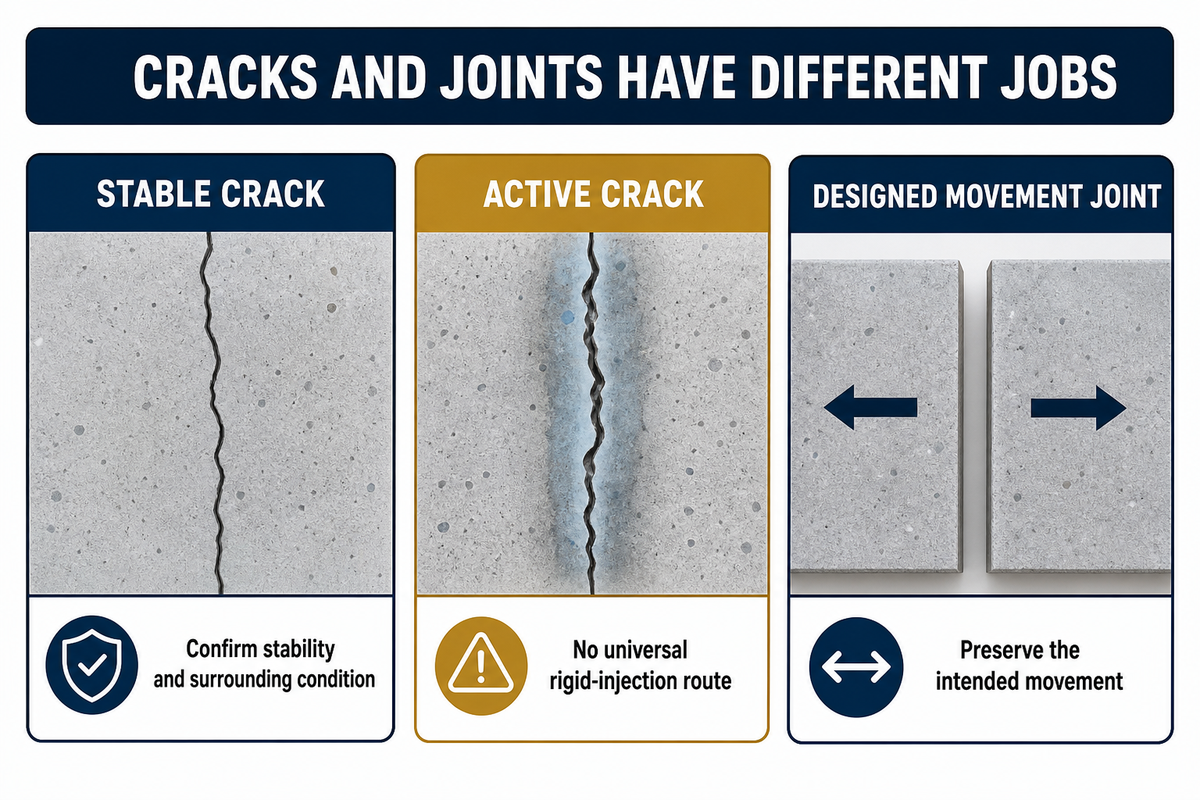
Function and movement should determine how cracks and joints are assessed. A concrete floor expansion joint must retain its intended movement role. A stable crack may have a different repair route, but stability and the condition of the surrounding material need evidence.
Can Epoxy Flooring Cover Cracks and Joints?
An epoxy floor coating system may include a documented treatment for a suitable stable crack, but covering a line does not stop movement beneath it. Isolation joints, expansion joints and other designed details require a review. Choose a compatible detail for the joint function and installed system before applying a continuous finish across it.
In its concrete-repair guidance, the Association of State Dam Safety Officials separates structural bonding from stopping water flow. The described epoxy injection method is unsuitable for an active crack. A urethane seal may address water flow while remaining flexible, but does not provide the same structural bond. That dam-repair distinction explains why repair objectives matter; its dimensions are not a floor-joint specification.
Brian O’Farrell’s CoatingsPro inspection article also differentiates joint types and static and dynamic concrete cracks. Ask to see the drawing or detail that governs the line. A contraction groove, an isolation joint around a column and a random crack are not interchangeable simply because all need a neat surface.
Epoxy paste, a flexible sealant and low-viscosity injection resin have different purposes. A paste-like filler chosen to reinstate a cosmetic edge isn’t necessarily a structural repair material. An owner who wants a jointless appearance should ask which movement function the proposed finish preserves and what happens if the existing crack remains active.
Record
- Joint type and intended function
- Observed movement and edge condition
- Proposed material and compatible detail
Question
- A filler chosen only by crack width
- A continuous coat across an unresolved joint
- A structural claim based only on a smooth finish
Choose an Epoxy Floor Crack Repair Route
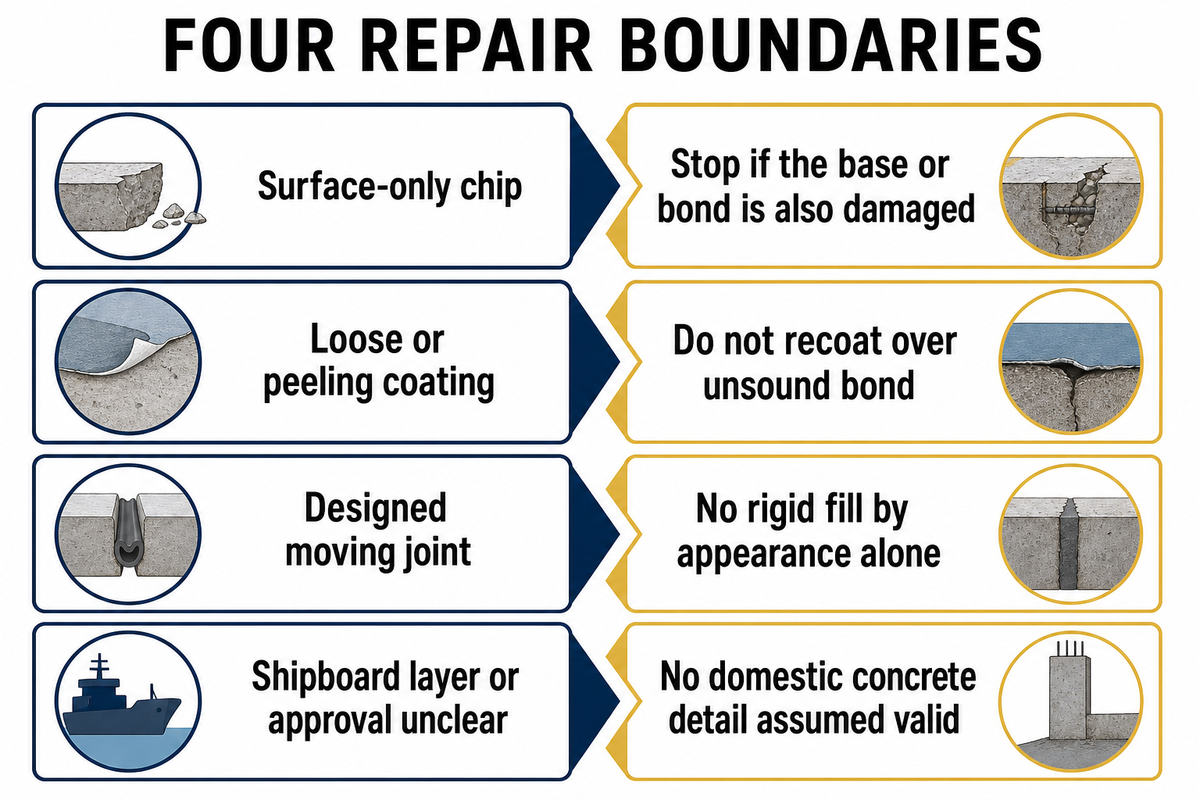
A repair route is a decision made based on confirmed conditions. The boundaries of finish restoration, removal of unsound material, and specialist substrate repair differ. Use the map below to ascertain the evidence required of each candidate; it neither permits a structural repair nor dictates a product-neutral procedure.
How can I fix cracks in my epoxy floor?
First ascertain if the crack is constrained to the finish, passes to the base or follows a moving joint. In the scope of the agreed repair procedure, remove unsound material and use an appropriate material to remediate the confirmed condition. Select a compatible material for the confirmed condition, then verify the repaired area before recoating or returning it to service.
Crack Diagnosis and Repair Map
A diagnosis-to-scope map connects an observed defect to confirming evidence, a candidate repair boundary and the condition that limits release.
| Observed condition | Evidence to request | Candidate scope | Limitations / hold point |
|---|---|---|---|
| Surface-only chip | Sound surrounding finish and known product | Compatible local finish restoration | Stop if the base or bond is also damaged |
| Line continues into concrete | Cause, movement and substrate assessment | Substrate repair before finish | No coating-only acceptance |
| Loose or peeling coating | Exposed interface and failed-layer record | Remove failed material; repair the cause | Do not recoat over unsound bond |
| Concrete attached to detached finish | Substrate condition and interpreted test results | Investigate and prepare a sound base | A strong coating does not repair weak concrete |
| Designed moving joint | Drawing, function and compatible detail | Preserve the specified movement detail | No rigid fill by appearance alone |
| Recurring random crack | Comparable observations and cause investigation | Resolve movement or other cause first | No repeat-kit promise |
| Reinforcement corrosion suspected | Qualified concrete investigation | Cause-specific professional design | Outside the cited injection application |
| Persistent soft or uncured finish | Batch, mix and cure records | Manufacturer review and agreed removal boundary | No new epoxy over unresolved cure failure |
| Shipboard layer or approval unclear | Installed build-up and current product documents | Yard, supplier and required authority review | No domestic concrete detail assumed valid |
The Concrete Society’s crack-injection guidance excludes cracks caused by reinforcement corrosion from the injection method it describes. Resin injection is specialist work. A dormant appearance doesn’t indicate whether injection is an appropriate remedy. Structural displacement, damaged reinforcement or an uncertain load-bearing condition needs an appropriate professional assessment.
When not to buy a repair kit: do not use an epoxy floor repair kit to substitute for unresolved movement, unsound concrete or an unknown marine build-up. A cracked concrete edge may need repair mortar or another substrate treatment, prior to the floor coating being restored. The material must be identified for that particular task; a small package can’t resolve bigger problems hidden below it.
Prepare and Accept the Repair Area
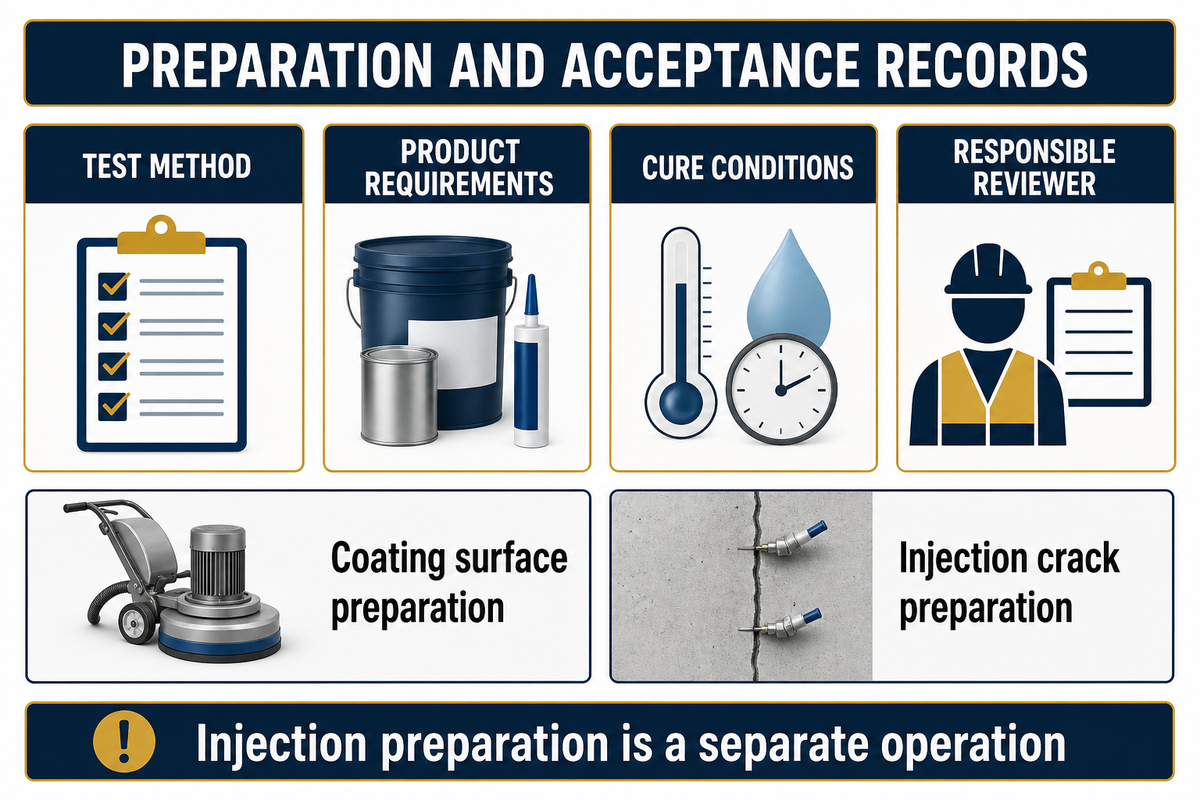
Epoxy floor Preparation and Acceptance should follow the prescribed repair procedure and product requirements. Concrete moisture, cleanliness, surface profile, compatibility and cure records answer different questions. Agree on the evidence and the reviewer before work starts, particularly when a shut down date has been committed to with no confirmed return to service date.
The public ASTM F2170-19a record (which is reviewed and marked Active) describes internal relative humidity testing of concrete slabs. It does not publish one pass value for every floor system. An observation of a plastic sheet or a surface that appears dry is not an acceptable internal RH test result.
“Moisture test results indicate the moisture condition of the slab only at the time of the test and in the specific locations tested.”
AMPP’s concrete moisture guidance describes a number of test methods. Ensure the test method and the coating manufacturer’s requirements are in alignment. Record where the test occurred and the conditions affecting interpretation. A sealer or a similar moisture mitigation product should also be compatible with the proposed floor coating; referring to the polymer family doesn’t prove that.
Preparing bare concrete for a coating is different from preparing an internal crack passage for pressure injection. TxDOT’s concrete-repair procedure recommends against grinding around the injection crack or cutting a V-shaped groove, unless the manufacturer or engineer requires it. Removing the cured residue from the concrete-repair surface is a separate procedure. Keep the concrete-repair procedure in its scope; it doesn’t restrict all floor grinding.
Epoxy floor curing time must follow the product’s service-release requirements under the actual installation conditions. A grinder selected for epoxy installation can’t provide the missing batch records. Ask if the mixed epoxy adhered to the specified ratio and batch procedure, what environmental conditions were present, and how the work was released. Improperly mixed material, an expired recoat window and an incompatible layer are independent hypotheses that require supporting evidence rather than a diagnosis based on color.
The federal fuel-resistive resinous-flooring specification separates the coating work plan, patch demonstration, inspection, and curing requirements. Their primer-plus-urethane-coats system isn’t a universal epoxy recipe. The valuable procurement lesson is to require the product instructions, a defined trial, if warranted, and a documented acceptance decision.
Review Shipboard Repairs Against the Actual Floor Build-Up
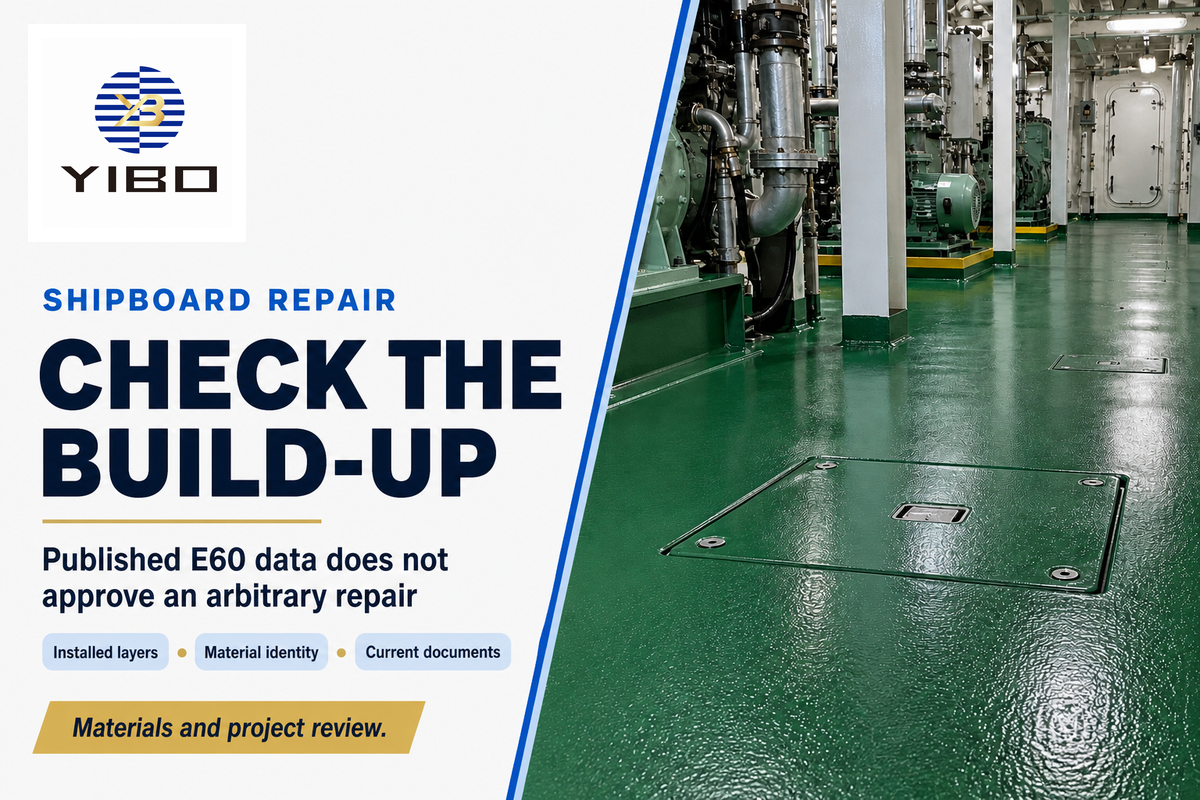
A marine epoxy flooring crack review begins with the installed construction and service space. Identify steel plating, primer, underlay, and finish if those layers exist. Concrete tests can’t be assigned to steel simply because the finish is resin. Material selection and acceptance belong to the actual vessel, system and repair scope.
AMPP’s guidance for different ship areas distinguishes service environments. An exposed work deck and an accommodation floor don’t present the same brief. Review the applicable primary deck covering layer and adjacent materials and then specify a local finish.
Yibo’s published marine epoxy floor E60 data describes a nominal 5 mm covering: 4.8 mm epoxy resin and coloured sand with 0.2 mm polyurethane varnish. These are product-scoped published values. These are published values, but they do not state how much a crack can vary or prove that an arbitrary repaired assembly has the required approval.
4.8 mm
Published E60 resin/coloured-sand layer
0.2 mm
Published polyurethane varnish
5 mm
Published nominal total
Imagine a yard reviewing a cracked finish over a marine screed. The old purchase order reads “epoxy floor,” but the repair contractor can’t decipher the underlay grade or the primer, if any, underneath. Ordering another finish layer would leave the uncertain interface in place. The yard can retrieve the installed layer record, identify the failed layer during the agreed inspection and ask the supplier for the matching technical documents. A nominal 5 mm finish helps identify an E60 configuration; it does not define the thickness or condition of the complete floor beneath it. The approval discussion then follows the proposed construction and vessel space.
The same E60 page lists compressive strength ≥50 MPa, flexural strength ≥35 MPa and adhesive strength ≥2.0 MPa. Retain each operator and model name in the submittal. Durability under the project’s service conditions, installation compatibility and crack bridging are different questions. Those strength figures cannot be extrapolated to a movement allowance. Calling a coating high-performance doesn’t state its crack-movement capacity.
For a narrow example of document traceability, the UK MCA’s UK21/F001 marking recommendation discusses packaging and accompanying approval or acceptance documents for relevant marine materials. This doesn’t mean every crack repair requires recertification. Ask the vessel’s responsible parties which current records apply, rather than infer a blanket rule from a supplier certificate reference.
Compare Repair Quotes on the Same Work Boundary
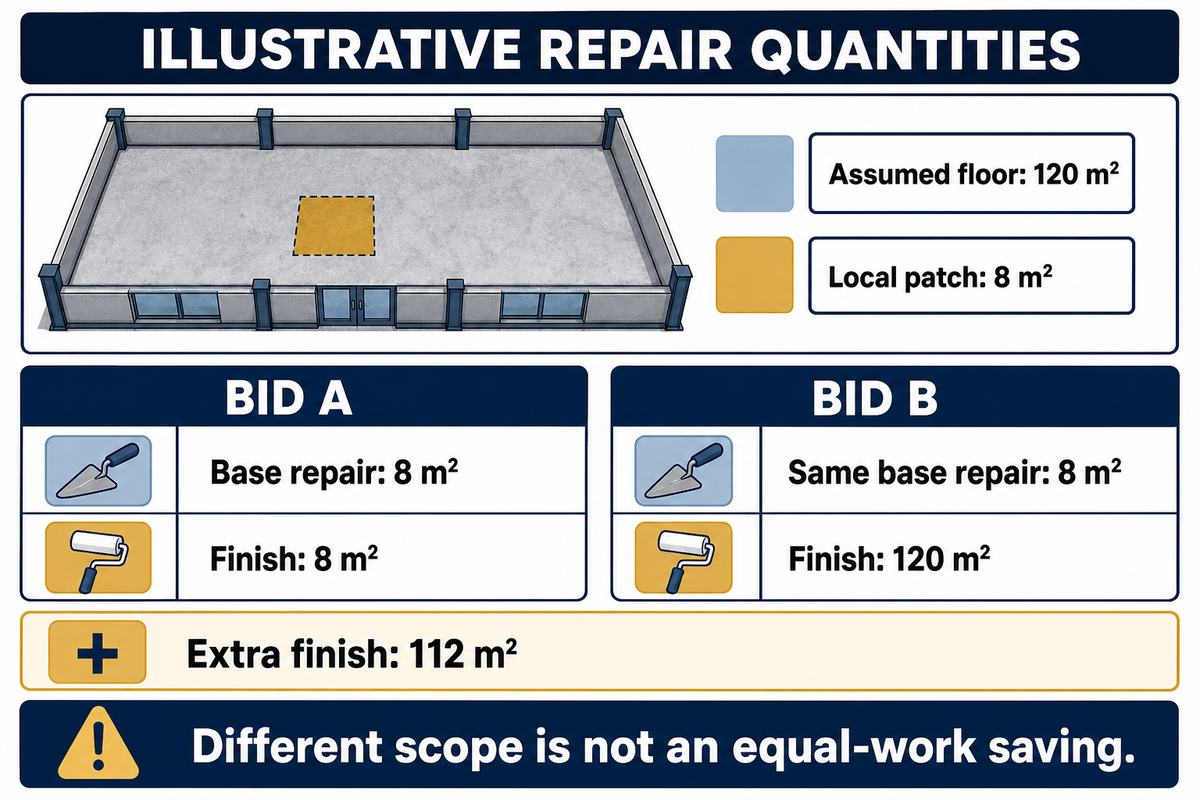
Quotes become comparable when they describe the same surveyed work and responsibilities. Crack treatment, local substrate repair and finish restoration should be regarded as separate quantities. Access, protection, disposal and service release should also be regarded as part of the surveyed work. The lowest headline price may simply exclude work that another bidder has included.
Repair Quote Boundary Sheet
A quote boundary sheet separates defect quantities, proposed layer work, unresolved conditions and release responsibilities, allowing bidders to price the same surveyed work.
Maintenance supplies observations, QA defines the evidence needed, and procurement asks bidders to state their inclusions. This allows Finance to compare prices against the same boundary instead of assigning a saving to a smaller quantity.
| Field | Quantity or record | Bidder response | Who resolves a gap |
|---|---|---|---|
| Crack or joint length | Surveyed m; identify the detail | Which line treatments are included? | Maintenance and designer |
| Crack condition | Width in mm; movement and edge record | What condition would change the method? | Investigator / QA |
| Local patch | Confirmed m² and removal boundary | Does it include damaged base material? | Contractor and QA |
| Finish restoration | Proposed m², product and layer build | Patch blending or full-area coat? | Owner and applicator |
| Hidden deterioration | Unopened area and provisional allowance | How is additional scope measured? | Owner and procurement |
| Preparation | Approved method for the repair task | What cleaning, profile or testing is included? | Applicator and supplier |
| Trial and acceptance | Test method, location and interpretation | Who accepts the repaired area? | QA / responsible reviewer |
| Access and shutdown | Agreed access and product service-release conditions | Protection, ventilation and access restrictions? | Owner and contractor |
| Marine documents | Installed layers, material identity and applicable records | Which current documents are supplied? | Yard and required authority |
To illustrate, assume 120 m² of area contains an 8 m² patch. Bid A prices the 8 m² patch plus a compatible finish over the patch. Bid B prices the same base repair plus finish restoration over all 120 m². The scope for finish restoration includes 112 m² outside the patch. That difference can explain a price gap without establishing that either bid is cheaper for equal work. Add surveyed crack length in m separately, then ask both bidders to identify their removal depth, hidden-base allowance and acceptance conditions. These are assumptions. These are assumed quantities, not a Yibo customer project or a cost forecast.
O’Farrell’s inspection method maps existing repairs and contamination before work to define responsibility when the final cover-up conceals them. The marine deck compound quotation guide provides the wider document and supply discussion; this repair sheet fixes the defect-work boundary first.
Equal-scope comparison: treating an 8m² patch and a 120m² finish restoration as the same thing is wrong. Keep the extra 112 m² finish area visible in the bid comparison and assign the release decision. Procurement can then challenge exclusions instead of treating every price difference as a material-quality difference.
FAQ: Epoxy Floor Cracking
What are the drawbacks of epoxy flooring?
Preparation and substrate conditions can limit the benefits of epoxy.
The benefits of epoxy depend on a suitable base and the specified installation. Existing cracks, contamination or unresolved moisture can affect the result. A continuous finish can also make defects underneath harder to see. Compare the floor system with its service conditions and maintenance needs, rather than expect one coating to withstand every exposure or repair damaged concrete.
How to tell if epoxy resin is bad?
A sticky or damaged finish needs product and installation records.
Check product identity, storage and shelf-life information alongside batch, mixing and cure records. A stain, softness or incomplete cure can prompt review, but appearance alone doesn’t establish that the unopened resin was defective. Ask the manufacturer to assess the evidence before applying a new layer over the suspect area or accepting a repair without identifying its cause.
What is the typical lifespan of an epoxy floor?
There is no single service-life figure for every installation.
Longevity depends on the installed system, substrate, traffic, exposure and maintenance. A supplier’s expected lifespan isn’t a guarantee for a repaired floor with unresolved damage. Review the product-specific service conditions and the repair acceptance record. For residential and commercial floors alike, inspect recurring cracks and wear and tear before relying on a calendar-based replacement promise.
Can you recoat epoxy garage floor?
Recoating requires a sound base and a compatible preparation procedure.
An epoxy garage floor can be considered for recoating after its condition and compatibility are confirmed. Remove failed material and address the cause first. Another layer of epoxy doesn’t repair a moving substrate or an unsound bond.
How do you repair chipped epoxy floor?
The chip’s depth and surrounding bond determine the repair scope.
Check whether the chip is limited to the finish and whether the surrounding material is sound. Select the manufacturer-supported repair detail. Cracks and chips extending into the base need a different scope from local appearance restoration.
Is epoxy floor cracking a structural issue?
A surface crack alone cannot establish structural condition.
A structural issue must be assessed from the construction, loading, movement and underlying damage, rather than inferred from a photograph of the finish. A line confined to a floor covering and a displaced or fractured base are different observations. Escalate uncertain load-bearing conditions, continuing displacement or suspected reinforcement corrosion to an appropriately qualified professional. A repair kit or coating recommendation can’t replace that assessment.
Inspection may show that damage is local and cosmetic, but the reviewer should explain what evidence supports that conclusion and which conditions remain untested. The Concrete Society notes that crack repair necessity can depend on edge damage and use. Recording observed width in mm helps describe the defect; it doesn’t establish a universal structural threshold. Keep the investigator’s decision, repair method and handover record together.
Prepare a Marine Repair Document Review
Send the vessel space, installed layer sequence, photographs and surveyed repair quantities. Identify the required finish and the documents requested by the yard or responsible authority. Yibo can review the material family for supply; the applicator and project reviewers still need to settle substrate repair, installation and acceptance.
Source scope: This article relies on public standards summaries and guidance, named technical publications and Yibo’s published data. Illustrative quantities are indicated. It reports no private Yibo failure case, verified crack-bridging capacity, or blanket repair approval. The diagnosis map and quote sheet are original procurement aids that require project-specific review.
References & Sources
- Remedial Repair of Cracks in Floors, The Concrete Society.
- Paints and Coatings Knowledge Area, Whole Building Design Guide.
- The Case of the Car Dealership Floor Failure, Hopps and Nelson, CoatingsPro, 2017.
- ASTM D7234-22 Public Scope, ASTM International.
- Concrete Repair Techniques, Association of State Dam Safety Officials.
- What’s Under the Coating? Inspecting the Concrete, O’Farrell, CoatingsPro, 2015.
- Crack Injection, The Concrete Society.
- ASTM F2170-19a Public Scope and Significance, ASTM International.
- Concrete Moisture Testing and Mitigation, AMPP.
- Crack Repair: Pressure-Injected Epoxy, Texas Department of Transportation.
- UFGS 09 67 23.15 Fuel Resistive Resinous Flooring, USACE, NAVFAC and AFCEC.
- Coating Systems for Different Areas of a Ship, AMPP.
- Affixing the UK Conformity Mark: UK21/F001, UK Maritime and Coastguard Agency.
Commercial marine flooring systems
Plan the deck build-up before the workfront is released.
Yibo manufactures commercial marine flooring systems in Suzhou for vessel projects that need a coordinated deck-covering, resin-floor, or acoustic-floating-floor build-up.
Review marine deck covering systems, marine resin floor systems, and marine acoustic floor systems against the vessel area and planned application sequence.
Project enquiry
Give the engineering team the inputs that shape the system review.
Include the vessel area, substrate or deck condition, intended floor build-up, fire or acoustic target, and project schedule so the enquiry can begin with the relevant deck constraints.
Send Your Deck Schedule